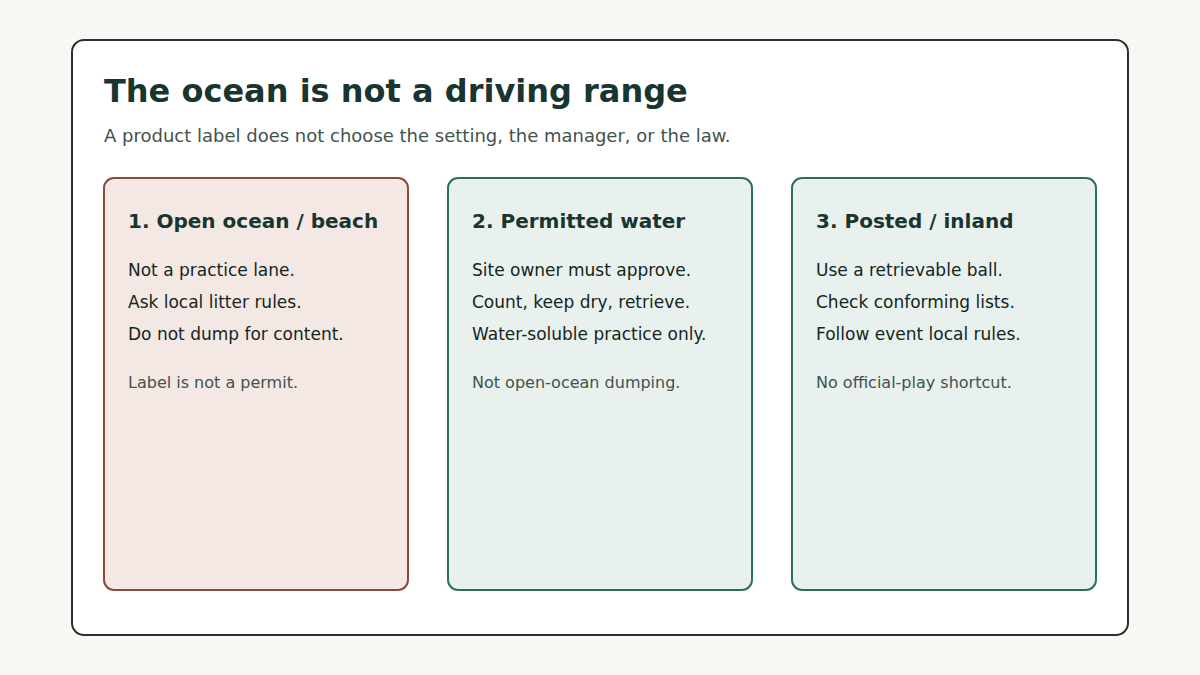
Searchers asking whether it is legal to hit golf balls into the ocean usually mix four jobs: a legal answer, a site-permission answer, an environmental-harm answer, and a product-label answer. Those jobs are not the same. A biodegradable, water-soluble, or "ocean-safe" label does not complete any of them.
The ocean is not a driving range. Local officials have treated beach and surf shots as littering. Marine-debris research shows conventional golf balls persist, fragment, and accumulate near coastal courses. A practice-ball label does not grant access to the sea.
Quick answer
Do not treat the ocean as a practice lane. Ask who manages the water, whether the activity is allowed, and whether you can retrieve what you hit. If any of those answers is no or unknown, do not hit.
A water-soluble or biodegradable label describes a material behavior. It is not a permit, not legal advice, and not proof that a ball is harmless in seawater. Play Greenly's water-soluble practice balls are for permitted water-adjacent practice. They are not designed as ocean-dumping balls, wildlife feed, or a substitute for local rules.
What people mean by hitting golf balls into the ocean
The query mixes four different questions:
- Is this illegal where I am standing?
- Does a beach, pier, boat, resort, or coastal course allow it?
- Does it harm marine life or count as pollution?
- Does an "ocean-safe" or dissolvable label make the shot acceptable?
Only the first two questions can be answered by a site owner, harbormaster, course committee, or local government. The third is an evidence question. The fourth is a marketing-claim question. Collapsing them into "the ball dissolves, so it is fine" is the error this article exists to stop.
Why ocean is a different job from a lake or pond
A backyard pond, a managed course pond, and the open ocean are not interchangeable water features.
A pond or marina is usually a bounded site with an owner, a use policy, and a chance to ask for permission in writing. Play Greenly already covers that job in the pond-permission FAQ and the course-staff pond FAQ.
The ocean adds navigation, coastal access, marine debris, and often a public shoreline. NOAA's Marine Debris Program is the U.S. government's lead for reducing debris in the ocean, coasts, and Great Lakes. Plastic is the most common type of marine debris NOAA describes. Microplastics are plastic pieces smaller than five millimeters. Those facts do not depend on a golf-ball brand.
A lake article that says "yes, you can hit golf balls into lakes" is answering a different, and often over-broad, question. This article does not repeat that permission.
What local officials have actually said
This is not a nationwide ruling. It is a documented local example.
In March 2026, Myrtle Beach officials warned people to stop hitting golf balls into the ocean. Myrtle Beach police said hitting golf balls into the water is considered littering. Police spokesperson Randall Angotti said people can be held accountable with fines. City spokesperson Meredith Denari said the ocean is not a personal driving range and that items returning to the water litter the city or beach and pose risks to wildlife. Local reporting also cited city littering penalties and South Carolina's state litter law for smaller amounts of debris.
That is one coastal city, one police department, and one state's litter framework. Other towns may treat the same act as trespass, illegal dumping, a park-rule violation, or a harbor rule. Some sites may allow a supervised, permitted activity with controls. None of those outcomes is created by a product label.
If you are on a boat or other vessel, a separate international rule can also apply. MARPOL Annex V generally prohibits discharging garbage, including plastics, into the sea from ships. IMO says Annex V applies to ships of any type operating in the marine environment, including pleasure craft, unless an express exception applies. That is a ship-source rule. It is not a blanket criminal code for every beach swing. Do not stretch it into one.
Conventional golf balls do persist in the ocean
The documented marine-debris problem is about conventional balls, not a Play Greenly field test.
Researchers working with a Carmel High School student in California's Monterey Bay National Marine Sanctuary collected 50,681 golf balls from shoreline and shallow waters near coastal courses, about 2.5 tons of debris. The peer-reviewed paper is in Marine Pollution Bulletin (DOI 10.1016/j.marpolbul.2019.01.013). The authors described golf balls as a point source of marine debris. Many balls showed only light wear; others were fragmented by waves. They estimated more than 60 pounds of irrecoverable microplastic had already shed from the recovered balls. Modern conventional balls use a polyurethane shell and a synthetic-rubber core.
Coastal Carolina University marine scientist Lauren Stefaniak, speaking to WPDE about Myrtle Beach, described wave action wearing the outer covering into pieces she would call microplastics. That is a conventional-ball observation, not a Play Greenly dissolve-time.
These sources support a conservative practice rule: do not add balls to the ocean as a hobby, a social-media stunt, or an assumed "eco" shortcut.
A label is not a permit
"Ocean-safe," "ocean-friendly," "marine degradable," and "dissolves in the ocean" are marketing phrases until they are tied to a specific, substantiated claim.
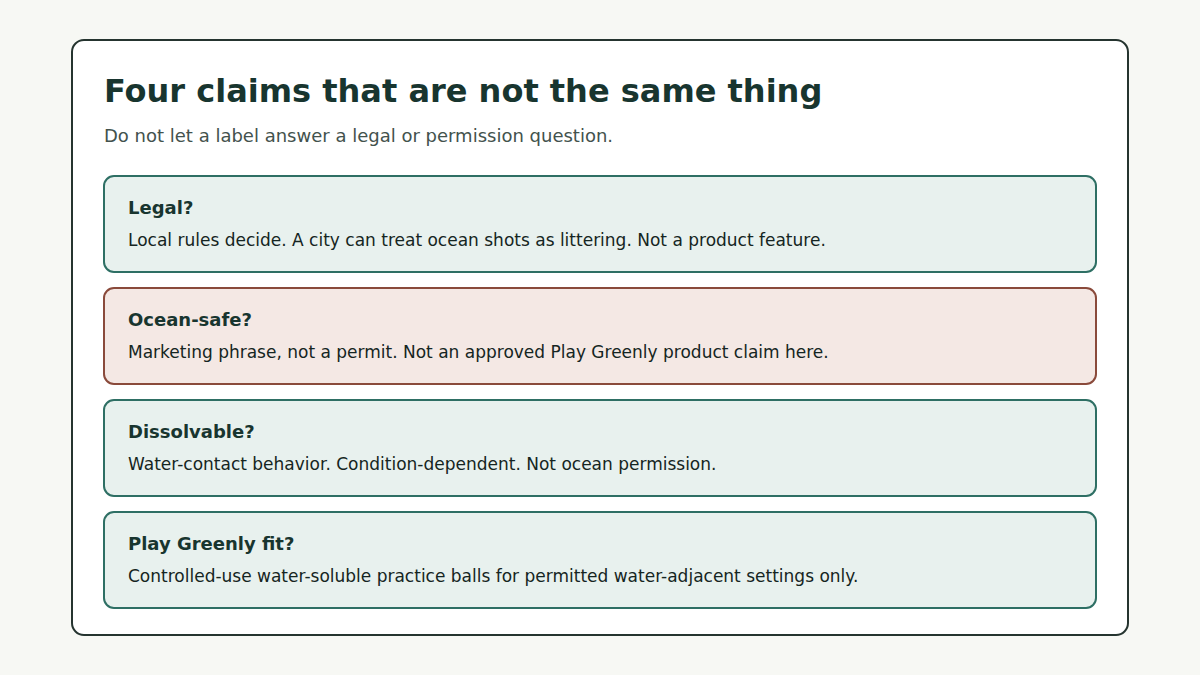
The FTC Green Guides, 16 CFR Part 260, say unqualified general environmental-benefit claims are difficult to interpret and often imply far-reaching benefits or no negative impact. Marketers should not make those claims unless they can substantiate every reasonable interpretation. Degradable claims need evidence that the entire item will completely break down and return to nature in a reasonably short period after customary disposal. Non-toxic claims likely convey safety for humans and the environment generally.
An "ocean-safe golf ball" headline can be read as: legal to hit into the ocean, harmless to marine life, and free to leave behind. This package does not make those claims. Play Greenly should not use "ocean-safe" as an approved product claim in this article.
Water-soluble describes a material behavior in water. Manufacturer literature on polyvinyl alcohol treats solubility as grade- and condition-dependent. Temperature, agitation, and formulation change the result. Salinity can matter too. That is not a seawater field result for a finished Play Greenly ball, and it is not permission to use the ocean as a range.
A practical decision gate before any ocean-adjacent swing
Use this order. Do not skip to the product.
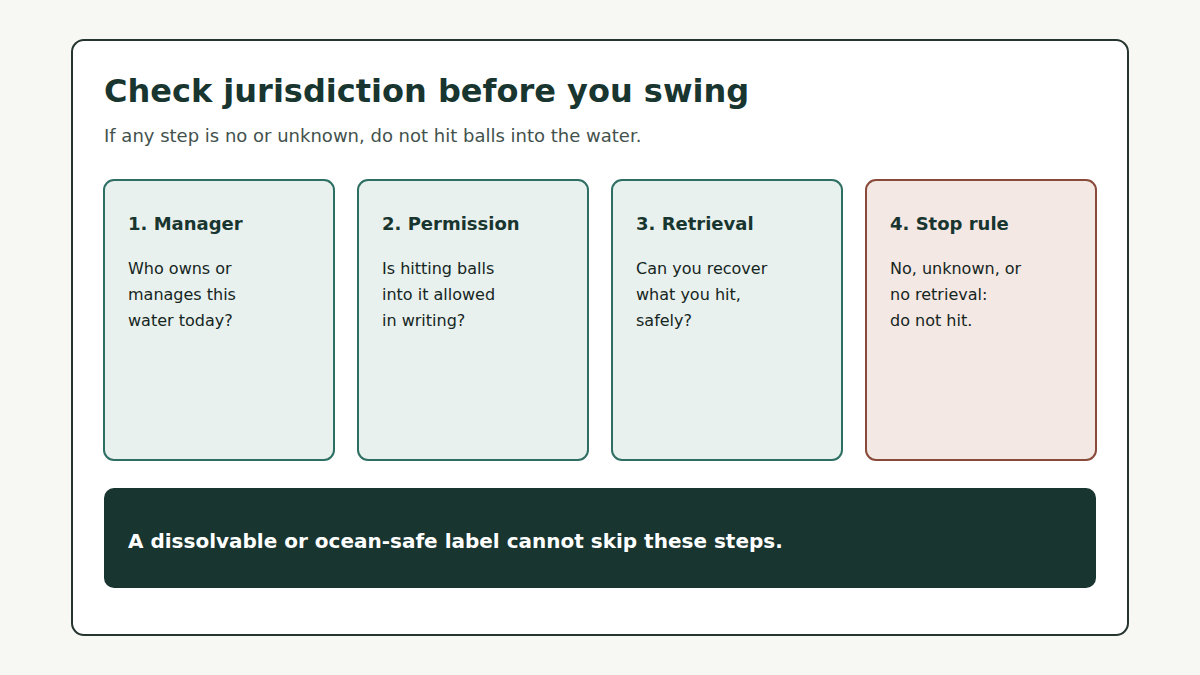
- Identify the setting. Beach, pier, bluff, boat, coastal hole, marina, or inland water are different jobs.
- Identify the manager. City, state, federal sanctuary, harbor, course, resort, or private owner.
- Ask whether hitting balls into that water is allowed. Get it in writing when the activity is organized.
- If the answer is no, unknown, or "we do not want debris in this water," stop.
- If a site does permit a controlled water-adjacent activity, keep the count small, keep unused balls dry, retrieve first when it is safe, and use only the product class the site approved.
- Do not post, promote, or sell the activity as ocean dumping, fish feeding, or an ocean-safe stunt.
Play Greenly's fit, when a site actually permits water-adjacent practice, is a controlled-use water-soluble practice ball. It is not a beach-range ball and not a tournament ball.
When any golf ball is the wrong choice
Leave every golf ball, including water-soluble practice balls, out of these jobs:
- hitting off a public beach, pier, or bluff into open ocean
- cruise-ship, charter, or backyard "watch it fly into the sea" entertainment
- "ocean-safe," "fish food," or "it will disappear" social posts
- coastal holes where the local rule is to play a provisional and not add debris
- any marine sanctuary, wildlife area, or site that has not approved the activity
- posted or conforming play that requires a listed ball
If the goal is to practice the swing and pick the ball up, use a retrievable land ball and a legal target. If the goal is a permitted dock, marina, or water-adjacent demo, use the pond, marina SOP, and event-test articles, not this ocean FAQ, as the operating guide.
Limitations
This article is not legal advice and not a ruling for any city, state, sanctuary, harbor, or country. It does not say hitting golf balls into the ocean is illegal everywhere, and it does not say it is legal anywhere a label looks green. It does not assign a dissolve time in seawater for Play Greenly or any other brand. It does not certify any ball as ocean-safe, non-toxic, wildlife-safe, fish food, zero-impact, or conforming. Conventional-ball marine-debris evidence should not be flipped into a claim that a water-soluble ball may be left in the ocean. The conservative practice remains permission, control, and retrieval.
Frequently asked questions
Is it legal to hit golf balls into the ocean?
Do not assume yes. At least one U.S. coastal city has treated the act as littering. Rules vary. Ask the site manager and check local litter, dumping, park, and harbor rules before you swing.
Does a biodegradable or water-soluble golf ball make ocean shots legal?
No. A material label is not a permit. Local rules and site policy still control the activity.
Are ocean-safe golf balls a real product class?
Treat "ocean-safe" as an unapproved marketing phrase unless a specific, substantiated claim is in front of you. This article does not use it as a Play Greenly product claim.
Do conventional golf balls pollute the ocean?
Peer-reviewed coastal collections have recovered tens of thousands of conventional golf balls from marine waters, with fragmentation into microplastics. NOAA treats plastic marine debris as a persistent pollution problem. That evidence supports retrieval and prevention. It does not authorize dumping a different product.
Can I use Play Greenly balls for beach or boat shots into open water?
Only if the specific site has approved that activity. Play Greenly is a controlled-use water-soluble practice ball for permitted water-adjacent settings, not an ocean-dumping or beach-range product.
Sources and further reading
Internal: Can You Hit Golf Balls Into Lakes?; Can You Hit Water-Soluble Golf Balls Into a Pond?; Course Staff FAQ: Using Water-Soluble Golf Balls Around Course Ponds; Are There Golf Balls That Dissolve in Water?; Fish Food Golf Balls: Myth, Materials, and Safer Water Practice; Are Biodegradable Golf Balls for Land Practice?; Play Greenly product page.
External: Myrtle Beach WPDE report, 24 March 2026; Myrtle Beach Sun News / Yahoo local report quoting city spokesperson Meredith Denari; NOAA Marine Debris Program; NOAA National Ocean Service microplastics fact sheet; Marine Pollution Bulletin 2019 golf-ball debris study (DOI 10.1016/j.marpolbul.2019.01.013) and The Conversation summary by the study author; IMO MARPOL Annex V; FTC Green Guides, 16 CFR Part 260.