Golf course staff get a version of this question often: if a ball dissolves in water, can guests hit it toward a pond, lake, or penalty area?
The responsible answer is not simply yes. A water-soluble practice ball can reduce one kind of long-term litter risk compared with a conventional ball, but it does not turn a managed course pond into an open target. Course ponds store irrigation water, handle stormwater, affect wildlife habitat, and require maintenance. Staff still need permission, limits, cleanup, and careful language.
Use this FAQ as an internal review before approving a Play Greenly demo, resort activation, clinic station, or member event near course water.
Quick answer for staff
Water-soluble golf balls should be treated as controlled-use practice equipment.
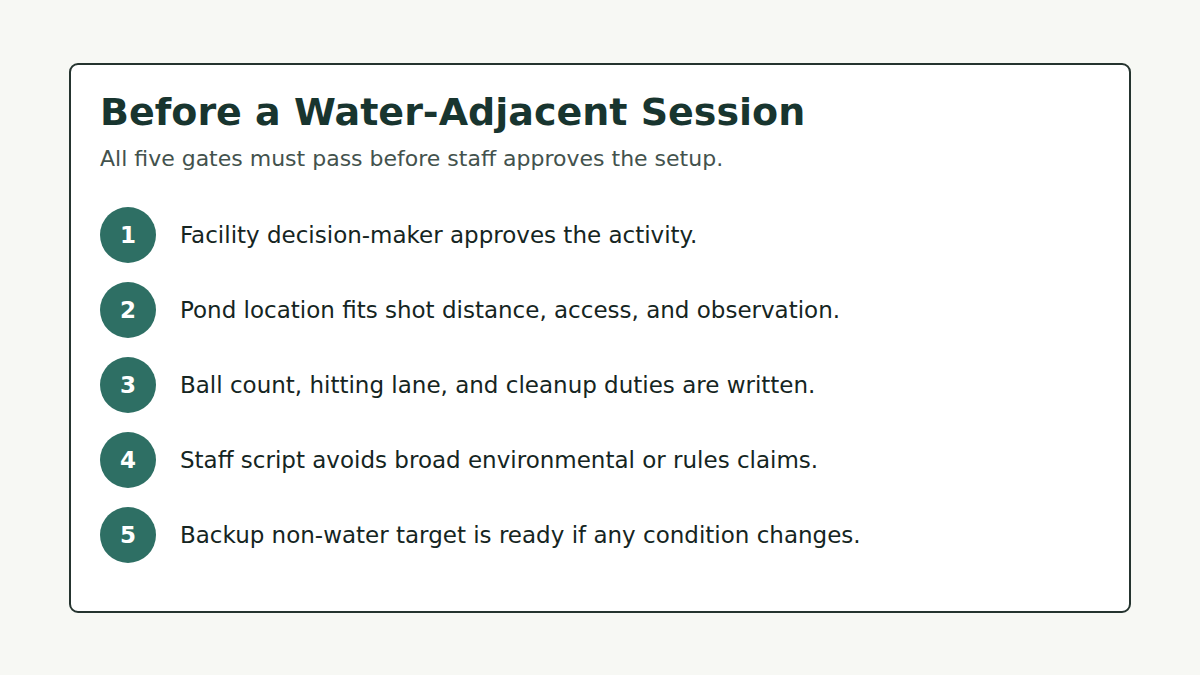
Approve a water-adjacent session only when all five checks pass:
- The course owner, operator, superintendent, or event decision-maker approves the activity.
- The pond or lake is suitable for the planned shot distance, location, and retrieval/observation plan.
- The ball count, hitting direction, station boundary, and cleanup duties are written down before the event.
- Staff avoid broad claims such as pond-safe, non-toxic, fish food, zero impact, tournament legal, or legal anywhere.
- The product is described as a practice ball for permitted settings, not as a substitute for local rules or course judgment.
If any check fails, move the station away from water or use a non-water target.
Why course ponds need a different standard
A course pond is not just scenery.
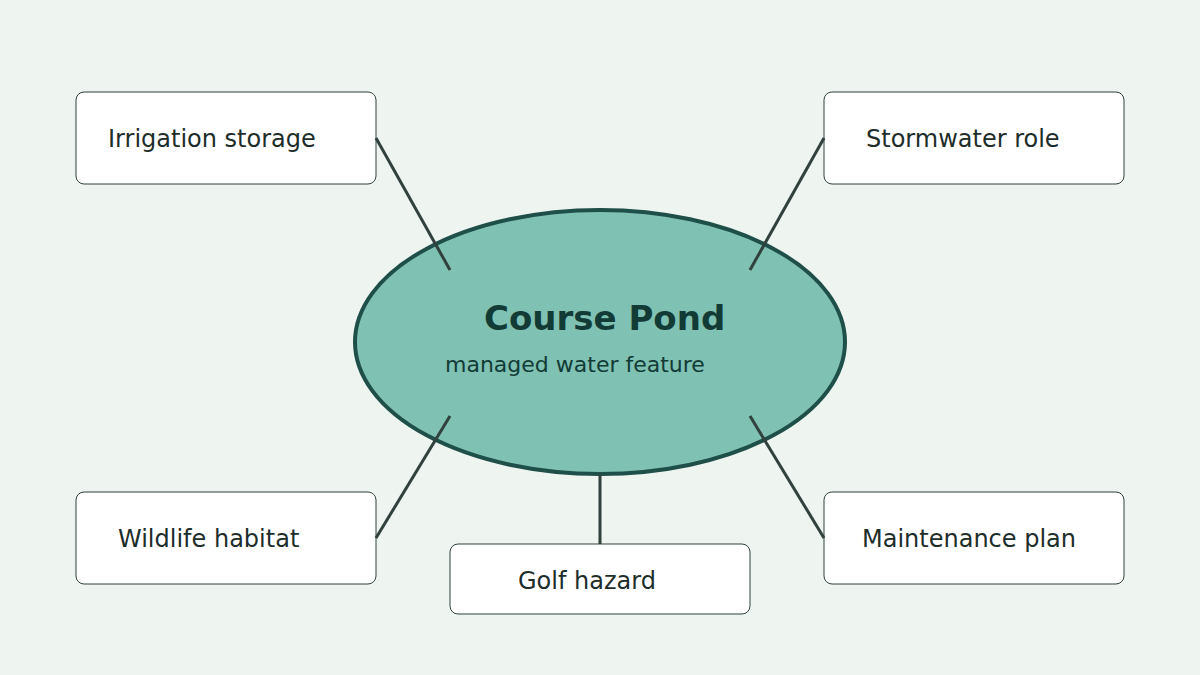
USGA course-care guidance describes golf course ponds as functional water features that may store irrigation water, help manage stormwater, serve as hazards, and provide habitat. The same guidance explains that nutrients, stagnant water, warm temperatures, debris, algae, aquatic weeds, and maintenance practices all affect pond health and function.
That means staff should not evaluate a water-practice idea only through the product label. They should also ask how the activity fits the pond's management plan, season, water quality, shoreline access, wildlife conditions, irrigation use, and guest traffic.
Who needs to approve the session?
Treat approval as a site decision, not a marketing decision.
The right reviewer depends on the facility, but the decision usually belongs with a general manager, owner, superintendent, tournament committee, marina/resort operator, or another person responsible for the water feature and guest safety. For public water or regulated shoreline areas, staff may need a separate local check.
Play Greenly can supply practice-product language and operating suggestions. It cannot approve a course pond on behalf of the facility.
What staff should inspect before saying yes
Use a short pre-event walk-through:
- Is the water feature used for irrigation storage, stormwater retention, drainage, or habitat?
- Is there a buffer zone, protected shoreline, wetland edge, nesting area, or sensitive bank?
- Can the hitting lane be aimed away from people, carts, roads, greens, tees, docks, boats, and neighboring property?
- Can staff control the number of balls and stop the session if conditions change?
- Is there a dry setup area so packaging, tees, signs, and broken containers stay out of the water?
- Will the product be stored cool and dry until use?
- Is there a record of the number of balls opened and used?
If the answer is unclear, the safest staff decision is to pause and ask the course operator or superintendent.
What to write into the event plan
A water-adjacent station should have a one-page plan. It does not need to be complicated, but it should be specific.
Include:
- approved location and backup location;
- decision-maker name or role;
- planned ball count and maximum ball count;
- hitting direction and distance limit;
- station boundary and spectator boundary;
- storage and dry-handling instructions;
- cleanup responsibilities for packaging and non-dissolvable materials;
- staff script for claim-safe language;
- incident stop rule if weather, wildlife, water conditions, or crowd control changes.
This makes the activity easier to audit and easier to stop if it drifts outside the approved setup.
Staff script: what to say
Use plain language:
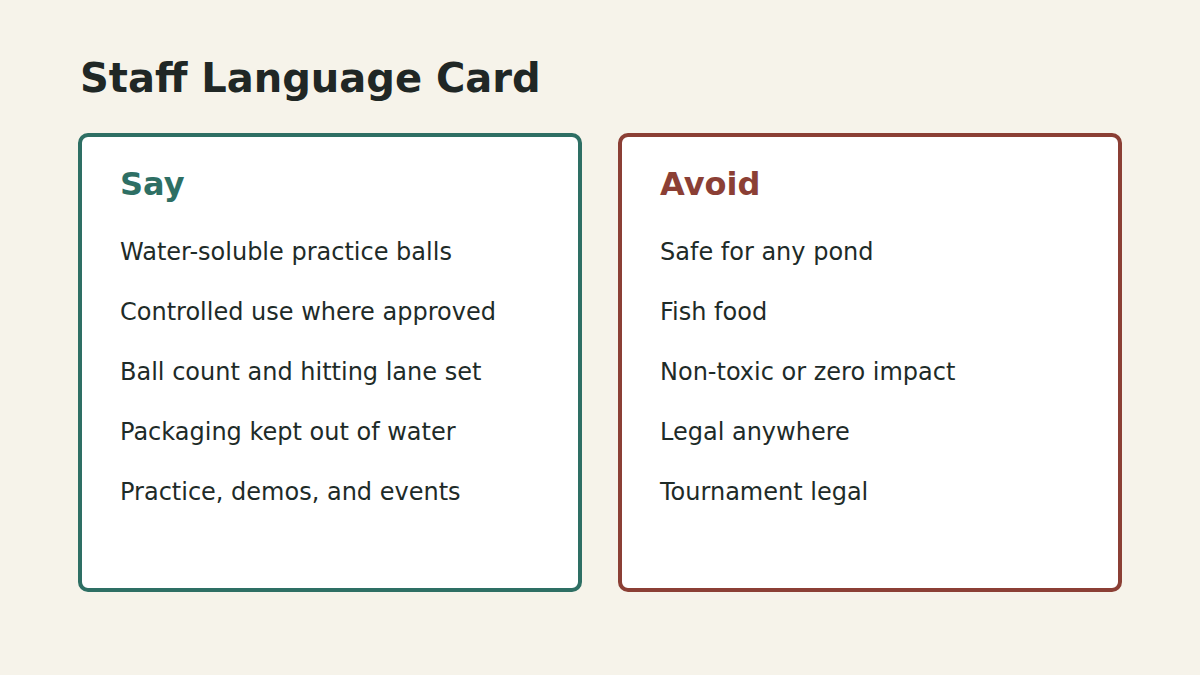
"These are water-soluble practice golf balls for controlled use where the course allows the activity. We still set a ball limit, control the hitting lane, keep packaging out of the water, and follow course rules."
That statement does three things. It tells guests what the product is, explains the control system, and avoids unsupported environmental promises.
Staff script: what not to say
Avoid:
- "These are safe for any pond."
- "They are fish food."
- "They are non-toxic."
- "They have zero impact."
- "You can hit them into any lake."
- "They are tournament legal."
- "The course does not need to approve it because they dissolve."
Those phrases create risk because they imply evidence or permission the product label does not supply.
How this differs from normal play
During normal play, a pond or lake may be a penalty area. That does not mean the course has approved a separate entertainment station aimed at the water.
Competition rules, handicap posting, and casual play policies are separate from event operations. For Play Greenly, the clean boundary is simple: use these as practice balls in approved settings, not as official scoring equipment.
What Play Greenly should say on a sales call
Play Greenly should help the facility make a controlled decision:
"For course, resort, or event use, treat Play Greenly balls as water-soluble practice balls. The product can support controlled water-adjacent activities when the venue approves the setup, sets a ball count, protects the station, and avoids fish-food, non-toxic, zero-impact, official-play, or permission-free claims."
That wording supports the sale without stepping past the evidence.
Related Play Greenly guides
- Play Greenly water-soluble practice golf balls
- /blog/hit-water-soluble-golf-balls-pond
- Resort and marina golf activity SOP
- /blog/how-many-water-soluble-golf-balls-event
- /blog/are-water-soluble-golf-balls-legal-tournament-play
Frequently asked questions
Can a golf course let guests hit water-soluble balls into a pond?
Yes, if the course approves the location and controls the session. The product being water-soluble is only one input. Course permission, pond management, ball count, station safety, and cleanup still decide whether the activity is appropriate.
Does a penalty area count as permission to run a water-ball demo?
No. A penalty area is part of golf play and rules. A demo or event station is a separate activity that should be approved by the course operator or event decision-maker.
Should staff call these pond-safe golf balls?
No. "Pond-safe" can imply broad environmental proof. Use narrower language: water-soluble practice balls for controlled use in permitted settings.
Who should approve a course-pond activation?
At minimum, the facility decision-maker responsible for the pond and guest activity should approve it. Depending on the site, that may be the owner, general manager, superintendent, tournament committee, resort operator, or local authority.
What is the easiest way to reduce risk?
Move the target away from water unless the course has a written plan. If water is part of the experience, set a low ball count, control the hitting lane, keep packaging out of the water, and use claim-safe staff language.