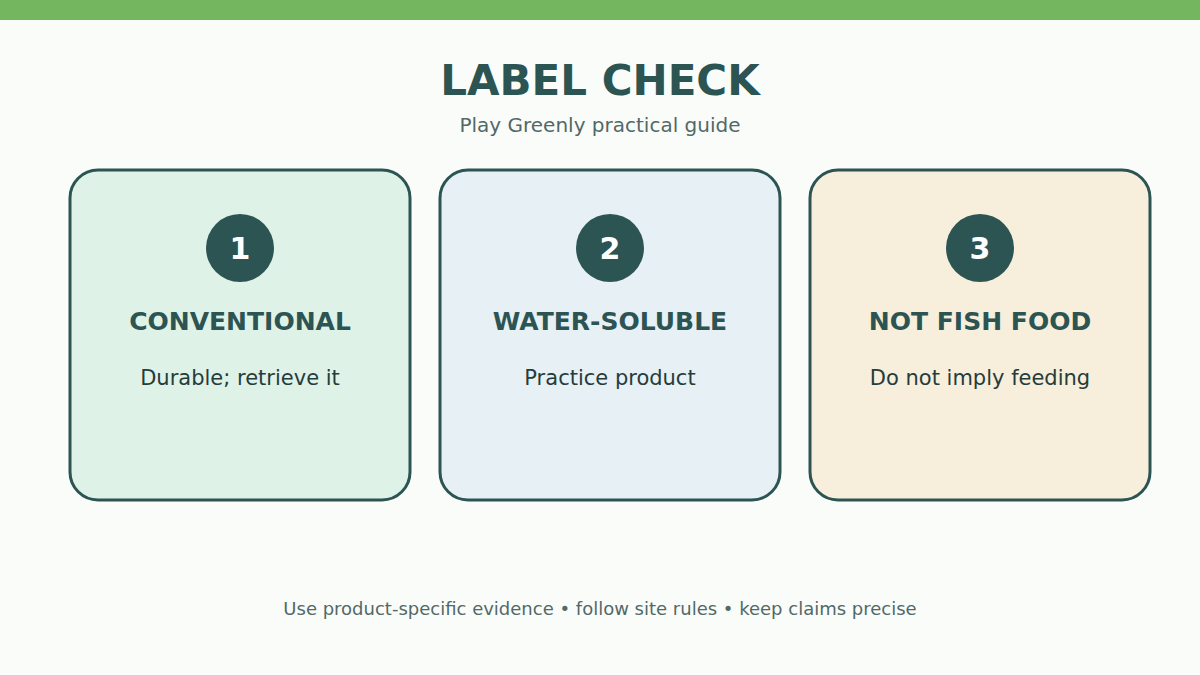
Some golfers use the phrase "fish food golf balls" for almost any ball that is meant to disappear after it lands in water. That shortcut is understandable, but it can also create the wrong expectation. A product can be water-soluble, biodegradable, or made for short-flight practice without being something fish should eat.
The safer way to think about these products is simpler: choose a ball that matches the place you are practicing, get permission before hitting near water, and avoid leaving durable conventional balls behind.
Quick answer
"Fish food golf ball" is a marketing phrase, not a proof standard. Before using any ball near water, check whether the product documentation explains what the ball is made from, where it is intended to be used, and what conditions affect breakdown. If a brand cannot support those points, do not treat the ball as fish food.
The most precise description is “practice-oriented water-soluble golf balls,” with documented test conditions. Do not infer that fish should eat them, that every aquatic setting is appropriate, or that the product leaves no environmental footprint.
What people usually mean by "fish food"
Most searchers are asking one of three things:
- Can I hit balls into a lake, pond, dock, marina, or beach area without leaving conventional golf balls behind?
- Are dissolvable or biodegradable practice balls meaningfully different from standard golf balls?
- Is the product actually safe for fish and other aquatic life?
Those are separate questions. A product can help avoid long-term litter while still requiring permission, limited quantities, and conservative use. A "dissolves in water" claim also does not automatically answer every fish, wildlife, water-quality, or local-rule question.
Why conventional balls are the wrong default near water
Conventional golf balls are built for durability. That is useful on a course, but it is a problem when balls are intentionally hit into places where retrieval is unlikely.
Public marine-debris guidance treats plastic debris as a serious ocean and waterway problem. The National Park Service explains that plastic debris can harm wildlife and coastal habitats, and that plastic can break into smaller pieces over time. The R&A also frames sustainable golf around resource efficiency, conservation, water, materials, and waste.
Golf-specific evidence points in the same direction. A 2019 Marine Pollution Bulletin paper on coastal golf courses documented large numbers of golf balls recovered from Monterey Bay-area waters and described golf balls as a source of marine debris. That study should be used carefully: it is coastal evidence, not a universal count for every lake or pond. Still, it supports the basic editorial guidance: if the ball is conventional and you cannot retrieve it, do not make water the target.
Biodegradable vs. dissolvable vs. edible
Use these terms precisely:
- Biodegradable usually means a material can be broken down by biological processes under certain conditions. It does not mean "disappears instantly" or "safe anywhere."
- Dissolvable or water-soluble means the material is designed to break apart or dissolve in water. Time, temperature, agitation, salinity, and formulation can change the result.
- Edible or fish food should be reserved for products with direct, product-specific evidence supporting ingestion by the relevant animals. Do not borrow the phrase just because it is popular in search.
“Water-soluble practice ball” is more precise than “fish food golf ball.” The popular search phrase is a shopper shortcut, not a recommendation to feed wildlife.
A safer water-practice checklist
Before a backyard, dock, resort, or event session:
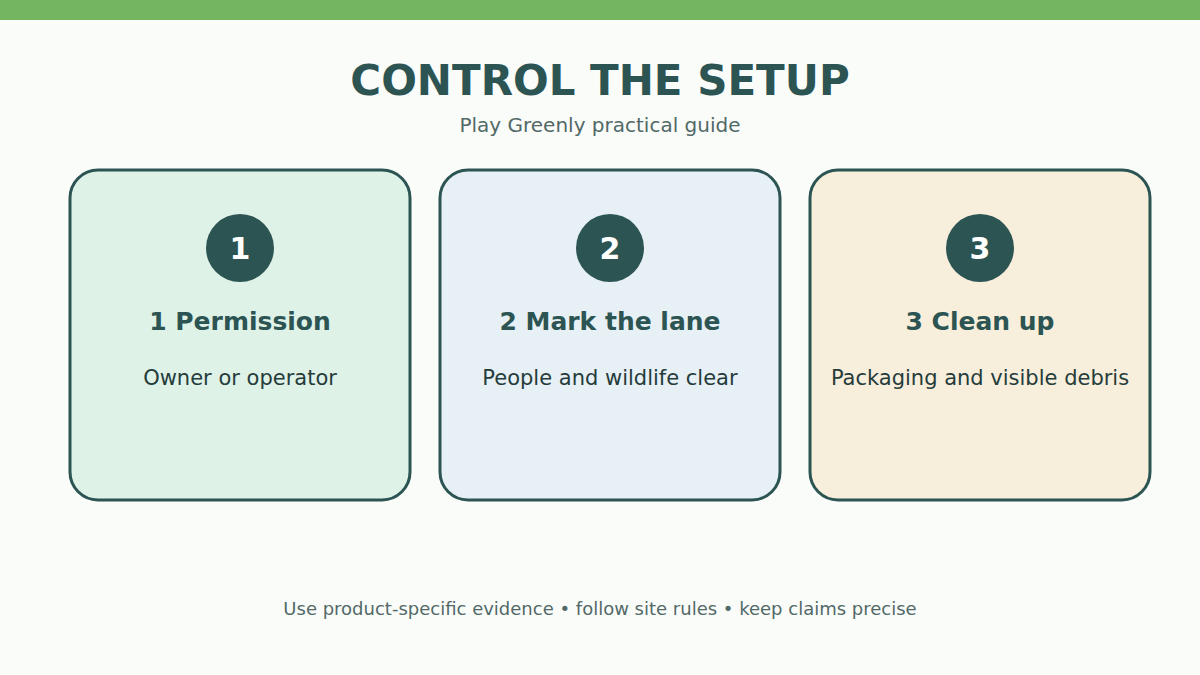
- Confirm the property owner, course, marina, beach, or local authority allows the activity.
- Use a marked hitting lane and avoid people, boats, wildlife, swimmers, shoreline plants, and fragile habitat.
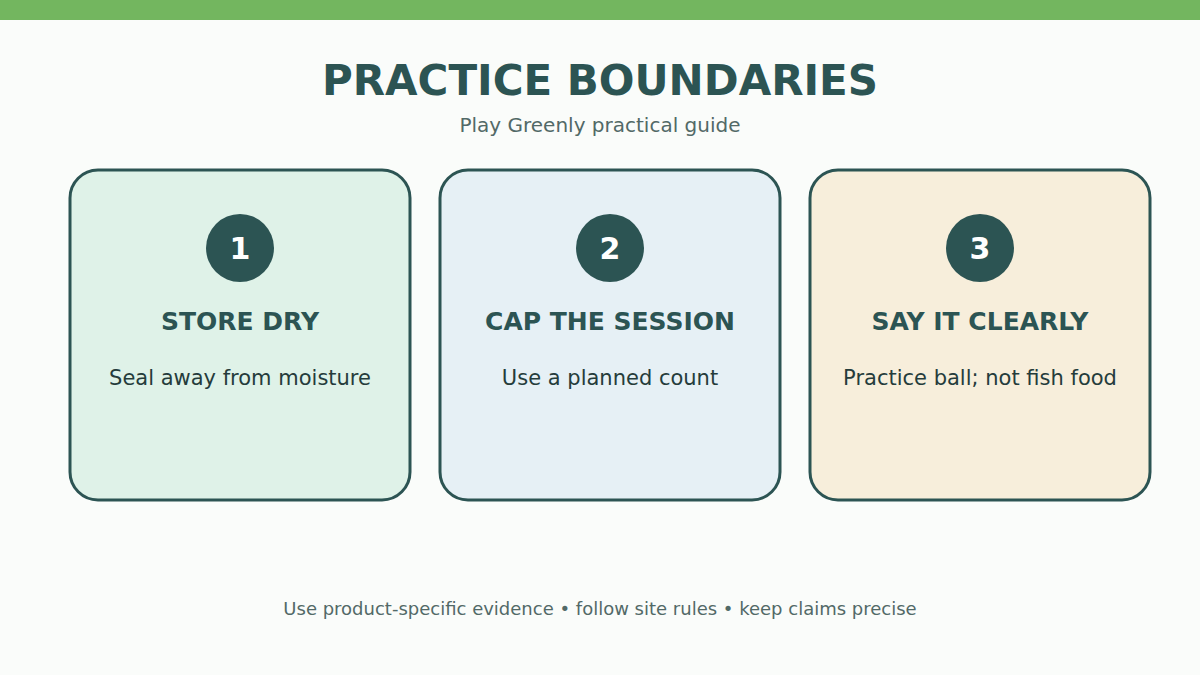
- Keep the session small. A 10-20 ball limit is a conservative planning rule, not a universal safety threshold.
- Retrieve any visible fragments, packaging, tees, or missed balls where retrieval is practical and safe.
- Store unused water-soluble balls dry, sealed, and away from heat or moisture.
- Do not use product claims to override local rules or common sense.
This checklist keeps the recommendation defensible. The environmental win is not "hit anything anywhere." The win is reducing durable litter risk when practice near water has been permitted and planned.
Where Play Greenly fits
Play Greenly balls are intended for recreational practice, demos, and controlled water-adjacent sessions where a customer wants a lower-persistence alternative to conventional balls. Keep three boundaries clear:
- Not for official scoring play unless separately certified for that use.
- Not a permission slip for public waterways or restricted properties.
- Not a claim that fish should eat the product.
The available product evidence supports a conditional statement: supplier-summary lab testing reported rapid dissolution under specified stirred freshwater conditions, while field conditions can differ. That is useful, but it is not a blanket environmental-safety certification.
Related Play Greenly guides
- Play Greenly water-soluble practice golf balls
- Do fish eat golf balls?
- Dissolvable golf balls for docks and marinas
- Are golf balls bad for lakes?
- How biodegradable golf balls dissolve
Frequently asked questions
Are fish food golf balls actually food for fish?
Not by default. Treat "fish food golf balls" as a search phrase unless the seller provides product-specific evidence that the ball is intended and safe for the relevant fish or wildlife to ingest.
Can I hit dissolvable golf balls into any lake?
No. You still need permission from the property owner or relevant authority, and you should avoid sensitive habitat, swimmers, boats, wildlife, and areas where local rules prohibit the activity.
Are dissolvable golf balls better than conventional balls near water?
They can reduce long-term persistence risk when used as directed, but that does not make every water setting appropriate. Retrieval and prevention remain the best defaults.
How many balls should I use in a dock or water-practice session?
For a controlled private session, start with 10-20 balls as a conservative planning rule and adjusting only after permission, visibility, and cleanup expectations are clear. That number is editorial guidance, not a scientific safety limit.
What should Play Greenly avoid saying?
Avoid "non-toxic," "safe for all water," "leaves no residue," "fish eat them," and universal dissolve timelines unless those claims are backed by product-specific, current evidence.