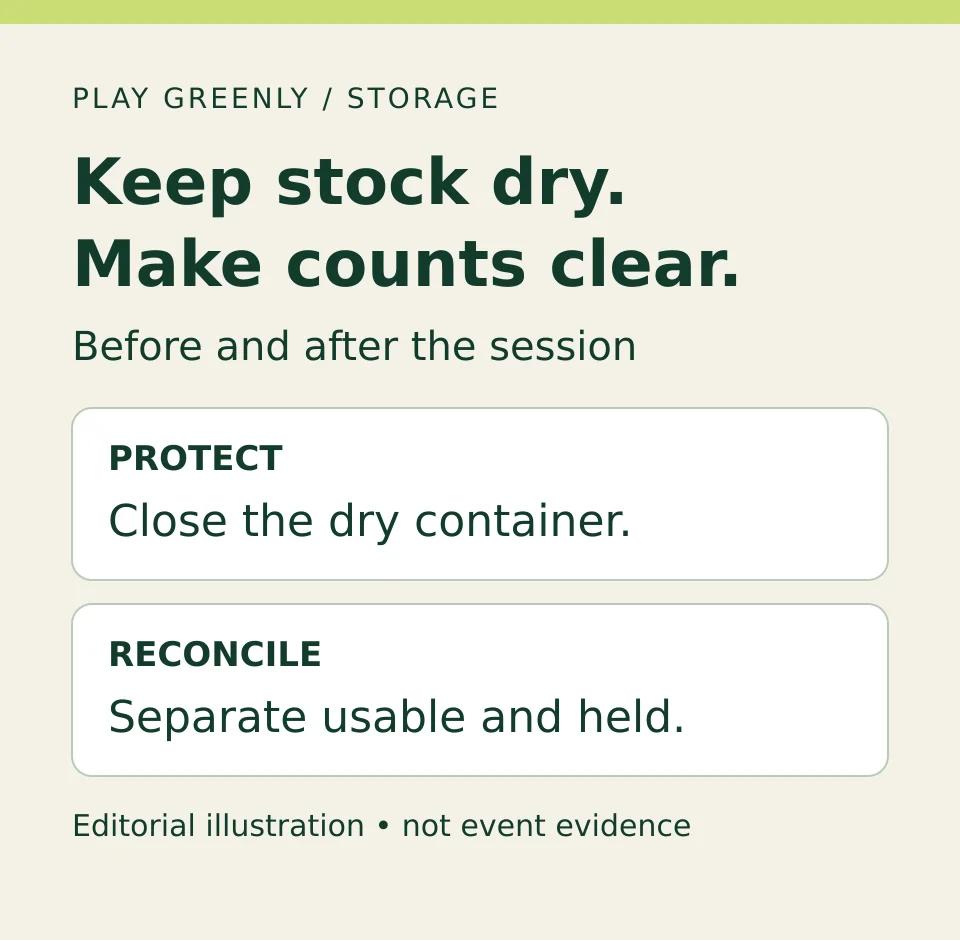
Keep unused water-soluble practice balls in a closed, dry container, protected from rain, spray and damp storage. Issue a counted batch, separate wet or damaged returns, and reconcile the remaining stock. These are practical handling recommendations, not a tested shelf-life guarantee. During a lightning threat, leave equipment behind and get people to safe shelter immediately.
A dry-storage routine for event hosts
Storage means protecting unused stock, issuing a counted batch, and recording what comes back. For a marina host, outing organizer or resort activity lead, that routine starts before the box reaches the hitting station.
Play Greenly makes PVA-based, water-soluble practice golf balls built for the ocean and other bodies of water. The product and use-case guide explains their intended role. Results vary with temperature, water movement, salinity, storage and ball condition. Use only in private or approved settings and follow local rules. Not a tournament ball. Not fish food. Not a permit.
The recommendations below are a conservative handling workflow. Follow current product-specific instructions supplied with your order and ask Play Greenly about any conflict or unclear storage condition. This article does not establish a temperature range, humidity limit or expiry date for a finished ball.
What resin guidance can tell you
Kuraray’s PVOH FAQ describes its material as powder or pellets. It recommends unopened original packaging in a dry place at normal room temperature, protection from rain and water, and avoiding high heat and humidity because the resin can absorb moisture and solidify into blocks.
That is useful background for moisture-conscious handling. It is not a Play Greenly finished-ball study, a statement that Kuraray supplies this ball, or a transferable storage warranty. Do not copy a resin shelf-life number, dissolution temperature or processing method onto a golf-ball label.
A sealed bag also does not prove the contents are dry or undamaged. Check the container and visible condition before issue. If the history is uncertain, hold the affected stock separately and ask for product-specific advice; do not promise that drying it out restores its performance.
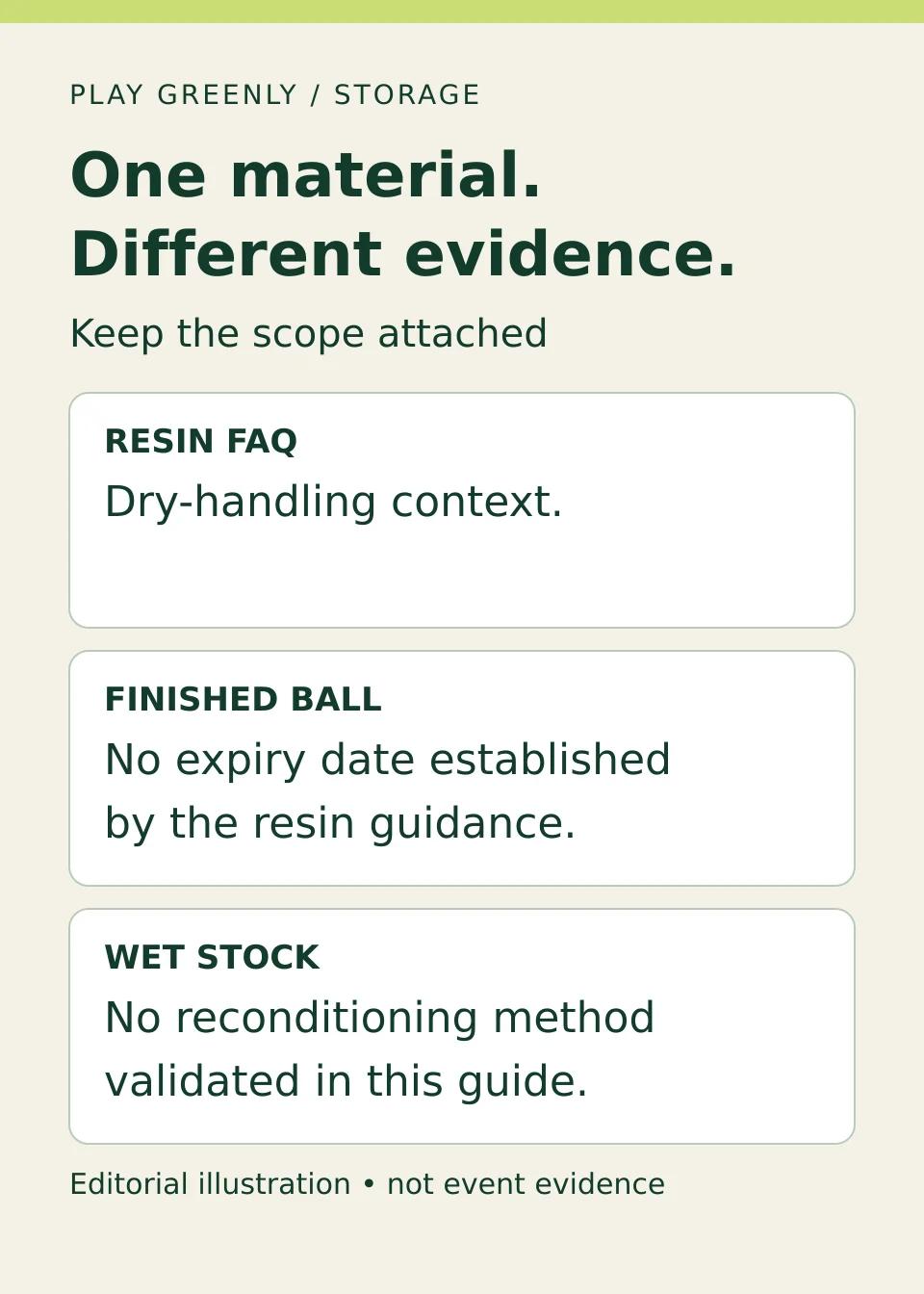
Original editorial diagram. The resin reference supports context, not a finished-product warranty.
Set up, issue and return
- Choose a dry storage location before the event. Keep unused stock closed and protected from water, including spray and cooler meltwater. A dock box is suitable only if the actual storage conditions meet the product’s instructions; being called a dock box proves nothing about dryness.
- Count a manageable batch for the station. Keep the reserve protected and note how many balls leave storage. Do not pre-soak inventory or treat a bucket of water as preparation for play.
- At a safe time, sort returns. Return unused, dry, visibly undamaged balls to protected stock. Keep wet, damaged or uncertain-condition balls separate and marked “hold — do not issue.” Do not mix them back into usable stock pending product-specific advice.
- Reconcile the counts. Record balls used, dry returns, held stock and unexplained differences. Count only when conditions are safe; inventory work never takes priority over people.
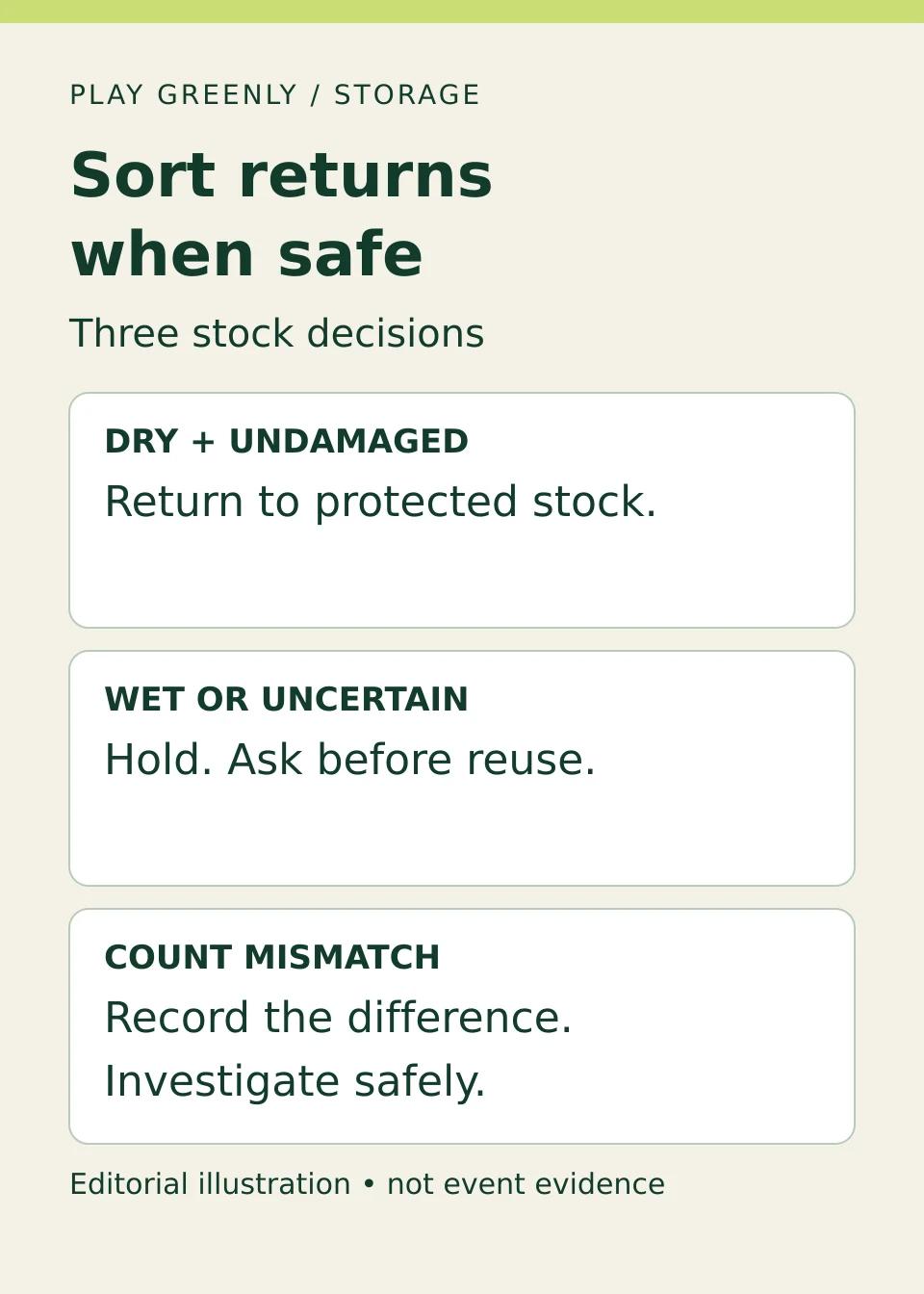
Original editorial decision aid. “Hold” is an administrative status, not a finding that every wet ball is permanently unusable.
A count that closes without double-counting
Here is an illustrative worksheet, not a report from a real outing. Start with 120 balls and issue 40. That leaves 80 in reserve. After the activity, record 30 used, eight unused dry returns and two wet unused returns held separately.
The issued batch reconciles: 40 issued = 30 used + 8 dry returns + 2 held. Closing usable stock is 88: 80 reserve + 8 dry returns. Total reconciliation is 120 opening = 88 usable + 2 held + 30 used.
“Used” means balls recorded as taken into play, not merely issued to the station; it does not claim all balls were retrieved, identify where they ended up, or measure environmental outcomes. Record any recovery separately so a used ball is not counted twice as unused stock. If one ball cannot be accounted for, keep the difference visible and investigate safely rather than changing the numbers to make the form balance.
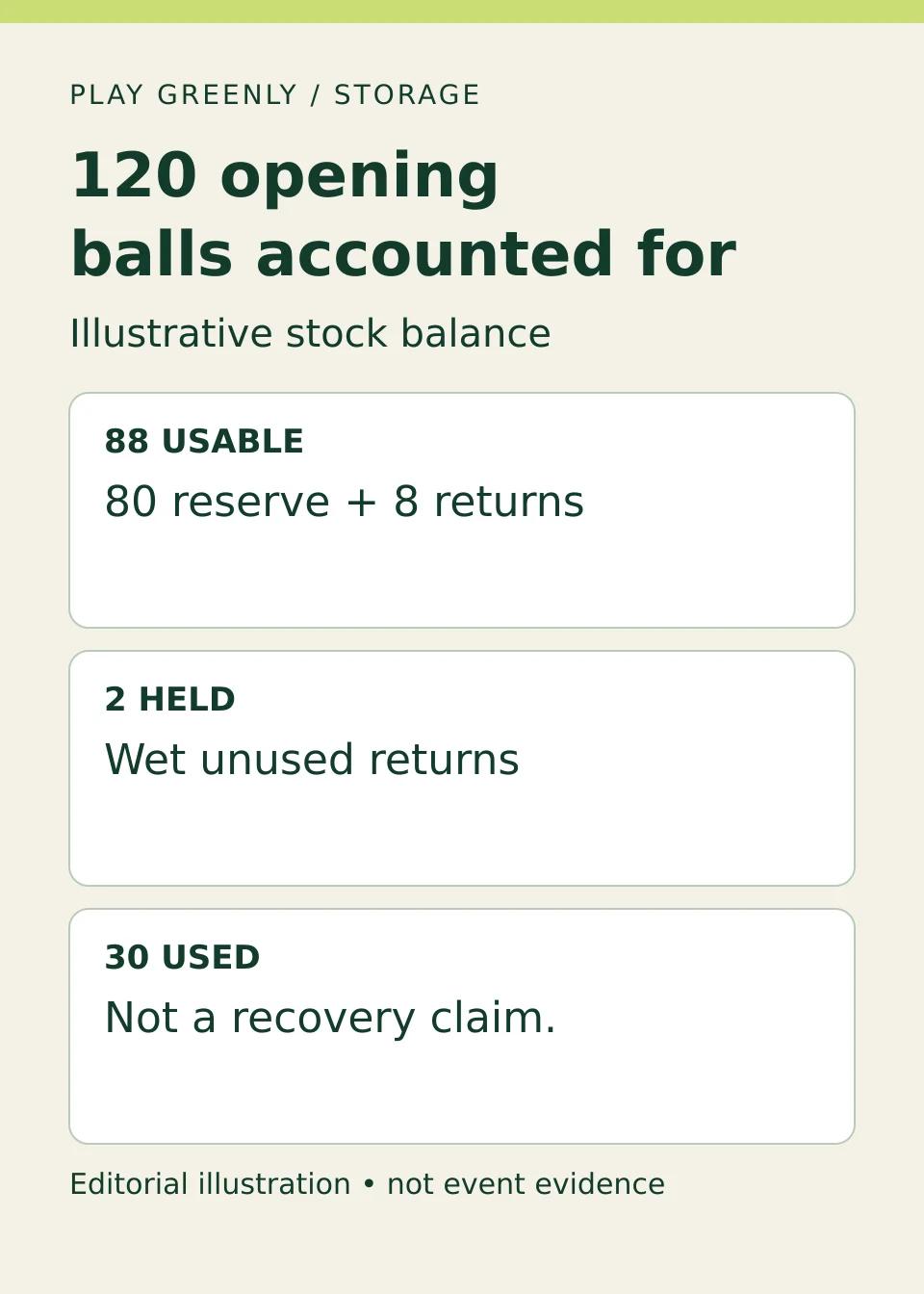
Illustrative arithmetic, not event evidence. Closing usable stock excludes the held balls.
Copy a stock handoff worksheet
Use this blank worksheet for one counted batch and one handoff. It is an editorial template, not a product inspection certificate. Keep existing held stock on a separate record; do not bring it into a new usable opening count. If you add or transfer stock during the session, record that movement separately before reconciling.
- Session and batch: [date / station / batch reference]. Outgoing role: [role]. Receiving role: [role]. Count time, when safe: [time].
- Opening usable stock: [O]. Issued to this station: [I]. Unissued reserve: [R]. Check O = I + R for this batch before any additional movement.
- Issued-batch outcome: [U] taken into play, [D] unused dry returns and [H] unused held returns. Unexplained difference: X = I − U − D − H. Keep each category separate.
- Closing usable stock: C = R + D. Opening check: O = C + H + U + X. Record a signed difference; a negative X means the recorded outcomes exceed the issued count and need checking too.
- Held-stock handoff: [quantity / container label / reason for hold / separate location]. Keep the hold label attached. Record the product-specific advice needed and the role responsible for obtaining it.
- Next shift: [usable count and location / held count and location / open discrepancy / next check]. Receiving the worksheet acknowledges the counts and unresolved items; it does not release held stock for use.
In the earlier balanced example, O = 120, I = 40 and R = 80; U = 30, D = 8 and H = 2. That makes X = 0 and C = 88. If only seven dry returns are actually counted, keep D = 7: X = 1 and C = 87, so 120 = 87 + 2 + 30 + 1. This second example is also fictional. One unexplained ball is a count difference, not evidence of where a ball ended up.
Before changing a figure, check the issue note, recount the relevant containers when safe, and check for an unrecorded transfer or duplicate entry. Keep the original discrepancy and any documented correction together. Do not relabel a missing ball as “used,” treat a recovered used ball as an unused return, or issue held stock simply to make the numbers close. If a discrepancy remains, carry it into the next handoff rather than claiming a reconciled balance.
Keep the actual staff roster and completed records in the venue’s normal internal system. The public article needs only these blank fields and fictional numbers. During a lightning threat, abandon the count and shelter people immediately; complete the handoff only when returning is safe and authorized.
If weather interrupts the session
Plan the storage location and weather response before starting. If thunder or nearby lightning threatens, stop and get people to safe shelter immediately. Do not first gather balls, close boxes, finish the count or recover equipment.
The National Weather Service’s outdoor-sports guidance identifies substantial buildings with wiring and plumbing as the best protection; if unavailable, a hard-topped metal vehicle with windows closed provides protection. Small sheds, rain shelters and open outdoor structures are not safe lightning shelters.
NWS says to wait at least 30 minutes after the last thunder before resuming outdoor activity. Follow the venue’s lightning plan and account for other hazards too; the elapsed time alone is not a command to restart. Sort and count stock only when returning is safe and authorized. For ordinary rain without a lightning or other safety threat, pause issue and protect dry stock only if safe to do so.
Leftovers need a destination
Keep usable leftovers as inventory for a suitable future session, subject to current product instructions. Do not throw unused product into water to empty a box. EPA’s Green Meetings guidance recommends minimizing prizes and giveaways and working with waste-minimization programs. Our stock-count workflow is an editorial application of that broad planning idea, not an EPA-approved golf-ball procedure or certification.
For wet, damaged or unsuitable unused product, ask Play Greenly and the relevant local waste service about handling. Do not assume that water-soluble means food, compostable or accepted in a particular recycling stream. Our fish-food golf-ball explanation covers the feeding misconception; the old golf-ball disposal guide separately discusses conventional balls. Do not transfer a conventional-ball disposal route to a different material without checking.
Storage does not answer the site-permission question. Review the lake-permission guide and confirm requirements with the responsible venue and relevant authority. Keep this stock routine within the broader golf-event planning checklist.
Common storage questions
How long can I keep an unopened box?
This guide does not establish a finished-ball shelf life. Ask Play Greenly for current instructions for the product you have. A resin supplier’s storage statement cannot fill that evidence gap.
Can I dry a wet ball and use it later?
This package contains no validated reconditioning method. Hold affected balls separately and ask for product-specific guidance before reuse. Wet appearance alone does not establish either restored performance or permanent failure.
Does “ocean-safe” change the storage routine?
No. Play Greenly uses ocean-safe as brand language for the intended water use-case. It does not establish a marine-biodegradation certificate, a storage warranty or permission to hit anywhere. Keep unused stock dry and keep site rules separate from product wording.
What should I put on the storage card?
“Keep unused stock closed and dry. Issue a counted batch. Hold wet or uncertain returns separately. Reconcile stock when safe. During a lightning threat, shelter people immediately.” Add the venue’s actual plan and current product instructions; do not add an invented expiry date.