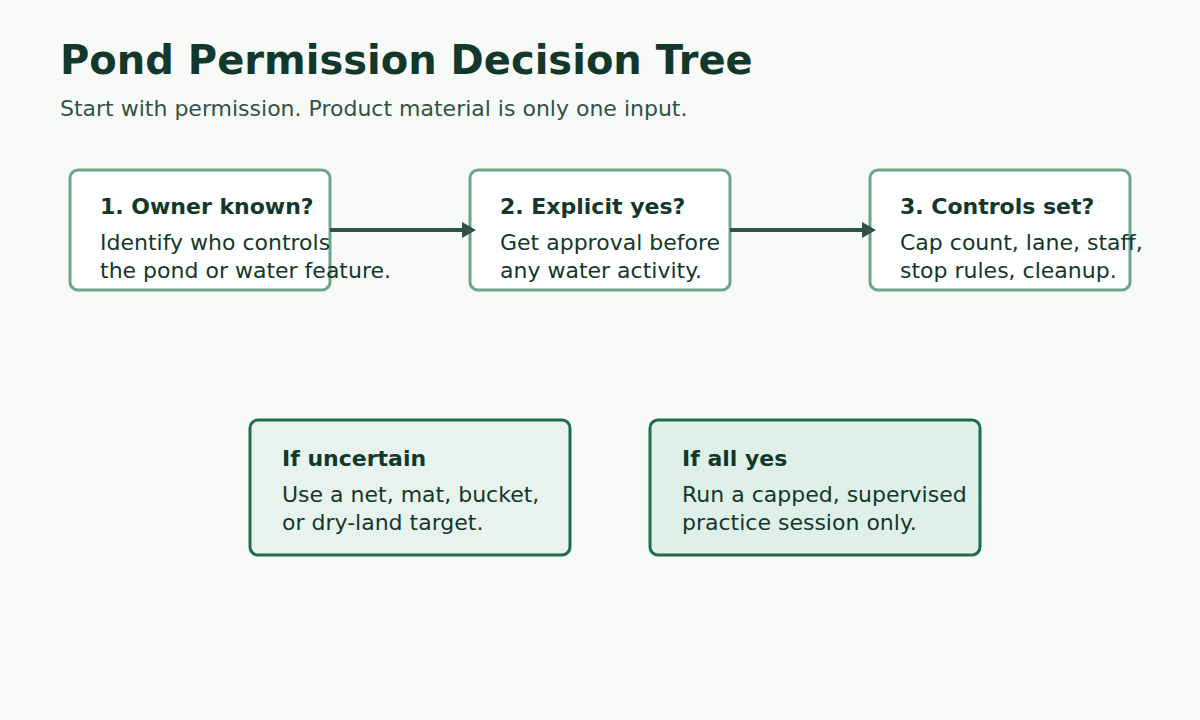
Sometimes. A water-soluble practice ball does not automatically make a pond an approved target. The safer answer is: use it only where the property owner or operator permits it, where the activity is supervised, and where the shot count, lane, retrieval expectations, and claim language are controlled.
This article is for backyard ponds, golf-course ponds, resort water features, marina-adjacent events, and brand demos where someone is asking whether a dissolvable golf ball changes the rules. It is not legal advice, a public-water permission slip, or an environmental safety certification.
Quick answer
Before anyone hits into a pond, ask four questions:
- Who owns or manages the pond?
- Does that owner explicitly allow the activity?
- Can the session be capped, supervised, and stopped if conditions change?
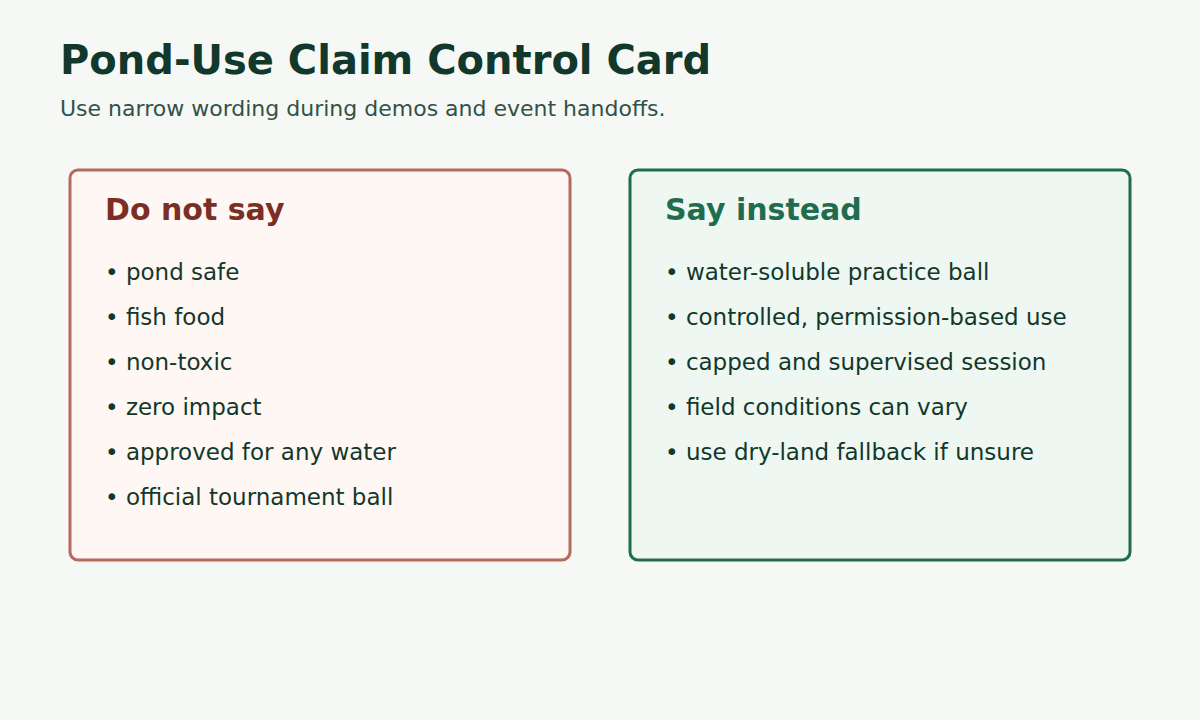
- Can the product claim stay narrow: water-soluble practice ball, not fish food, zero impact, non-toxic, official play, or safe for every water body?
If any answer is uncertain, use a net, mat, bucket target, floating retrieval target, or dry-land practice setup instead.
Use the pond-permission decision tree
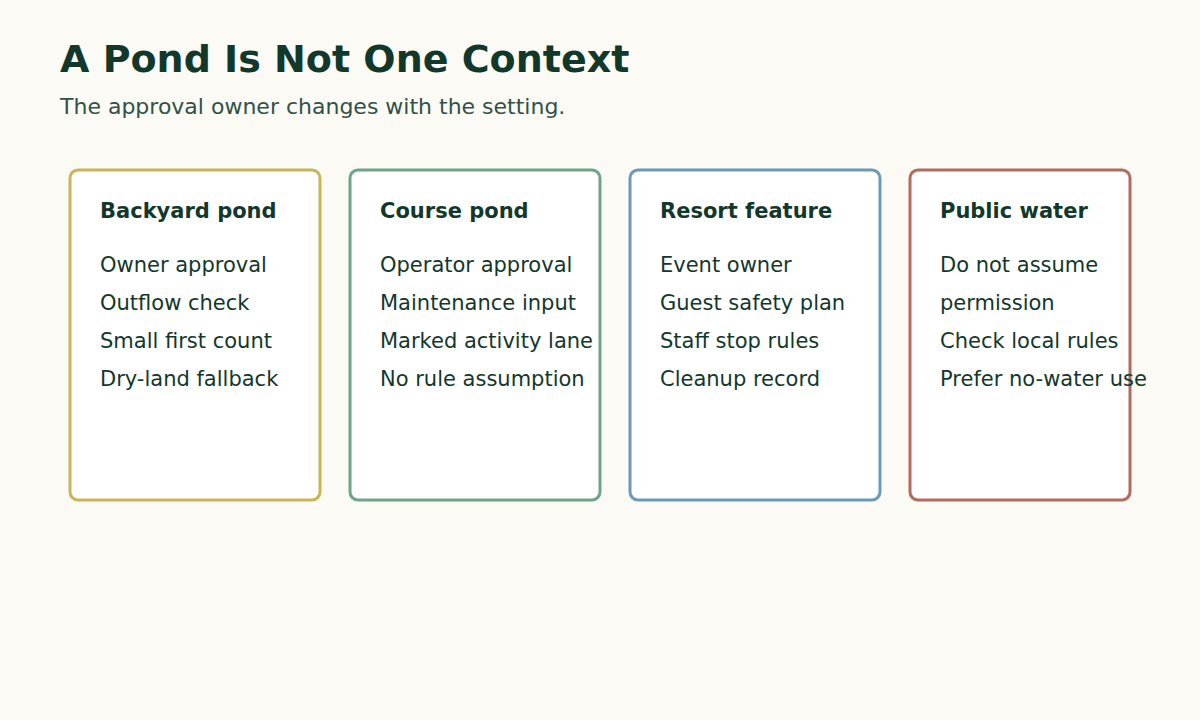
Start with permission, not product material. A private backyard pond, a golf-course penalty area, a managed resort pond, and a public shoreline are different operating contexts.
For Play Greenly, the product story should stay modest: a water-soluble practice ball designed for controlled practice use. Supplier-summary lab evidence can support dissolution under specified stirred freshwater conditions, but field conditions can differ. That evidence does not replace local rules or operator judgment.
Why a pond is not just "water"
EPA stormwater guidance explains that runoff can move pollutants directly into water bodies when there is no treatment or filtration step. NOAA's Marine Debris Program frames prevention as a core way to reduce debris in oceans, waterways, and the Great Lakes.
That context matters because a pond session is still an introduced-material activity. Even when the practice ball is water-soluble, the plan should reduce unnecessary inputs, avoid sensitive areas, and keep packaging, tees, buckets, and other event materials out of the water.
Golf-course ponds need the course's answer
On a golf course, the presence of a penalty area does not mean a player, guest, or sponsor can run a separate hitting activity into it. USGA rules resources explain how penalty areas function for play and relief, while USGA course-care material treats ponds and water features as managed assets that need maintenance and water-quality attention.
For a course, resort, or club, the right process is to ask the operator:
- whether the pond is available for any activity;
- where the hitting lane can be placed;
- how many balls are allowed;
- whether retrieval is expected or practical;
- what wildlife, shoreline, cart-path, guest, and maintenance restrictions apply;
- who can stop the session.
Backyard pond checklist
For a privately managed pond, keep the first session small and documented:
- Confirm the owner approves the activity.
- Use a fixed ball count.
- Keep bystanders, pets, and wildlife out of the lane.
- Avoid storm drains, outflow channels, public waterways, and sensitive habitat.
- Stop during wind, rain, low visibility, algal bloom concerns, wildlife activity, or guest crowding.
- Keep packaging and non-dissolvable items away from the water.
- Record what was used and what changed.
The goal is a controlled practice moment, not a permanent backyard driving range.
What not to say
The most common risk is not the product. It is overstating what the product proves. FTC Green Guides discipline is relevant because broad environmental claims can mislead if they imply more than the evidence supports.
Avoid these phrases:
- safe for all ponds;
- pond safe;
- fish food;
- non-toxic;
- zero impact;
- disappears everywhere;
- approved for any water;
- official tournament ball;
- permission-free.
Use narrower wording instead: water-soluble practice balls for controlled, permission-based use.
Better alternatives when permission is unclear
If the pond answer is not clearly yes, give the guest a satisfying practice format without using the pond:
- chip into a landing net;
- hit foam balls toward a floating-looking dry target;
- run a three-shot backyard accuracy game;
- use a mat and bucket challenge;
- stage a pre-event water-solubility demo in a clear container;
- use the pond only as background, not as the target.
These alternatives still let Play Greenly talk about responsible practice without asking a venue or customer to make a broader water-use decision on the spot.
Where Play Greenly fits
Play Greenly can be the right fit when the use case is supervised practice, the pond owner approves, the session is capped, and the staff language is disciplined. The product should be described as practice-oriented and water-soluble, with field caveats.
Do not frame the product as a way to bypass course rules, public-water restrictions, stormwater controls, wildlife protections, or common-sense supervision.
Related Play Greenly guides
- Play Greenly water-soluble practice golf balls
- Dissolvable golf balls for docks and marinas
- How to test water-soluble golf balls before an event
- Resort and marina golf activity SOP
- Fish food golf balls: myth and materials
Frequently asked questions
Are water-soluble golf balls automatically allowed in ponds?
No. Product material does not decide permission. Ask the pond owner or operator and follow local rules before any water-adjacent activity.
Can I hit Play Greenly balls into a backyard pond?
Only if the pond owner approves and the session is controlled. Start small, cap the count, supervise the lane, and stop if weather, wildlife, water, or guest conditions change.
Are water-soluble balls fish food?
No. Water-soluble means the material is designed to dissolve under certain conditions. It does not mean edible, nutritious, or appropriate for wildlife feeding.
Are these official golf balls for scored play?
Treat them as practice products unless separate conforming-equipment evidence is provided.
What should I do if a venue is unsure?
Use a dry-land alternative: a net, mat, bucket target, supervised container demo, or short backyard accuracy game.