Searchers asking for biodegradable golf balls for land usually want one of three things: a backyard or range practice ball, a ball that will disappear if it is lost in grass, or a lower-waste alternative to a conventional ball they expect to retrieve. Those jobs are not the same, and a biodegradable or water-soluble label does not complete any of them by itself.
A land-practice session still needs a ball designed for that setting, a safe hitting area, and a retrieval plan. Water-soluble practice balls are a different product class: they are intended for permitted water-adjacent practice, not as a conforming posted-round ball and not as a compost-in-the-rough product.
Quick answer
Use a retrievable land-practice or conventional ball when you are hitting on grass, into a net, at a range, or during a posted round. Treat biodegradable and water-soluble labels as material descriptions, not land-use instructions.
A water-soluble practice ball needs water to dissolve. Grass, soil, a backyard, and a driving-range hopper are not that setting. Play Greenly's water-soluble practice balls are for permitted water-adjacent practice. They are not designed as tournament balls, compostable land balls, or permission to leave a ball wherever it stops.
What shoppers mean by for land
The search phrase biodegradable golf balls for land mixes three jobs:
- I want a ball I can hit in a backyard, net, or range and pick up again.
- I want a ball that will break down if I lose it in rough, a yard, or a field.
- I want a lower-waste choice but I still expect to play or practice on land.
Only the first job is a clear land-practice use case. The second job is a fate claim: it assumes the ball will disappear after customary loss in grass. The Federal Trade Commission's Green Guides say marketers should not make unqualified degradable or biodegradable claims unless they can prove the entire product will completely break down and return to nature in a reasonably short period after customary disposal. For solid-waste products, that reasonably short period is one year. Items destined for landfills, incinerators, or recycling facilities generally will not meet that test.
Lost-in-the-rough is not a compost program. Grass is not a documented disposal system. A land-practice article should not promise that a biodegradable label makes a lost ball vanish on a lawn, fairway, or field.
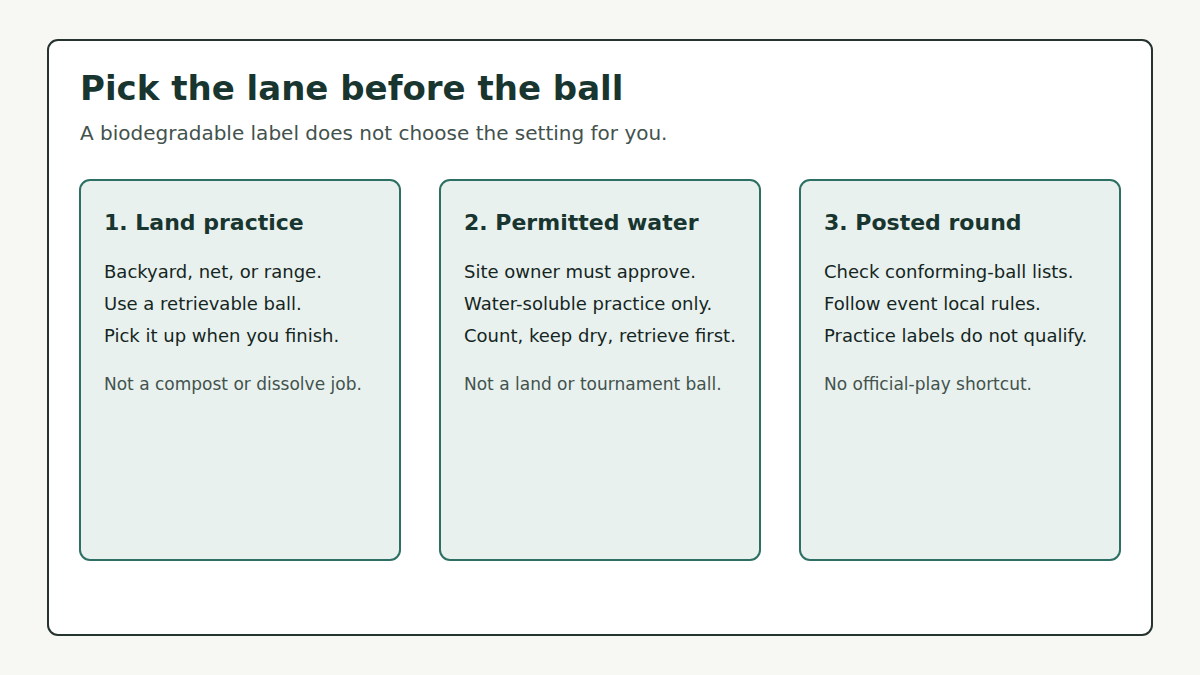
Choose the lane before the ball
Pick the setting first. Then pick the ball.
Land practice or posted play. Use a retrievable practice ball or a conventional ball intended for that setting. Retrieve what you hit. Follow course, range, backyard, and neighbor rules.
Permitted water-adjacent practice. A water-soluble practice ball can be the right class of product when the site owner approves the activity, the ball count is controlled, and retrieval remains the first choice when it is safe and feasible.
Posted or formal play. Check the USGA and R&A conforming-ball lists and the event's local rules. A practice ball is not automatically legal for a posted score.
Play Greenly's own product comparison already points everyday land play toward standard or reusable balls when retrieval is easy. That is the conservative reading: inland, backyard, and range sessions are retrieval settings first.
Why a biodegradable label is not a land-practice spec
Biodegradable, compostable, water-soluble, and conforming describe different things.
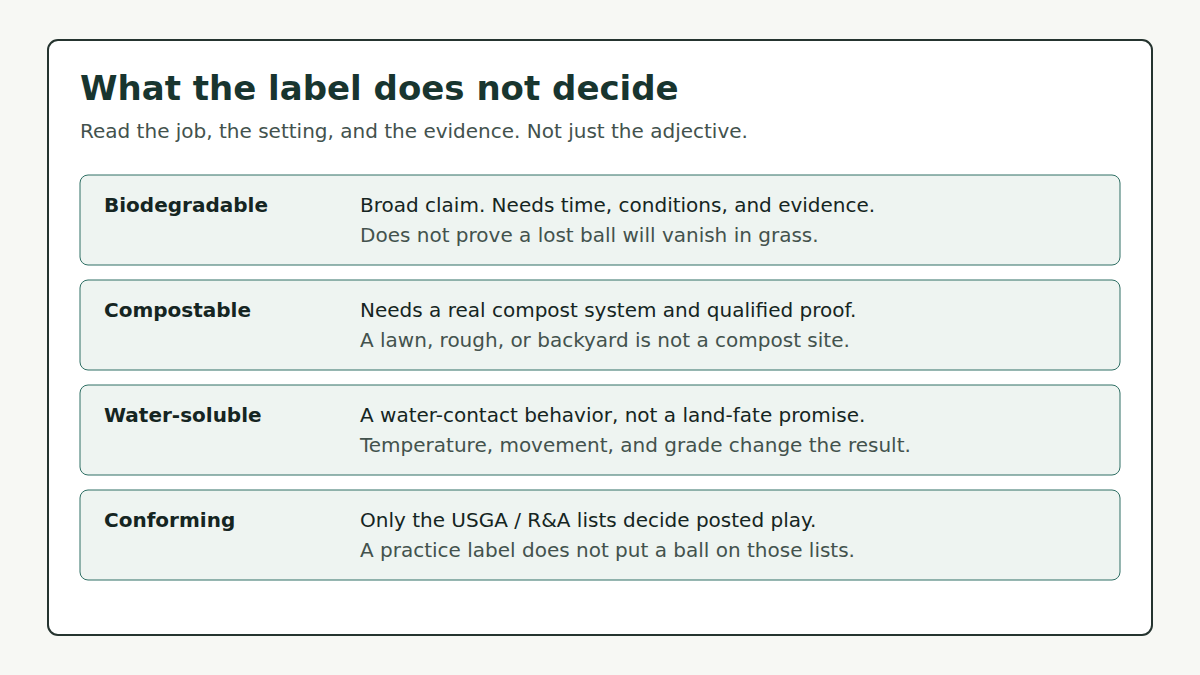
Biodegradable is a broad environmental claim. Without conditions, time, and evidence, it can overpromise what happens after a ball is lost.
Compostable is narrower. The Green Guides say a compostable claim needs competent and reliable scientific evidence that the product will break down into usable compost safely and in about the same time as the materials with which it is composted. Home-compost claims need extra qualification if the product cannot be composted at home safely or in a timely way. A golf hole, rough, or backyard is not a compost facility.
Water-soluble describes a material behavior in water. Manufacturer literature on polyvinyl alcohol, a common water-soluble polymer family, treats solubility as grade- and condition-dependent. Temperature, agitation, and formulation change how a water-soluble material behaves. That is a water-contact fact, not a land-fate fact.
Conforming describes whether a submitted ball has been evaluated against the Rules of Golf. The USGA Equipment Database and conforming-ball list, and the R&A conforming-ball list, are the public check for posted play. A marketing label does not put a ball on those lists.
What to use for backyard, range, and course land practice
For land practice, start with physical control.
Use a net, cage, or clearly bounded target when you are in a yard. Check local rules, HOA rules, and neighbor safety before you swing. A backyard is not a driving range just because the ball is described as eco-friendly.
At a range, use the balls the facility provides unless the operator has approved a different product. Do not drop water-soluble practice balls into a range hopper. They are not a substitute for the range's durable inventory, and accidental water or dew exposure is the wrong way to learn what the product does.
On a course, play the ball the hole and the rules call for. A penalty area or rough is not an invitation to switch to a water-soluble ball so you can leave it. Course staff still manage turf, irrigation, and guest safety. Product type does not replace that judgment.
If the goal is simply to practice the swing and pick the ball up, a retrievable land ball is the honest match.
When a water-soluble practice ball is the wrong choice
Leave water-soluble practice balls out of these jobs:
- backyard chipping without a water-adjacent, permitted setup
- range-hopper or simulator-bay reuse
- posted rounds, qualifying, or any event that requires a conforming ball
- "it will disappear in the grass" lost-ball insurance
- wildlife, fish-food, ocean-safe, or zero-impact stories
- any site that has not approved the activity
Play Greenly should be described as a controlled-use water-soluble practice ball for permitted settings. It is not a land-compost ball, not a tournament ball, and not permission to skip retrieval.
How to pack the bag without mixing jobs
A simple pack check prevents the most common mix-up.
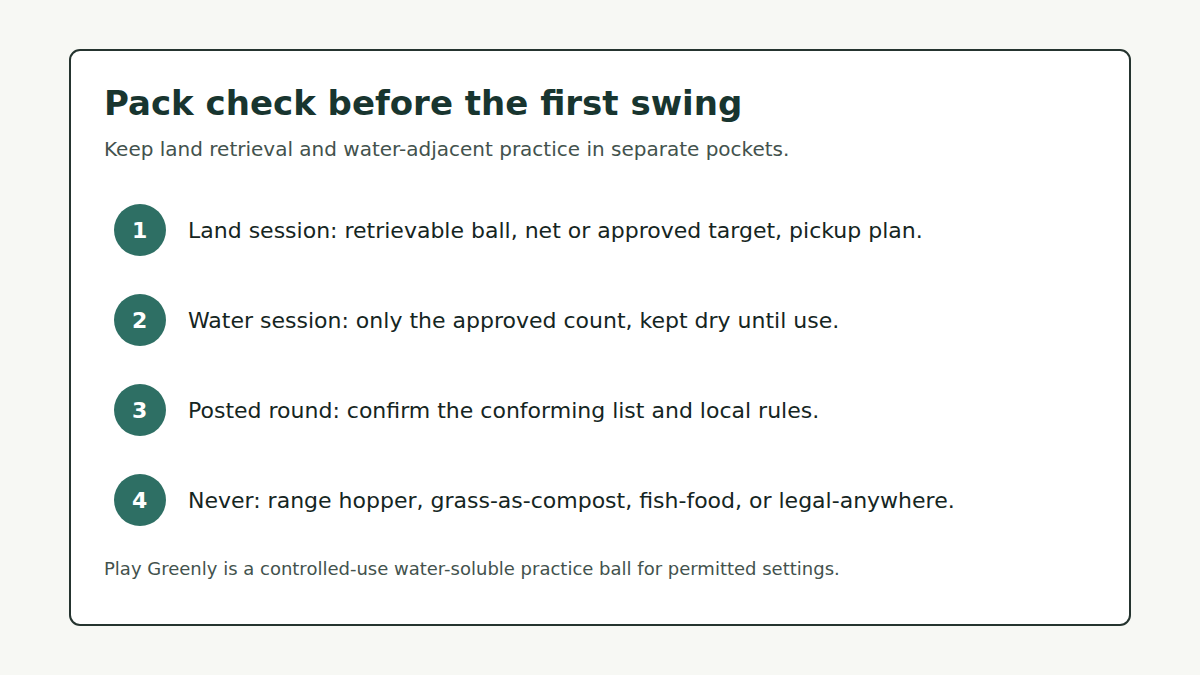
Land session: retrievable practice or conventional balls, a net or approved target, and a pickup plan.
Water-adjacent session: only the number of water-soluble practice balls the site has approved, kept dry until use, with a count and a retrieve-first rule.
Posted round: a ball you can identify on the conforming list if the event requires one.
Do not store unused water-soluble balls in a wet cart pocket, dock bag, or damp range pouch. Keep them cool and dry until the permitted session starts.
Limitations
This article does not assign a breakdown time for any ball in grass, soil, a landfill, or a backyard. It does not certify Play Greenly or any other brand as compostable, ocean-safe, non-toxic, wildlife-safe, or conforming. It does not give legal advice for a specific city, HOA, range, or course. Real-world dissolution or biodegradation, where it occurs at all, varies by formulation and conditions. The conservative practice is still permission, control, and retrieval.
Frequently asked questions
Are biodegradable golf balls meant for backyard practice?
Not by label alone. Backyard practice needs a safe target, local permission, and a ball you intend to retrieve. A biodegradable claim does not turn a yard into an approved range or a compost pile.
Can I use water-soluble golf balls on land?
They are the wrong class of product for ordinary land practice. They need water to dissolve and are positioned for permitted water-adjacent practice, not as a durable land or tournament ball.
Will a biodegradable golf ball disappear if I lose it in the rough?
Do not plan on that. Unqualified biodegradable claims require evidence that the entire product returns to nature in a reasonably short period after customary disposal. Lost-in-grass is not that evidence.
What ball should I use for a posted score?
Check the USGA or R&A conforming-ball list and the event's local rules. Practice-product labels do not replace that check.
Is Play Greenly a land-practice ball?
No. Describe Play Greenly as a controlled-use water-soluble practice ball for permitted water-adjacent settings. For inland or backyard retrieval practice, use a retrievable land ball.
Sources and further reading
Internal: Biodegradable vs. Water-Soluble Golf Balls; Are There Golf Balls That Dissolve in Water?; Are Water-Soluble Golf Balls Legal for Tournament Play?; 7 Backyard Golf Games for Beginners; Play Greenly product page.
External: FTC Green Guides; FTC environmental-claims summary; 16 CFR Part 260; USGA conforming club and ball lists; R&A conforming ball list; Kuraray PVOH overview.