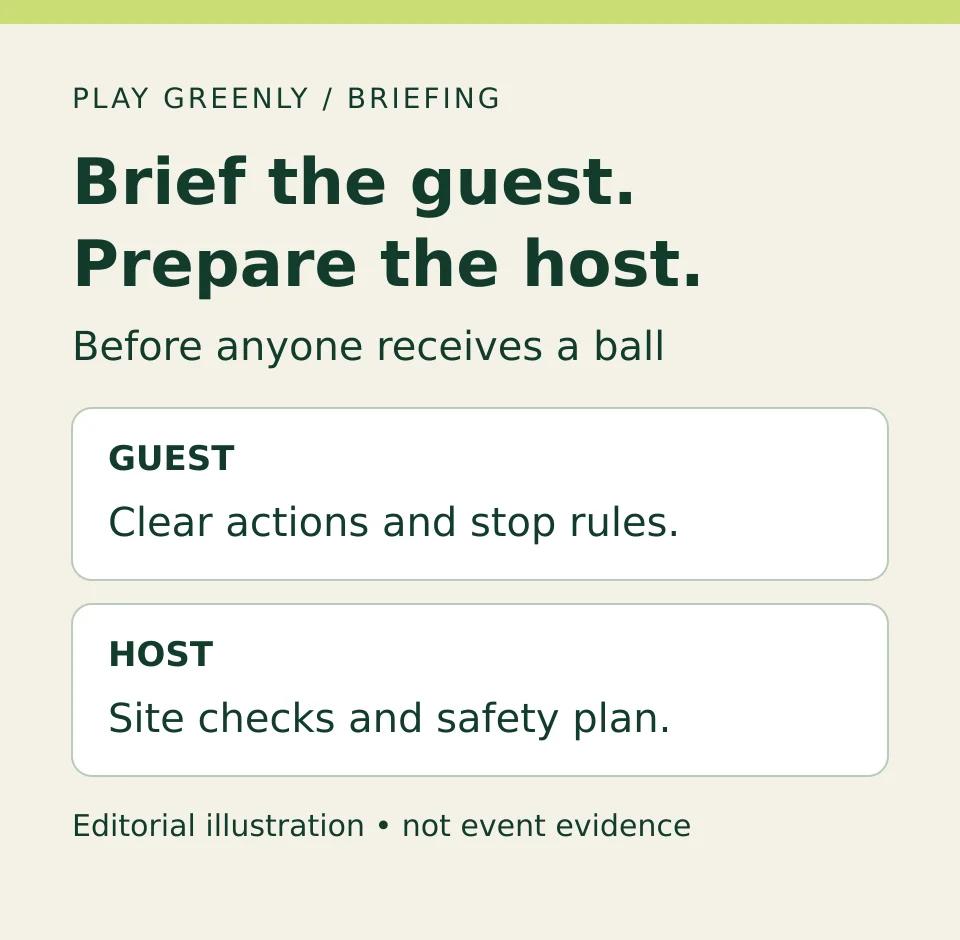
Before handing out water-soluble practice golf balls, explain the product, the permitted station, who supervises, how unused balls return, and what happens when play stops. Keep guests out of retrieval work. If thunder is heard, stop and seek safe shelter immediately. A briefing supports the venue’s plan; it does not establish permission or promise environmental outcomes.
Prepare the host card before guests arrive
A guest briefing is a short spoken instruction, backed by a matching printed card, that tells participants what they may do and when to stop. The useful unit is an action a guest can follow—not a slogan about what a ball eventually does.
Before running this activity, the organizer should verify the applicable site permission and rules, the marked hitting area, supervision, and the venue’s safety plan. Naming a property owner alone does not settle every applicable rule. If those checks remain unresolved, hold the activity and use the lake-permission guide to frame the questions for the venue and relevant authority.
Fill in the supervisor’s role, unused-ball return point, stop signal, and planned safe shelter on the host card. These are preparation fields, not blanks for guests to improvise. A tent, open rain shelter, or shed is not an appropriate lightning shelter. The National Weather Service’s outdoor-sports guidance identifies substantial buildings with wiring and plumbing, or a hard-topped metal vehicle with windows closed when a substantial building is unavailable.
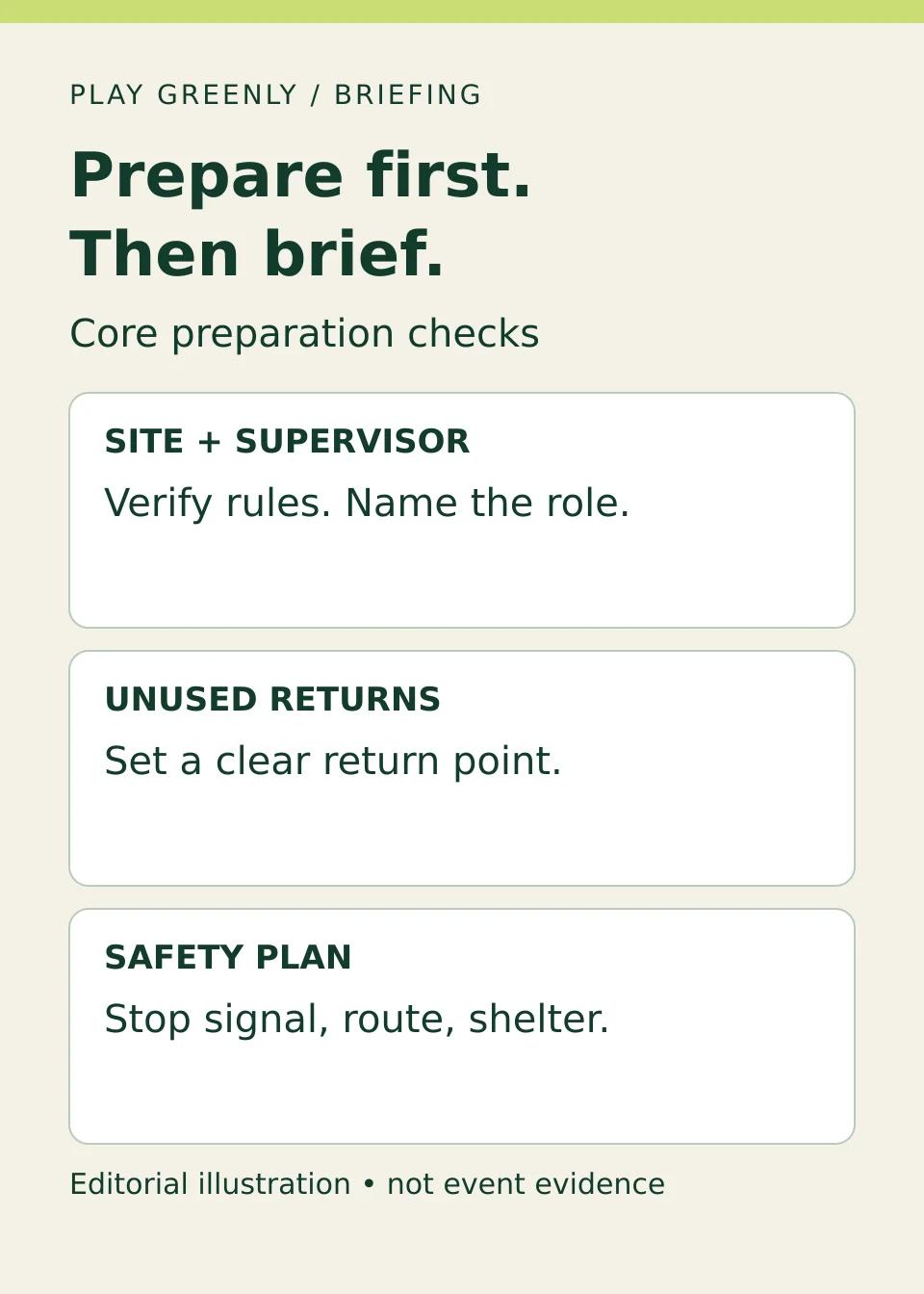
Original editorial illustration. Complete these checks before handing out balls; the card is not a venue safety assessment.
Copy and complete this host card
This card is an editorial preparation aid for the organizer. Complete it privately with the venue before the session; do not publish staff contact details, access codes, or internal emergency records. Use the same wording here, in the spoken script, and on guest-facing signs.
- Approved station: [identify the marked hitting area and its limits]. Host check: [record where the applicable site permission and rules were checked]. If permission remains unclear, do not start.
- Supervisor: [role guests can identify]. Host check: [confirm who covers this role throughout the session]. If the supervisor is unavailable, stop issuing balls.
- Unused-ball return point: [specific place guests can find]. Host check: [assign staff to receive returns and keep uncertain stock separate]. This return instruction never delays lightning shelter.
- Stop signal: [word or signal used by the venue]. Guest action: stop and follow the venue’s instructions. Thunder requires immediate shelter even if this signal has not been given.
- Planned safe shelter and route: [venue-selected shelter and how participants reach it]. Host check: [review access and participant needs with the venue]. Do not treat a tent, shed, or open rain shelter as lightning shelter.
- Weather monitor and restart decision-maker: [roles designated by the venue]. Host check: [confirm the venue’s stop and restart process]. Waiting at least 30 minutes after the last thunder is a minimum, not automatic permission to reopen.
- Ball-location reporting: [supervisor role]. Guest action: report where the ball went; do not enter water or lean over an edge. Host check: [confirm separate staff recovery arrangements under the venue’s safe procedure].
Before issuing balls, replace every bracketed field and rehearse the script with the card beside it. As a proposed comprehension check, ask guests to identify the supervisor, unused-ball return point, and shelter action. Clarify any mismatch before play. This is not evidence that the activity has been safety-certified or that every participant has understood every risk.
The card adapts the NWS planning topics and this article’s conservative guest rules; it is not a complete venue safety plan. Keep full storage and weather procedures in the host’s separate operating instructions.
A short script to adapt to the venue
Use this script only after the preparation checks are complete. Replace each bracketed field and rehearse it aloud; reading time varies.
“These are water-soluble practice golf balls, not tournament balls or fish food. Use only this marked station when [supervisor role] gives the go-ahead. Return unused balls to [return point]. Guests must not enter the water or lean over an edge to collect balls; tell the supervisor where a ball went. If you hear [stop signal], stop and follow the venue’s safety instructions. If you hear thunder, stop immediately and go to [planned safe shelter]; do not wait to collect equipment.”
The no-water-entry and no-leaning instructions are conservative rules proposed for this guest activity. They are not presented as a universal regulation or a complete rescue procedure. The venue must review the script against its own setting, participant needs, access routes, and emergency plan.
Keep the host’s recovery arrangements separate from the guest script. Assign recovery only to suitable staff under a site-specific safe procedure. Reachability alone is not a safety assessment. NOAA’s On the Water guidance says recovery of small debris should be careful and safe; it does not provide a golf-ball retrieval method or approve this activity.
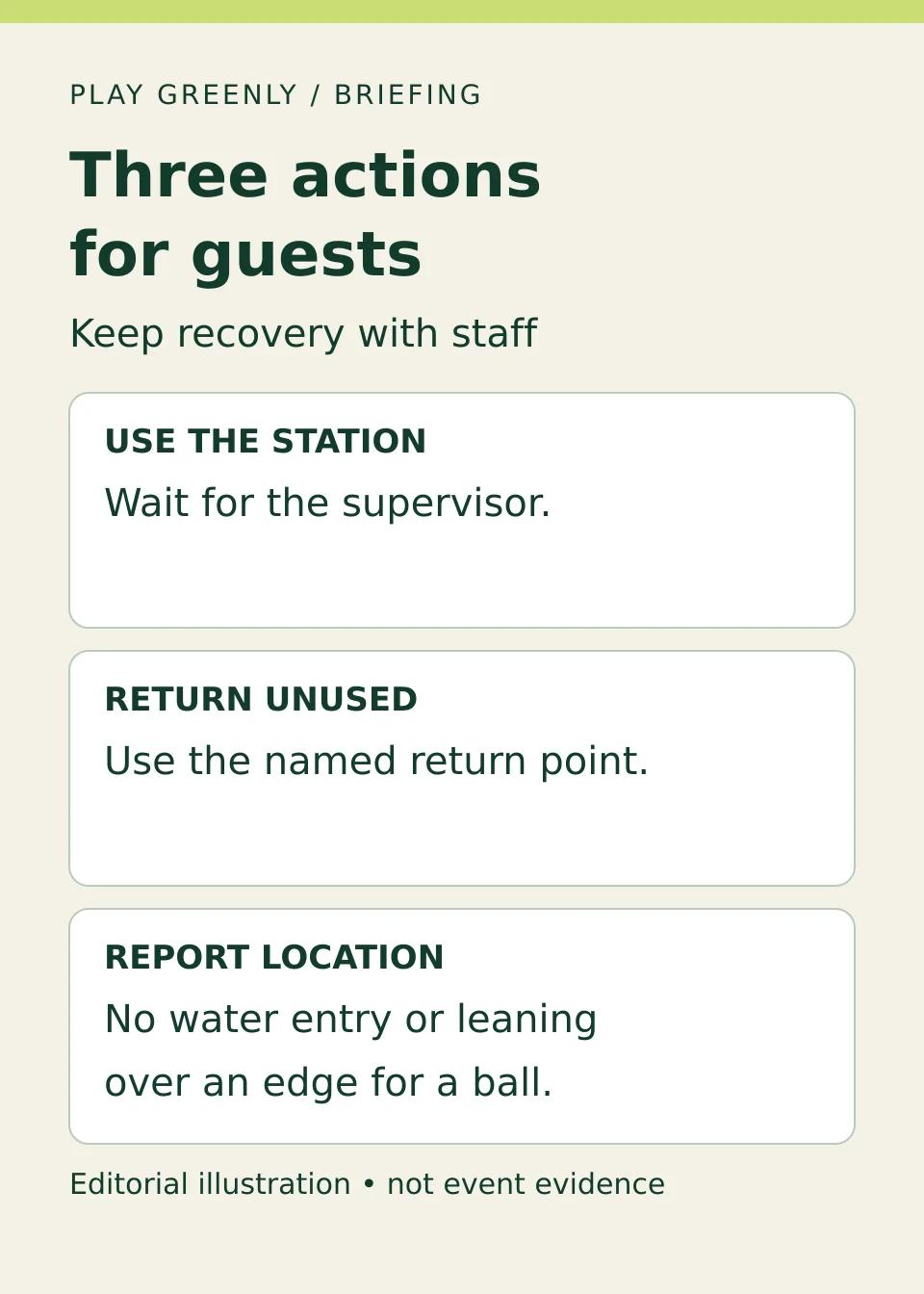
Original editorial illustration. The venue’s stop signal and immediate lightning response still apply throughout the session.
Say what the product is without adding promises
Play Greenly makes PVA-based, water-soluble practice golf balls built for the ocean and other bodies of water. Use only in private or approved settings and follow local rules. They are not tournament balls, not fish food, and not a permit. The product guide explains the intended water use; the fish-food explainer addresses that specific misconception.
If a guest asks about “ocean-safe,” explain that it is Play Greenly’s intended-use brand language, not a marine-biodegradation certificate or permission for any particular shot. Do not turn it into “fish-safe,” “zero impact,” or “no cleanup needed.”
If a guest asks how fast a ball dissolves, say: “We are not promising a dissolution time for this water.” A short station briefing does not need a laboratory result. Omitting a number is clearer than reciting a result while losing its test conditions. Do not substitute a two-week, ten-day, or instant-disappearance promise.
For signs and sponsor copy, use the separate event sponsor wording guide. Check the sign and spoken script together so one does not undo the other’s limits.
Stop play without making equipment the priority
For thunder or a nearby thunderstorm, the National Weather Service says to stop activity and get to a safe place immediately. Do not delay shelter to seal bags, count balls, take a photograph, or finish retrieval. The host should already know the shelter route and who monitors the weather.
NWS says to wait at least 30 minutes after the last thunder before resuming outdoor activities. That is a minimum lightning interval, not an automatic restart instruction. The designated venue decision-maker must also apply the safety plan and consider other hazards before reopening the station.
For a non-weather interruption, such as a missing supervisor, conflicting sign, or unclear permission, stop issuing balls and have the organizer resolve the problem before any restart. Do not ask guests to solve permission or recovery questions themselves.
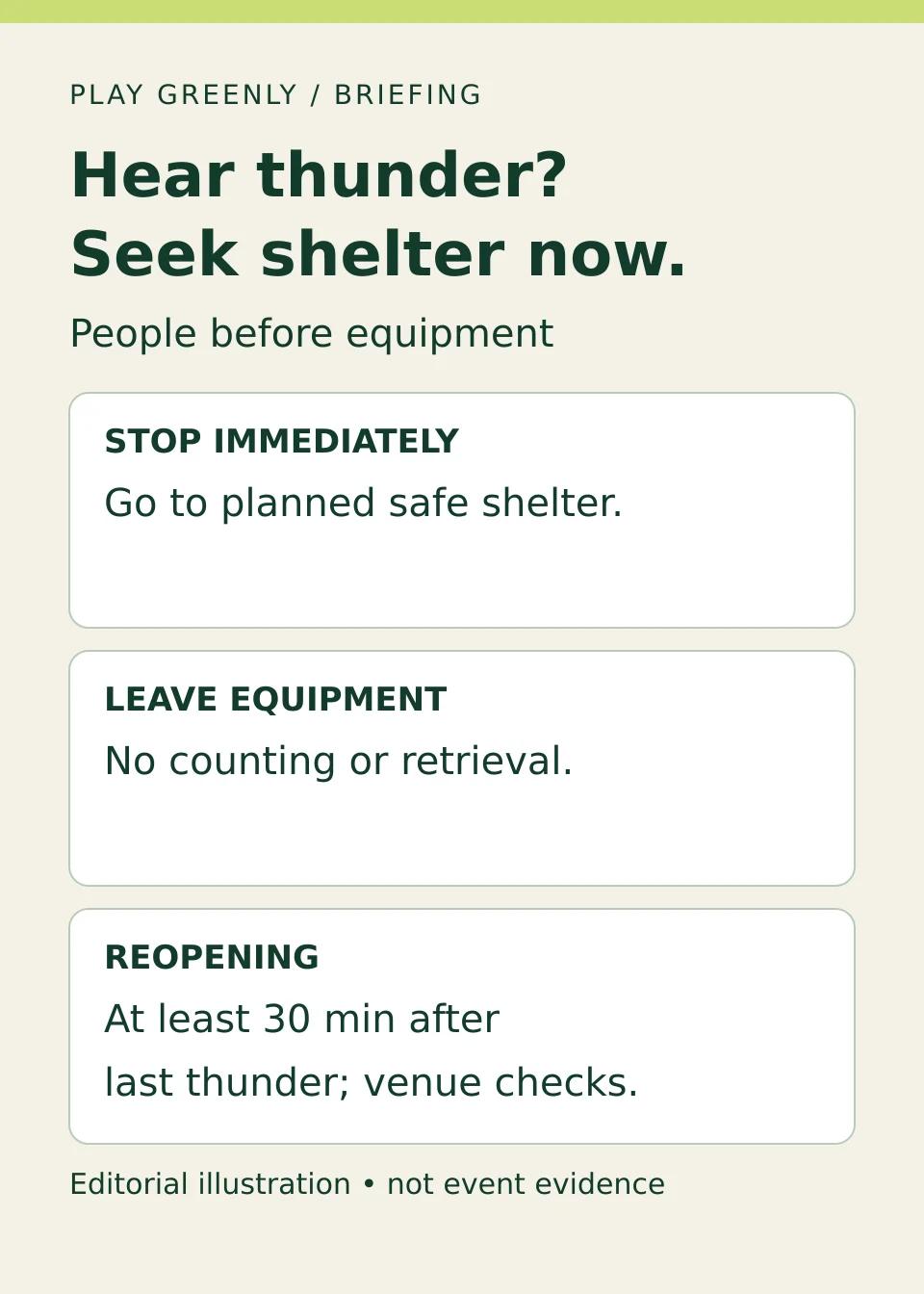
Original editorial decision aid based on NWS guidance. Other hazards and the venue plan can keep the activity closed longer.
Give unused balls a clear return route
Use a designated return point so guests can hand back unused balls without making their own storage or disposal decision. The host can separate dry, undamaged unused stock from wet or uncertain returns and seek product-specific guidance before reissue. This is an editorial handling recommendation, not a claim that drying a wet ball restores its performance.
Do not empty leftover stock into the water. NOAA’s boating guidance calls for properly stowing and securing trash and describes restrictions on garbage disposal. It does not establish whether a particular golf shot is legally classified as disposal. Neither this briefing nor a property owner’s agreement supplies a blanket legal exemption.
EPA’s Green Meetings guidance recommends minimizing prizes and giveaways and considering reusable signage. A clear return point and reusable host card are our suggested applications to this activity. They do not make the event EPA-certified or prove an environmental benefit.
Questions hosts should settle
Does naming the venue owner make the session legal?
No. Verify the applicable permission and rules before the activity. The script communicates the resulting plan; it cannot establish that all legal requirements have been met.
Should guests retrieve a ball they can see?
Not under this proposed guest script. They report its location to the supervisor. Staff recovery needs its own site-specific safety procedure; visible or reachable does not mean safe.
Can the host promise a dissolution time if guests ask?
This script makes no field-time promise. Direct detailed product questions to the current product information instead of turning a laboratory number into a guarantee for the venue’s water.
Does everyone return balls before taking lightning shelter?
No. Stop and seek safe shelter immediately. Equipment and inventory wait until conditions and the venue’s plan allow staff to address them.
Keep the briefing small and specific
Use the guest card to explain actions. Use the permission guide to prepare site questions, the product guide for product details, and the sponsor guide for promotional wording. This article is an adaptable briefing template, not legal advice, a complete safety plan, a field test, or a certification of the event.
Editorial author: Play Greenly. Reviewed October 7, 2026. Revision: added a copyable host card and rehearsal check; aligned the title with the script and card. Permission limits, guest reporting and immediate lightning shelter instructions remain in place.