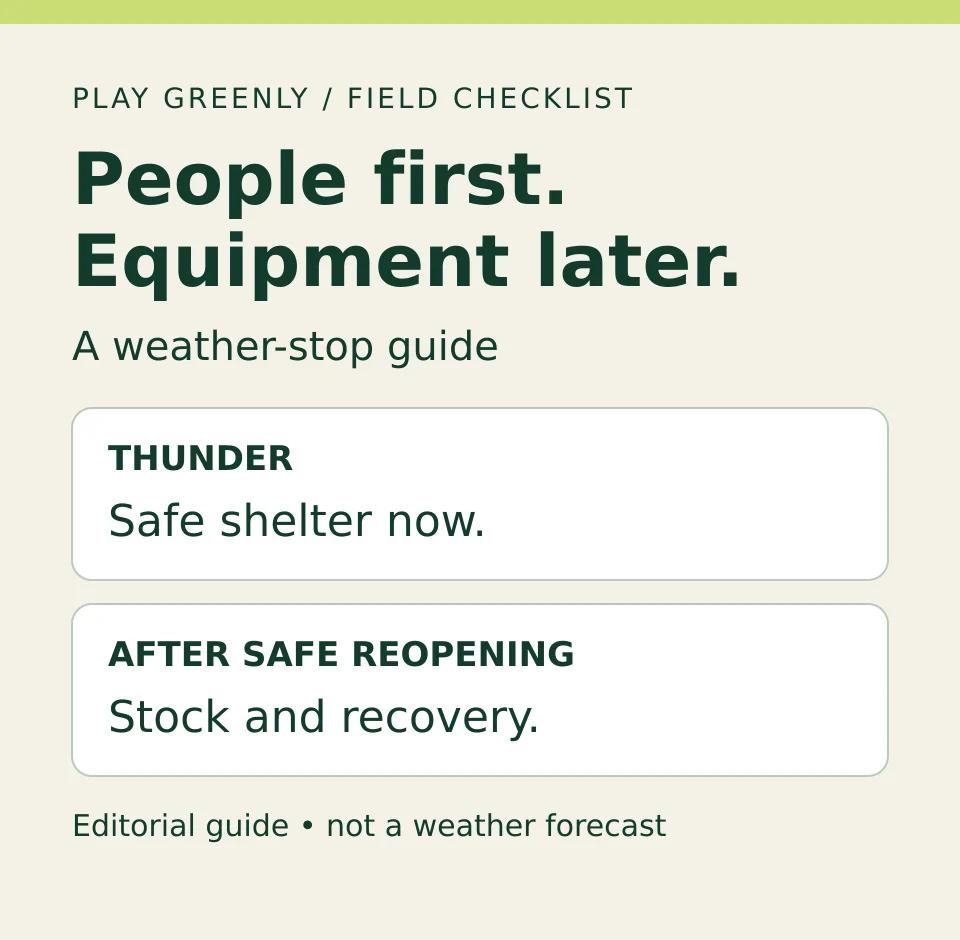
When thunder interrupts a water-soluble golf station, stop play and go immediately to safe shelter. Leave tote handling, counting and retrieval until outdoor work can safely resume. For a rain-only pause, follow the venue’s weather plan and protect unused inventory only when safe. Rain does not establish a dissolution time or give permission to dump leftovers.
Make two plans before opening
A rain-delay protocol separates immediate protection of people from later handling of equipment. The station lead should know who monitors weather, who stops activity, where everyone goes, and who authorizes reopening. The National Weather Service’s outdoor-sports guidance recommends a lightning safety plan that answers these questions and is followed without exception.
Put the shelter location and route in the guest briefing before the first swing. Choose a substantial building with wiring and plumbing; if none is available, NWS identifies a hard-topped metal vehicle with its windows closed as protection. Small rain shelters, sheds and dugouts are not safe lightning shelters. A covered golf station is not a substitute.
Separately, assign someone to manage dry stock, damaged stock and later recovery. These are tasks for safe conditions. No inventory target is a reason to remain outside in a thunderstorm.
For the wider event plan, use the golf tournament planning checklist. Confirm the proposed water activity and applicable rules through the venue before opening; the lake-permission guide explains why the location matters. A venue’s permission does not override other applicable restrictions.
Thunder: shelter comes before the tote
The NWS lightning-safety overview states that there is no safe place outside when thunderstorms are in the area. Hearing thunder means you are likely within striking distance. Do not wait for rain to reach the station.
- Stop play and move everyone immediately to safe shelter under the venue’s plan.
- Leave balls, totes and retrieval equipment. Do not ask guests to return unused balls before leaving or send a marshal back to close a lid.
- Keep the station closed. A pause in rain is not an all-clear.
- NWS says to wait at least 30 minutes after the last thunder before resuming outdoor activities. New thunder restarts that interval. Follow the venue’s reopening decision and any stricter requirements too; the interval alone does not establish that other hazards have cleared.
The same people-first rule applies when the venue stops activity for approaching storms or another hazard. Do not use the absence of audible thunder as proof that conditions are safe.
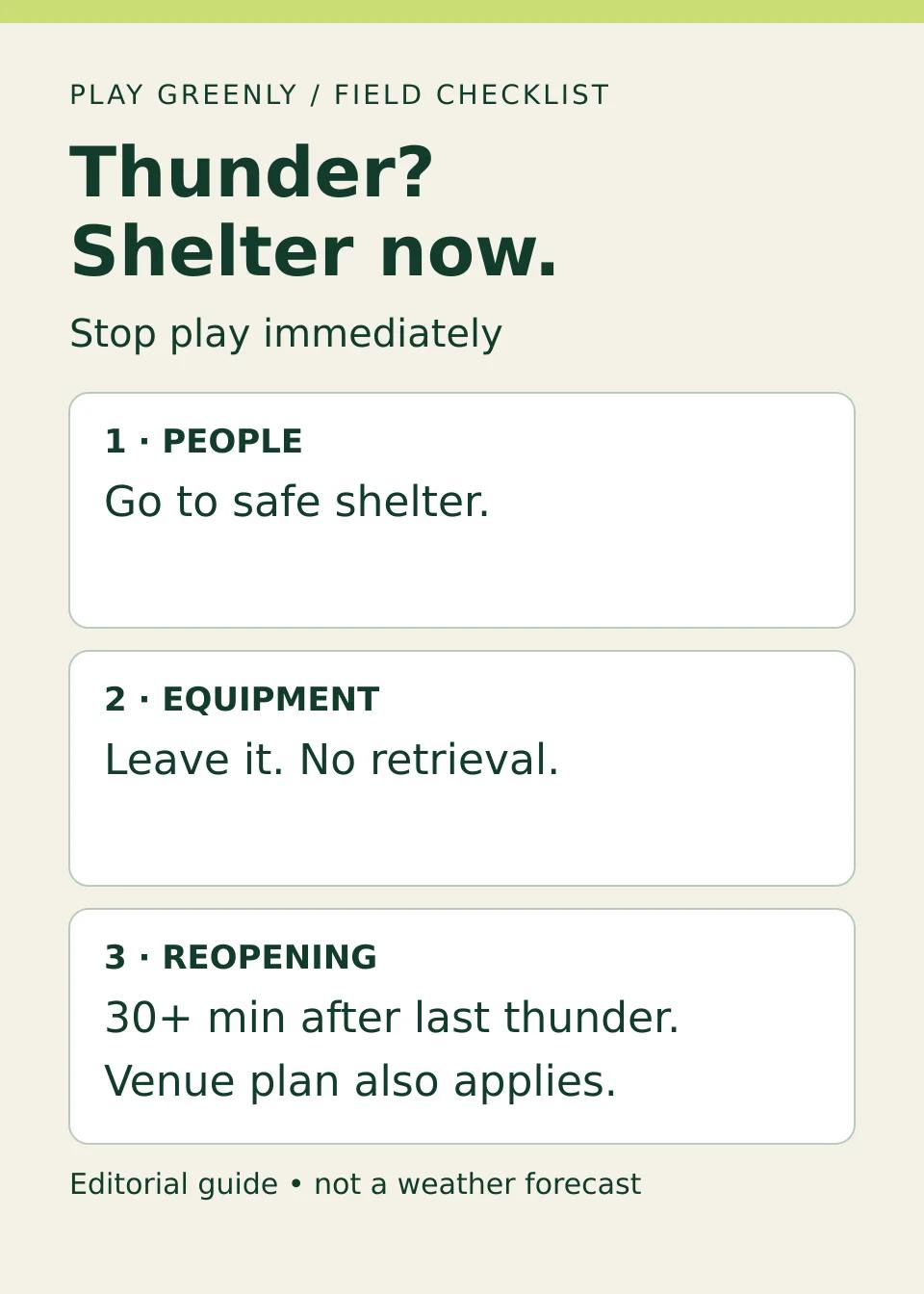
Original editorial decision card. NWS guidance summarized above; not a weather forecast or a photograph of an event.
Rain-only pause: protect stock when safe
If the venue pauses for rain without a lightning threat or another immediate hazard, stop issuing balls. Close the dry-stock tote and move it away from standing water only when doing so is safe. Do not keep guests at the station to finish a round, and do not treat ordinary rain cover as lightning shelter if conditions change.
Keep unused dry stock separate from rain-wet or damaged stock. Do not promise that a wet ball will recover its original playing condition after drying: this checklist has no validated recovery procedure. Ask for product-handling guidance before reissue, and use the old-golf-ball disposal and reuse guide to plan appropriate handling of unusable stock. Do not empty leftovers into the water.
Resume only when the venue permits activity, the station and landing area are safe, and suitable stock is available. Cancel if those conditions cannot be met. A rain-only pause does not automatically require the lightning interval; if thunder occurs, switch immediately to the lightning procedure.
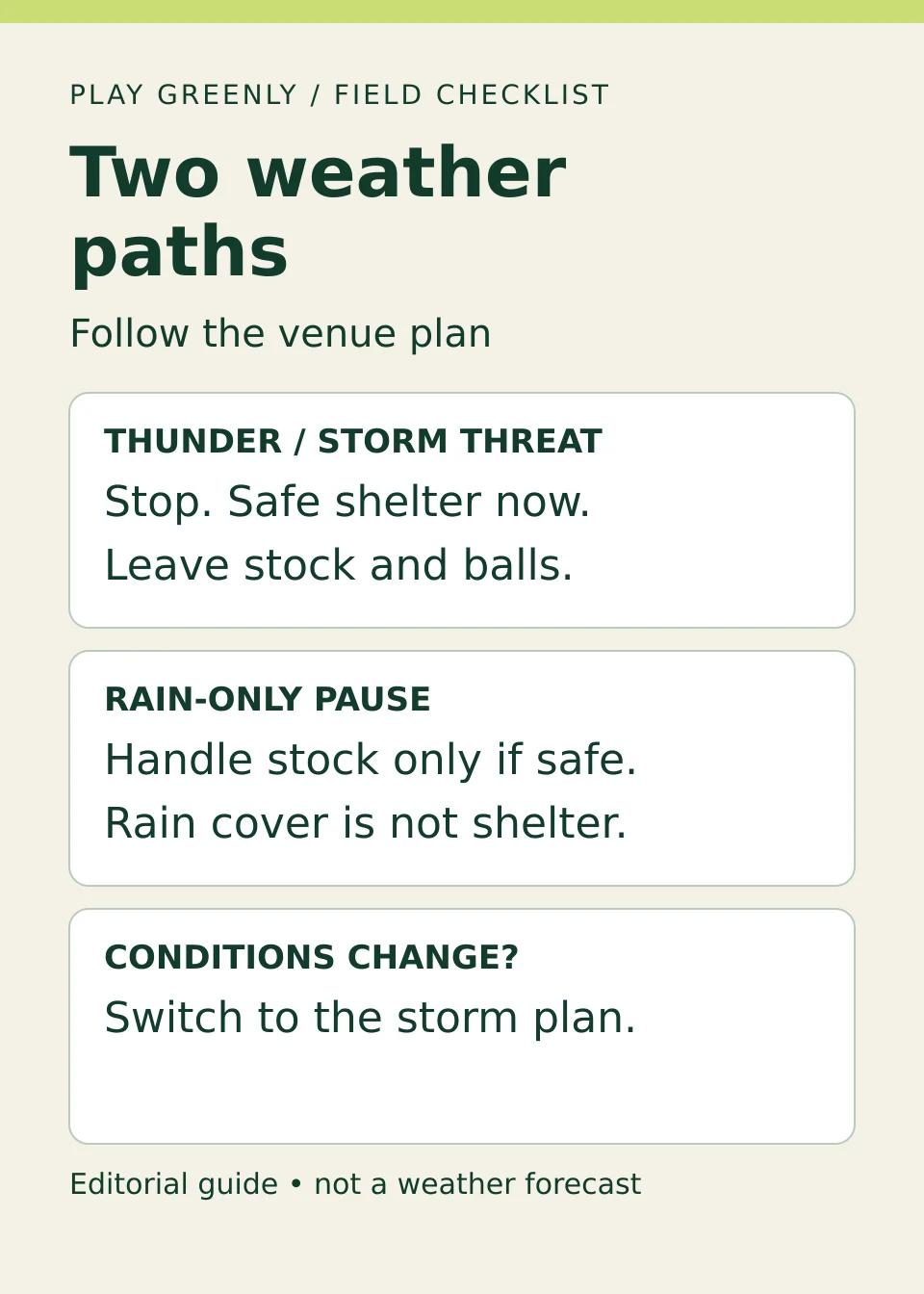
Original editorial comparison. Both paths remain subject to the venue’s weather plan.
Copy a stop-and-restart handoff log
Prepare the blank log before the event. During a lightning stop, go to safe shelter first; write the record only once sheltered. The log preserves the decision when staff change. It does not monitor weather, predict safety or replace the venue’s plan.
- Station and date: [station label; event date; local time zone].
- Closure: [time; reason reported; role that called the stop].
- Shelter: [location and route already agreed in the venue plan; any assistance needed].
- Latest thunder: [last observed time; observer role]. Update this field if thunder recurs. If the time is unknown or observations are incomplete, keep the station closed and follow the venue’s procedure; do not invent a start time.
- Venue decision: [decision-maker role; hold, cancel or authorize; time and conditions]. Keep the decision separate from the lightning interval.
- Station readiness: [after safe access is authorized, check the activity area, suitable stock and unresolved recovery]. Wet or damaged stock stays held for handling review; a reopening decision does not restore its condition.
- Handoff: [outgoing role; incoming role; current closed/open state; unresolved action]. Confirm the receiving person understands the current state before handing over.
Keep personal contact details and participant information out of any public copy. For a real event, the venue decides what its private operating record needs. Blank roles here are prompts to adapt, not staffed positions or a completed safety check.
Timing example: a new thunder report changes the record
Fictional local times: play stops at 2:05 p.m.; thunder is heard again at 2:18 p.m. The NWS minimum interval then runs to at least 2:48 p.m., provided no further thunder occurs. The 2:05 closure time is not the clock to use. This arithmetic illustrates the NWS outdoor-sports guidance; it is not an automatic reopening time.
At a 2:30 p.m. staff handoff, the incoming lead receives “closed; last thunder 2:18; venue decision pending.” If the venue continues the hold at 2:48, the station stays closed. After the venue authorizes safe access, staff can reassess the station and stock before play resumes. A fresh thunder report means immediate safe shelter and a new interval under the venue plan.
After reopening: recover and reconcile
Once outdoor work is authorized and safe, recover reachable balls without entering water, using unsafe footing or creating a new risk. Defer unsafe recovery and record what remains unresolved. NOAA’s On the Water guidance says small marine debris should be recovered carefully and safely and that trash should be secured. That is general marine-debris guidance, not a golf-ball permit or a legal classification of a practice shot.
Use a simple stock record. In this illustrative example, a station starts with 100 balls, issues 24 and has 76 unused when activity stops. After safe access resumes, the unused stock is split into 70 dry and 6 wet or damaged balls. Eight of the 24 issued balls are recovered; 16 remain unrecovered. The figures are a planning example, not a Play Greenly test or event result.
Keep issued and unused categories separate: 100 = 24 issued + 70 dry unused + 6 wet unused. The 8 recovered balls are a subset of the 24 issued, not eight extra unused balls. “Unrecovered” does not mean “dissolved.” Record the follow-up task without claiming an environmental outcome.
EPA’s Green Meetings guidance includes minimizing prizes and giveaways and planning for waste minimization. Applying that planning principle here means accounting for leftovers, not using a weather interruption as an excuse to distribute excess stock. EPA does not certify this checklist or the outing.
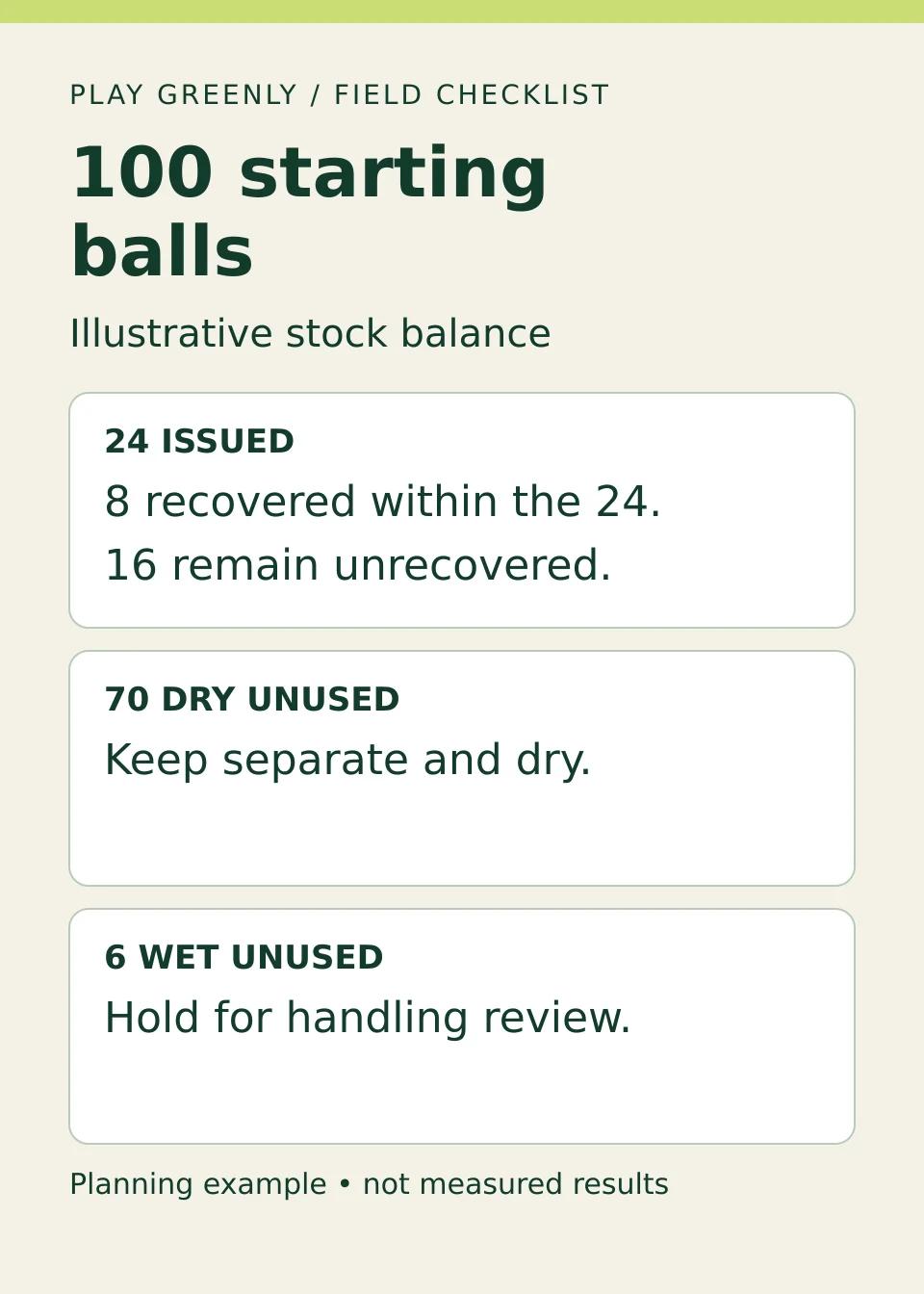
Illustrative stock balance; no measured event results. Eight recovered balls belong within the issued group.
What the product does—and what rain cannot prove
Play Greenly makes PVA-based, water-soluble practice golf balls built for the ocean and other bodies of water. See the product and evidence guide for the intended use and limitations. Ocean-safe describes the intended water use-case; it is not a marine-biodegradation certificate or permission to hit anywhere.
Rain on an open tote is not a controlled dissolution test. This article establishes no rain-softening time, field dissolution deadline, wildlife-feeding benefit or zero-impact result. These are practice balls, not tournament balls or fish food. The fish-food golf-ball guide addresses that misconception.
Keep recap language factual: “We stopped play for thunder, moved guests to shelter and completed the inventory check after safe reopening.” Add retrieval counts only when recorded. Avoid claims such as “the storm dissolved every ball” or “no impact” without evidence.
Questions hosts ask
Should someone seal the tote before leaving for shelter?
No. During a lightning stop, everyone moves immediately to safe shelter. Equipment can wait. Put that order in the briefing, radio call and printed card so nobody receives conflicting instructions.
Can a roof over the station make it safe to continue?
Ordinary rain cover is not safe lightning shelter. Use the substantial building or appropriate enclosed vehicle identified in the venue’s plan, consistent with NWS guidance.
Does an all-clear mean every ball must be retrieved?
No. It permits a reassessment of outdoor work; it does not make every recovery safe. Recover only safely reachable balls and record unresolved recovery separately. Never interpret a dissolution claim as evidence that a missing ball has disappeared.
Is this a complete emergency plan?
No. It is a product-station checklist to use within a venue’s weather and emergency procedures. NWS supplies the lightning guidance; the venue supplies its site-specific plan. The article is not legal advice, a weather forecast, an environmental certification or evidence of a finished-ball field test.