Old golf balls create a surprisingly practical question: keep them, donate them, throw them away, or switch to a different practice ball for risky settings?
The short answer is simple. Reuse ordinary golf balls on land when they are still playable. Donate or repurpose clean balls when a local program will accept them. Do not put golf balls in curbside recycling unless your local recycler specifically says they accept them. And do not treat water as a disposal plan.
Play Greenly is for a different decision: PVA-based, water-soluble practice golf balls built for the ocean and other bodies of water. That makes sense for approved water-adjacent practice settings, not for official play, wildlife feeding, or leaving ordinary balls behind.
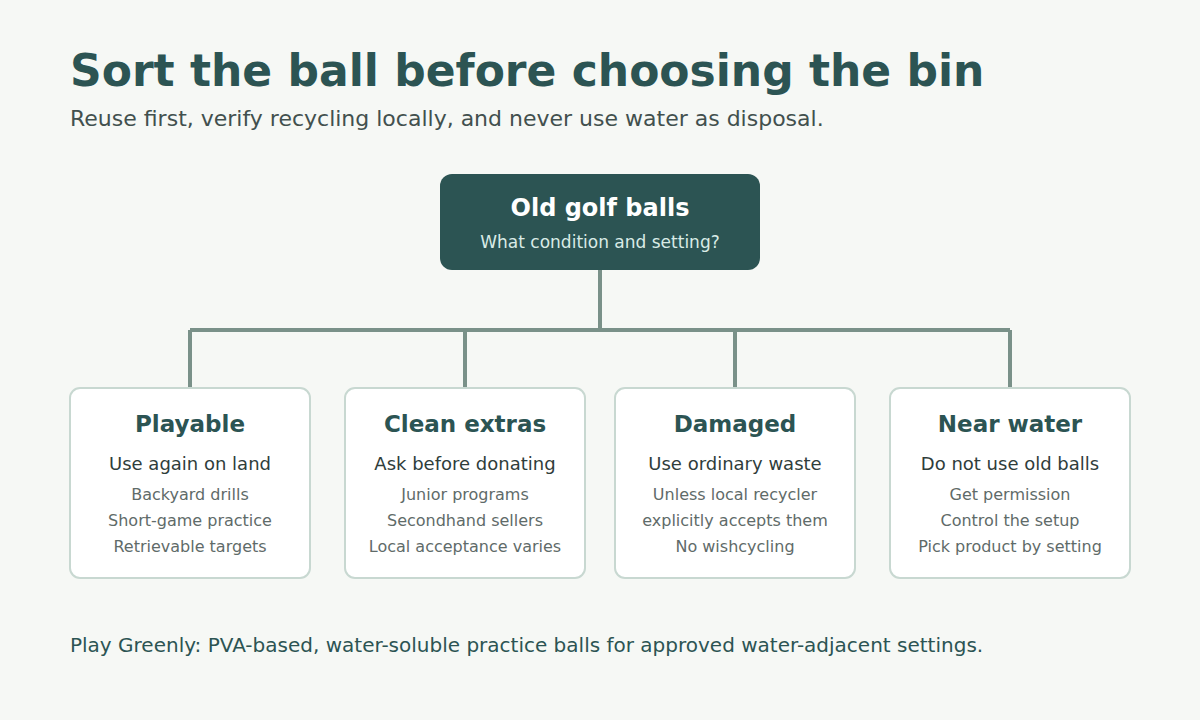
First, Sort the Ball by Use
Put each ball into one of four buckets:
- Playable on land. If the ball is clean and still useful for casual rounds, backyard drills, putting mats, short-game practice, or range-style practice where you can retrieve it, reuse it.
- Useful for practice only. Scuffed or mismatched balls can still work for chipping nets, backyard targets, or beginner drills where exact performance does not matter.
- Donation or resale candidate. Clean, usable balls may be accepted by local junior programs, thrift shops, practice facilities, or secondhand sellers. Check first, because acceptance rules vary.
- End-of-life trash. If the ball is cracked, waterlogged, badly damaged, or not accepted by a reuse program, dispose of it according to local waste rules.
What you should not do is wishcycle it. EPA recycling guidance warns that putting uncertain items in the recycling stream can contaminate recycling. A golf ball is a multi-material sports product, so curbside recycling should be treated as unverified unless your local program explicitly accepts it.
Do Not Use Water as Disposal
Hitting ordinary golf balls into water is not a cleanup plan. It is a loss plan.
A coastal golf-ball debris study from Monterey Bay area waters reported 50,681 retrieved balls, totaling about 2.5 tons of debris. That does not prove every pond, lake, or ocean site behaves the same way. It does show why "it is only one ball" is the wrong habit around water.
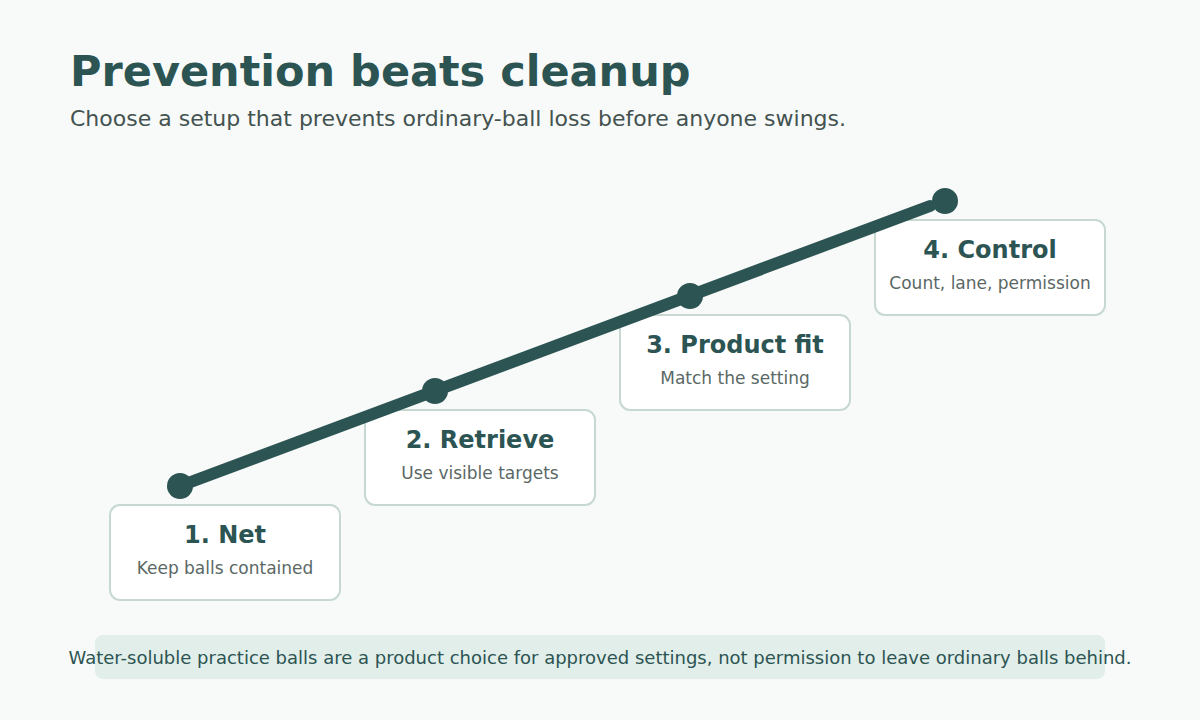
NOAA's marine-debris prevention guidance is the better planning lens: prevent debris before it needs cleanup. For golfers, that means using a net, target mat, practice area, floating retrievable setup, or water-soluble practice product only where the setting is approved and controlled.
Where Water-Soluble Practice Balls Fit
Play Greenly balls are not a disposal method for old golf balls. They are a different practice product for water-adjacent use.
Approved wording:
Play Greenly makes PVA-based, water-soluble practice golf balls built for the ocean and other bodies of water.
Useful boundary:
Use only in private or approved settings. Follow local rules. Not a tournament ball. Not fish food. Not a permit.
The controlled lab result can be mentioned only with the conditions next to it: supplier lab testing reported about 90% dissolution by day 7 and complete dissolution by day 10 in a slow-moving fresh-water simulation using 10-20 C water, 300 rpm stirring, and 1.5 L water changed daily. Field timing varies with temperature, water movement, salinity, storage, and ball condition.
That distinction matters. If you already own ordinary golf balls, reuse or dispose of those responsibly. If you are planning an activity near a dock, beach, pond, marina, lake house, or waterfront venue, choose the product and setup before anyone starts swinging.
A Simple Decision Tree
If the ball is playable and you can retrieve it, use it again on land.
If the ball is playable but you do not need it, ask a local program or secondhand channel whether they accept clean used golf balls.
If the ball is damaged, dispose of it through ordinary waste unless your local recycling or specialty recovery program says otherwise.
If the setting is near water, do not use old ordinary balls as targets. Use a net, a retrievable setup, or a product designed for the setting, with permission.
If the activity is public, shared, commercial, or event-based, get the venue or property approval in writing and keep sign copy qualified.
What Not to Claim
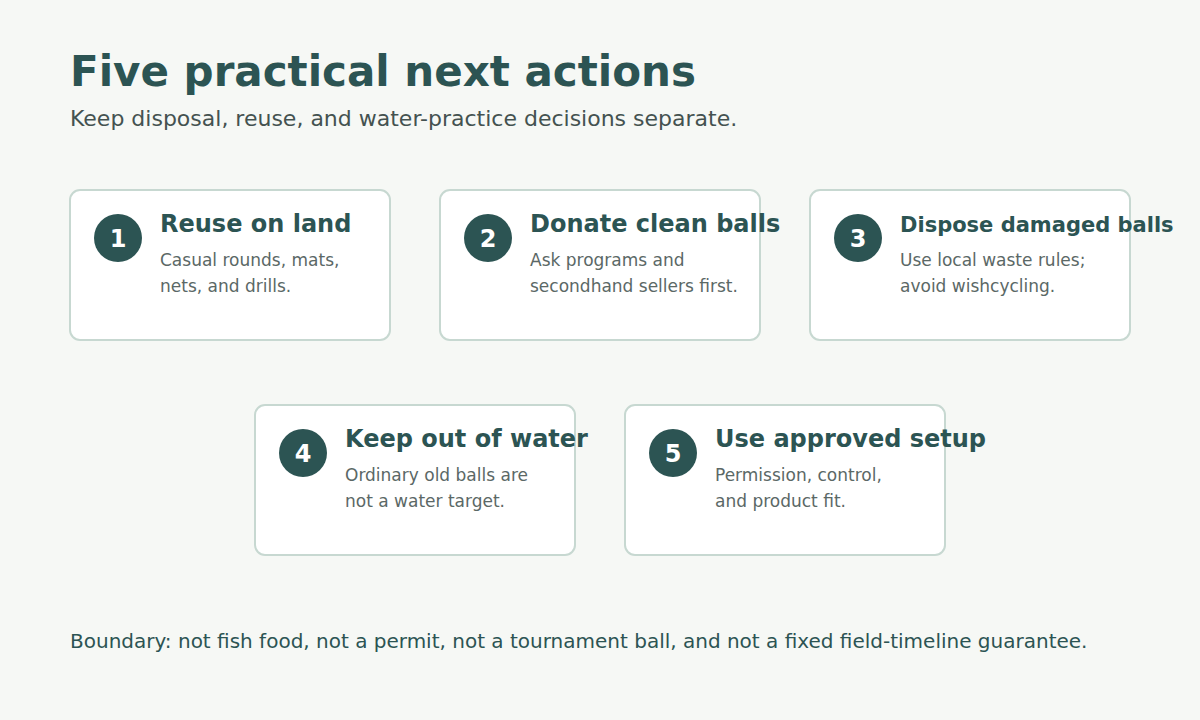
Do not claim:
- Ordinary golf balls are curbside recyclable everywhere.
- A ball is compostable unless the finished ball has the right finished-product evidence.
- A water-soluble ball is fish food or edible.
- A water-soluble ball is legal to use anywhere.
- Any golf ball has zero impact.
- Dissolution timing in a lab is a guaranteed field timeline.
- Practice balls are official tournament balls.
Those are separate claims. They need separate proof, local permission, or official equipment status.
Suggested Sign Copy for Events
Approved water-practice activity only.
Use the marked hitting area and host instructions.
These are water-soluble practice golf balls, not tournament balls and not fish food.
Frequently asked questions
Can golf balls go in the recycling bin?
Do not put golf balls in curbside recycling unless your local recycler specifically accepts them. When acceptance is uncertain, follow local waste guidance instead of contaminating recycling.
What should I do with old golf balls that are still usable?
Reuse them for land-based practice, give them to a golfer who wants practice balls, or ask local junior programs, thrift shops, ranges, or secondhand sellers whether they accept clean used balls.
Is it okay to hit old golf balls into a lake or ocean?
No. Do not use water as a disposal method. Ordinary golf balls that are not recovered can become debris.
Are Play Greenly balls for getting rid of old golf balls?
No. Play Greenly balls are a separate PVA-based, water-soluble practice product for approved water-adjacent settings. They are not a way to dispose of ordinary balls.
Are water-soluble golf balls fish food?
No. Water-soluble does not mean edible. Do not feed wildlife and do not describe Play Greenly balls as fish food.
Internal Links
- Biodegradable golf balls hub: https://www.playgreenly.com/biodegradable-golf-balls
- Are Golf Balls Bad for Lakes?: https://www.playgreenly.com/blog/Are-golf-balls-bad-for-lakes
- Do Fish Eat Golf Balls?: https://www.playgreenly.com/blog/fish-food-golf-balls
- Are There Golf Balls That Dissolve in Water?: https://www.playgreenly.com/blog/are-there-golf-balls-that-dissolve-in-water
- How to Test Water-Soluble Golf Balls Before an Event: https://www.playgreenly.com/blog/test-water-soluble-golf-balls-before-event
- Dissolvable Golf Balls for Docks & Marinas: https://www.playgreenly.com/blog/dissolvable-golf-balls-docks-marinas
External Sources
- Play Greenly Official Claims Map, version 2026-08-18.
- EPA, National Recycling Strategy FAQ: https://www.epa.gov/circulareconomy/frequent-questions-about-national-recycling-strategy
- NOAA Marine Debris Program prevention page: https://marinedebris.noaa.gov/our-work/prevention
- Weber et al., Marine Pollution Bulletin, coastal golf-ball debris retrieval abstract: https://pubmed.ncbi.nlm.nih.gov/30803622/
- eCFR, 16 CFR Part 260.4, General environmental benefit claims: https://www.ecfr.gov/current/title-16/chapter-I/subchapter-B/part-260/section-260.4
- eCFR, 16 CFR Part 260.8, Degradable claims: https://www.ecfr.gov/current/title-16/chapter-I/subchapter-B/part-260/section-260.8
- USGA Conforming Club and Ball Lists: https://www.usga.org/content/usga/home-page/equipment-standards/conforming-club-ball-lists.html
Claim Ledger Summary
Material claims covered: 7/7. Contradictions found: 0. Sensitive-information findings: 0. Useful body visuals: 3. Relevant internal links: 6. Primary/authoritative external sources: 5. Editorial QA score: 95/100.
QA Scorecard
Truth/evidence: 30/30. All material product, disposal, recycling, marine-debris, and environmental-marketing claims are tied to the Claims Map, EPA recycling guidance, NOAA prevention framing, PubMed coastal debris evidence, eCFR Green Guides sections, or USGA equipment-list context. Audience value: 19/20. The piece answers observed disposal and decomposition interest while moving readers toward safer reuse and water-practice choices. Platform craft: 19/20. Clear FAQ structure, decision tree, three body visuals, and direct claim-control language; minor loss for needing CMS formatting. Funnel/message: 14/15. Strong internal-link cluster and product-fit bridge; no live Attribution URL inserted because publishing is gated. Measurement: 9/10. GSC/GA4-backed hypothesis and stop/scale rule included; no post-publication baseline yet. Rights/accessibility: 4/5. Original SVG visuals with alt text specs; final CMS alt text must be checked after upload.
Total: 95/100. Approval-ready, not published.