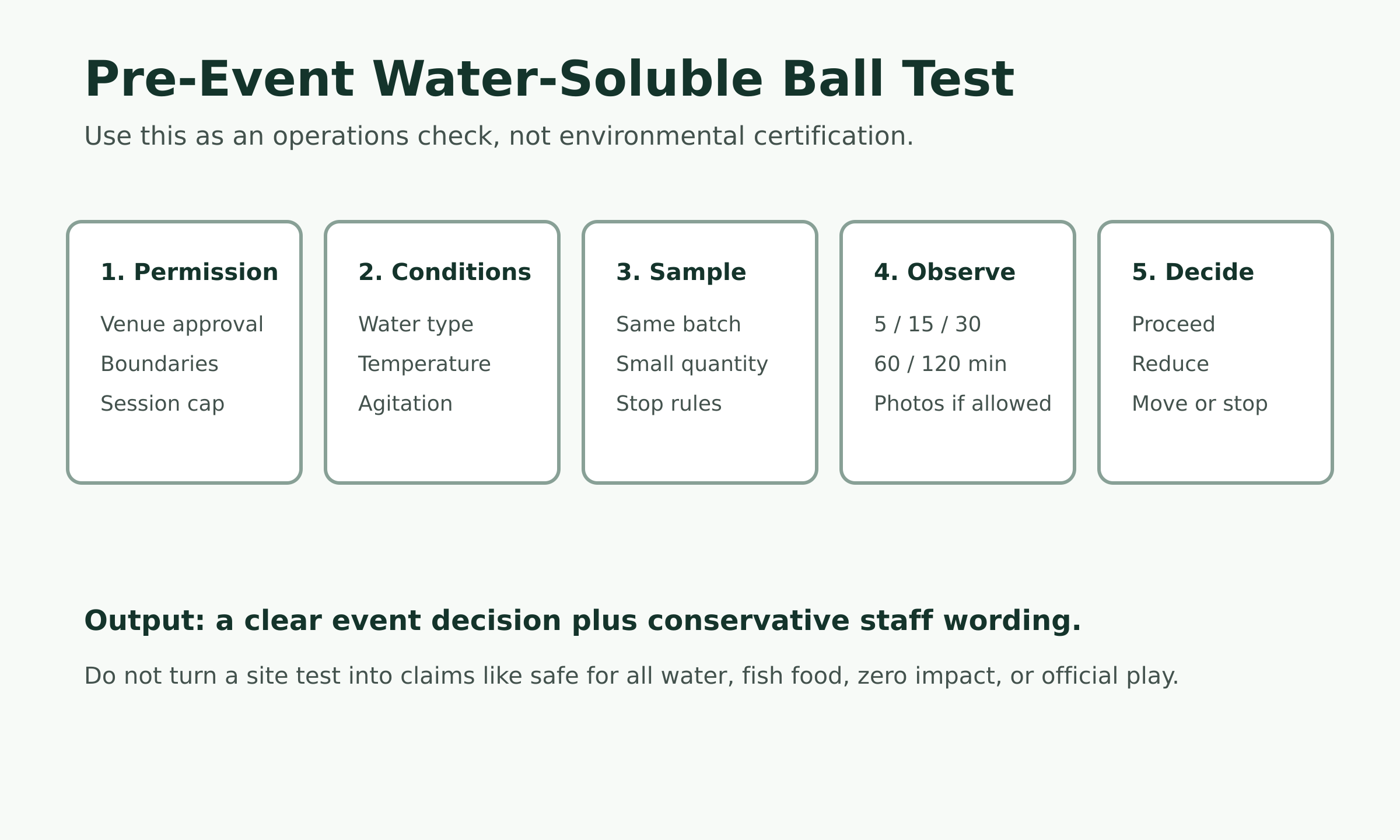
If you are planning a dock activation, marina demo, resort event, golf tournament side game, or backyard party, do not wait until guests arrive to learn how a water-soluble practice ball behaves.
A simple pre-event test will not prove that a product is safe for every water body or permitted at every venue. It can, however, help you set expectations, write better staff instructions, avoid overclaiming, and decide whether the format fits the site.
Quick answer
Test water-soluble golf balls in a small, documented pre-event trial using the same product batch, water type, temperature range, container or controlled site, hit count, retrieval plan, and observation window you expect for the event. Record what you can see, what you cannot prove, and which claims you will avoid. Treat the result as an event-planning check, not as environmental certification.
The 30-minute planning version
Before you order quantities or invite guests, confirm the venue rule, match the likely event conditions, test a small sample, watch the guest experience, and write down claim limits for staff.
- Confirm the venue rule: record written permission, water-body boundaries, retrieval expectations, and wildlife restrictions.
- Match event conditions: record water type, temperature, agitation, depth, shade or sun, and planned session size.
- Test a small sample: record quantity, batch or order date, placement or hit time, and observation times.
- Watch the guest experience: note flight feel, visibility, waiting time, cleanup, and signage needs.
- Write claim limits: specify what staff may say, what they must not say, and which questions need escalation.
Step 1: Start with permission, not product claims
Before any product test, ask the site owner or event operator what is allowed. A golf course pond, marina basin, hotel lagoon, private dock, and backyard pool are different settings with different rules and sensitivities.
USGA course-care guidance treats ponds and water features as managed systems where water quality, nutrients, runoff, and wildlife habitat matter. That is a useful reminder for event planners: a lower-persistence practice product is not a reason to ignore the person responsible for the water body. Read the USGA guidance on golf-course ponds.
For a public-facing Play Greenly event, the minimum permission note should say:
- who approved the test or activation;
- where hitting is allowed and where it is not;
- the maximum number of balls for the session;
- whether any retrieval or post-event inspection is required;
- what staff should do if wildlife enters the area or conditions change.
Step 2: Define the test question
Do not run a vague test called “is it eco-friendly?” That question is too broad and usually impossible to answer with a simple event check.
Use practical questions instead:
- Does the ball behave predictably enough for this activation format?
- Does it remain visible long enough for staff to monitor the session?
- Do water temperature and agitation change the observation window?
- Does the venue accept the planned quantity and cleanup plan?
- Can staff explain the product without making unsupported environmental claims?
This keeps the test tied to decisions you can actually make.
Step 3: Match the real event conditions
Manufacturer information about polyvinyl alcohol, also called PVOH or PVA, shows why conditions matter. PVOH products are water soluble, but behavior can vary by grade, degree of hydrolysis, molecular weight, and water temperature. Finished products can also behave differently from raw material descriptions. See Kuraray’s explanation of PVOH polymerization and hydrolysis.
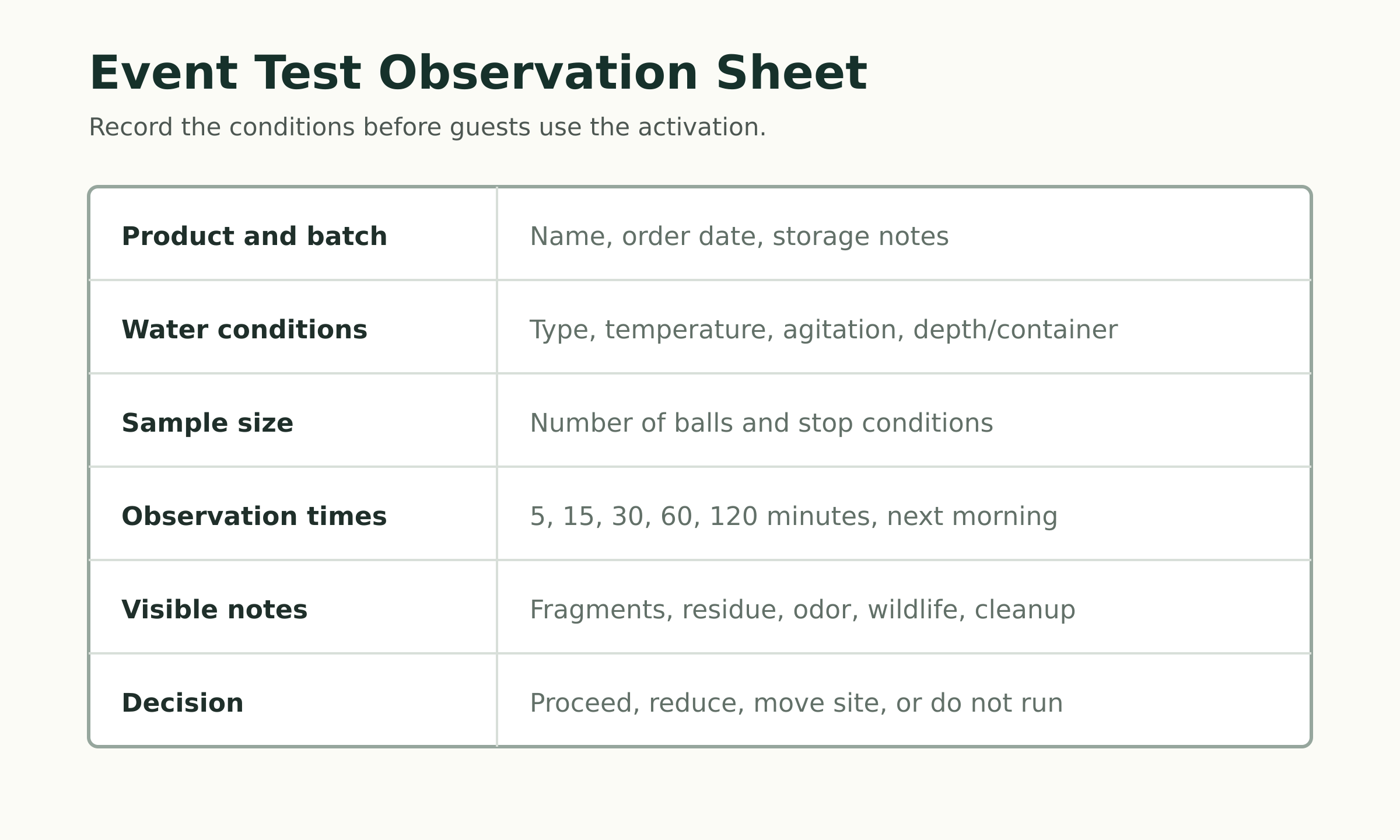
For an event test, record:
- product name and batch or order date;
- water type, such as freshwater, saltwater, pool water, or a tap-water control;
- water temperature at the start and each observation time;
- whether water is still, stirred, flowing, or wave-exposed;
- container size or controlled-site boundary;
- number of balls tested;
- observation times, such as 5, 15, 30, 60, and 120 minutes;
- visible fragments, residue, color, odor, or cleanup notes.
If the event is outdoors, also note wind, rain, sun exposure, and wildlife observations.
Step 4: Use a small sample before a full activation
A small sample test is not just cheaper. It is more defensible. The EPA quality-assurance handbook for participatory science emphasizes planning, documentation, procedures, and data quality before relying on observations. Event planners do not need a scientific study, but the same discipline helps: write the procedure first, then record what happened.
A practical test record includes the event lead, product and order date, controlled site, a sample of 3 to 12 balls, water conditions, observation schedule, stop conditions, and a final decision to proceed, reduce quantity, change site, or stop.
Keep photos if the venue allows it, but do not use photos as proof of environmental safety. They are event-planning documentation.
Step 5: Keep the staff script conservative
The FTC Green Guides warn marketers not to overstate environmental attributes. For a live event, that means the staff script matters as much as the product.
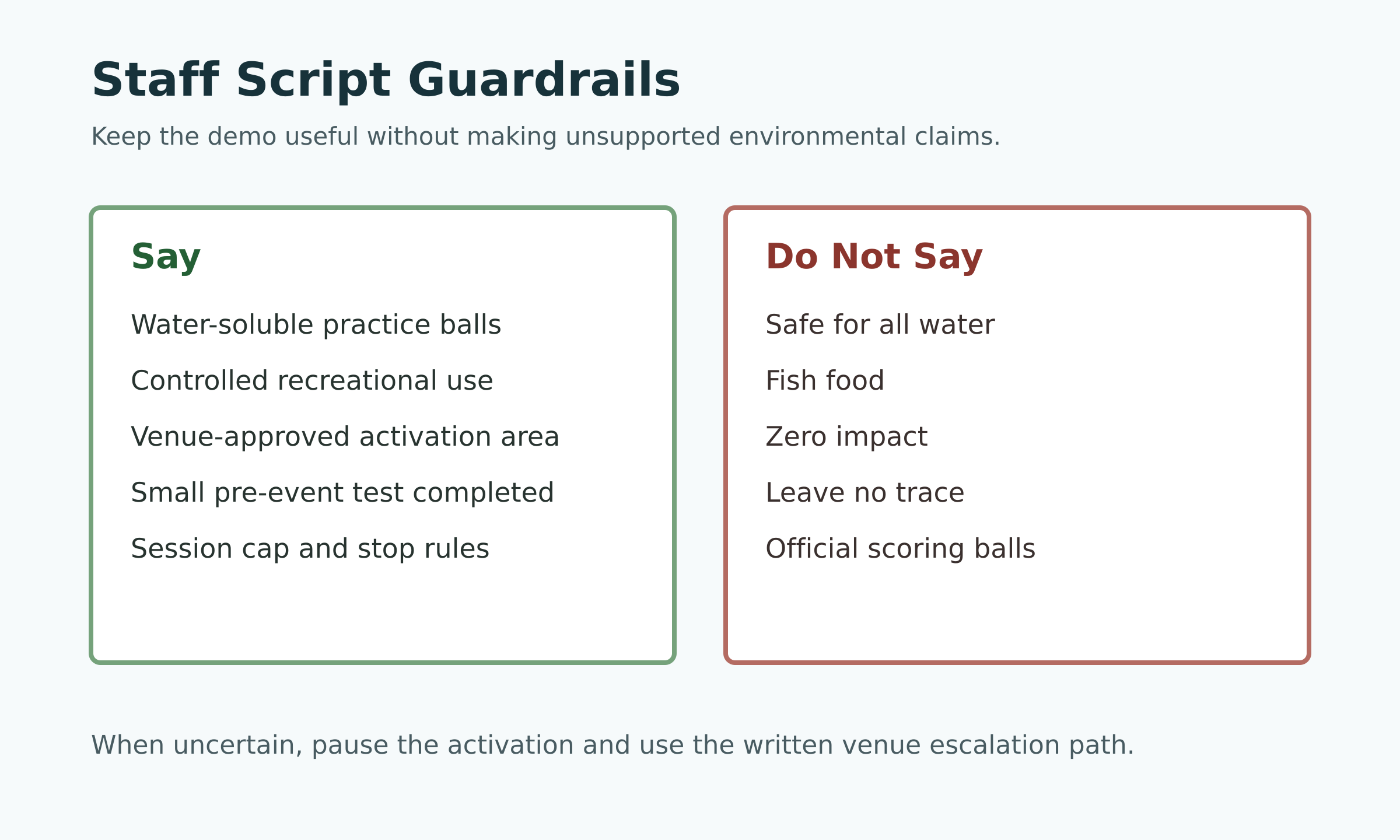
These are water-soluble practice balls for controlled recreational use. We tested this setup before the event, and the venue approved this activation area.
Avoid language like:
- “safe for all water”;
- “non-toxic”;
- “fish food”;
- “zero impact”;
- “leave no trace”;
- “official golf balls”;
- “biodegrades anywhere.”
Those claims need evidence beyond a site test.
Step 6: Decide what to do with the result
After the test, choose one of four outcomes:
- Proceed as planned. Use this only when permission, product behavior, staff instructions, and cleanup expectations all match the event.
- Reduce the session. Use a smaller hit count, shorter time window, or tighter staff supervision if the product works but the venue has limits.
- Change the site. Move from open water to a container demo, hitting net, backyard station, or land-based game if the water setting creates uncertainty.
- Do not run the activation. Choose this when permission is unclear, wildlife risk is active, staff cannot explain the limits, or the product behavior does not fit the venue.
Where Play Greenly fits
Play Greenly can support event planners with water-soluble practice balls, conservative product language, and a pre-event checklist. The strongest positioning is not “hit anywhere.” It is: plan the activation, get permission, test a small sample, cap the session, and keep the claims honest.
For related planning, use the lower-waste golf tournament checklist, the dock and marina setup guide, the biodegradable versus water-soluble explainer, and the fish-food golf-ball myth guide.
That approach helps venues offer a memorable experience without turning a marketing demo into an unsupported environmental claim.
Frequently asked questions
Can I test water-soluble golf balls in a bucket?
Yes. A bucket or clear container is a useful first check because it controls water volume, temperature, and observation times. It does not prove open-water safety or venue permission.
How many balls should I test before an event?
Use a small sample first, such as 3 to 12 balls, then scale only if the venue approves the activation and the observation results match your plan.
Does a water-soluble test prove the product is safe for fish?
No. A visual dissolution test is not an ecotoxicity study, a wildlife assessment, or a permit. Avoid fish-safety claims unless you have specific evidence reviewed for that claim.
What should event staff say about water-soluble practice balls?
Say they are practice balls intended for controlled recreational use and that the venue approved the activation area. Do not say they are fish food, zero-impact, safe for all water, or official scoring balls.
Should I test the same batch I plan to use?
Yes. Use the same product batch or order lot when possible, and record the order date and storage conditions so the event test reflects the actual materials guests will use.