Golfers often use "biodegradable," "dissolvable," "water-soluble," and "eco-friendly" as if they mean the same thing. They do not. Those words describe different material behaviors, different proof burdens, and different use cases.
The practical question is not which label sounds greener. The practical question is whether the product's evidence matches where you plan to use it.
Quick answer
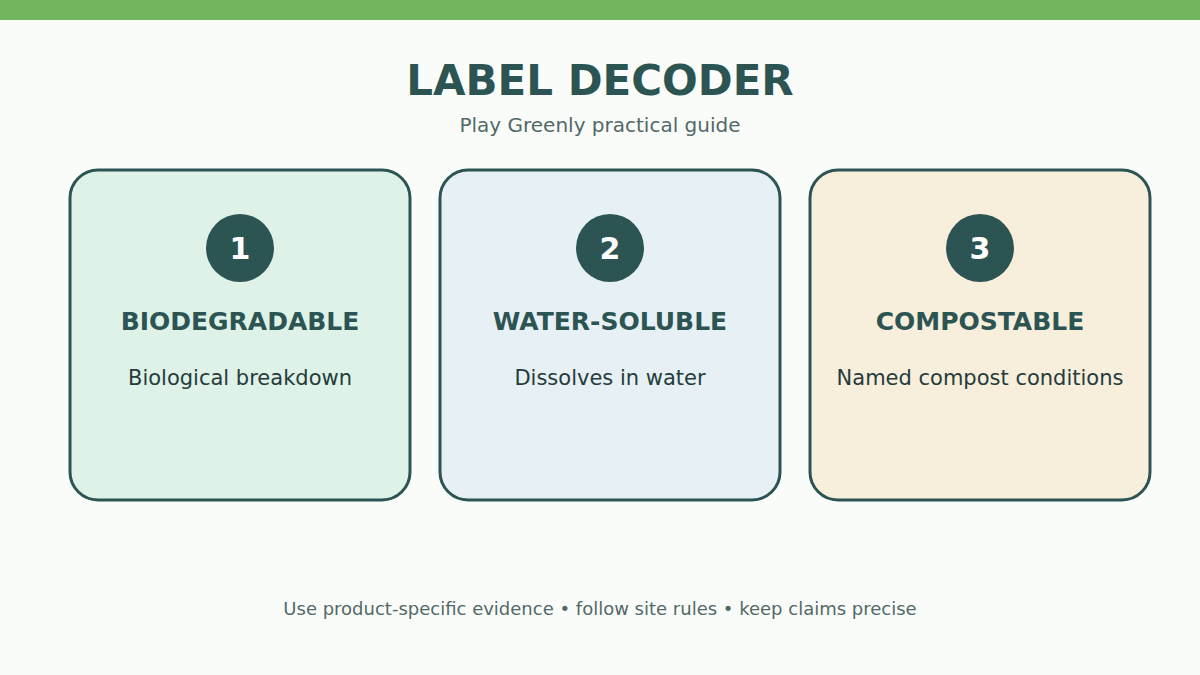
Biodegradable means a material can be broken down by biological processes under stated conditions. Water-soluble means a material is designed to dissolve in water. Compostable is narrower still: it usually points to a defined composting standard or facility condition. None of those labels automatically means "safe to hit anywhere," "edible for wildlife," or "approved for official play."
For Play Greenly, the safest language is specific and conditional: practice-oriented water-soluble golf balls, with dissolution behavior depending on product formulation and real-world conditions.
The comparison in one table
- Label: Biodegradable — What it can mean: Material can break down biologically under defined conditions. — What it does not prove by itself: Fast breakdown, open-water suitability, or complete-product proof in every setting. — Best reader action: Ask for the test method, test environment, complete-product scope, and timeframe.
- Label: Water-soluble / dissolvable — What it can mean: Material is designed to dissolve in water. — What it does not prove by itself: Food safety, ecological safety, or the same dissolve time in every water body. — Best reader action: Check formulation notes, water conditions, storage guidance, and use boundaries.
- Label: Compostable — What it can mean: Product is designed for composting under a named standard or facility condition. — What it does not prove by itself: Home-compost success, marine degradation, or permission to litter. — Best reader action: Match the claim to the disposal route and local facility acceptance.
- Label: Eco-friendly — What it can mean: Broad marketing shorthand. — What it does not prove by itself: A substantiated environmental outcome unless qualified. — Best reader action: Look for the specific benefit and the evidence behind it.
Why the words matter
The Federal Trade Commission's Green Guides warn that degradable and biodegradable claims can mislead when they imply more than the seller can substantiate. The important lesson for golf balls is simple: a broad environmental label needs competent evidence, and the claim should match the conditions where the product will actually be used.
That is why "biodegradable golf ball" is not enough information for a dock, lake, marina, backyard, or tournament buyer. A product might be biodegradable in an industrial composting context but not designed to dissolve during a water-practice session. Another product might be water-soluble in freshwater but still require permission, small-session planning, and conservative claim language.
Water-soluble is a material behavior, not a permission slip
Polyvinyl alcohol, often abbreviated PVOH or PVA, is a water-soluble polymer family. Manufacturer technical information from Kuraray and Sekisui shows that PVOH behavior varies by grade, degree of hydrolysis, molecular weight, and temperature. In plain language: formulation matters.
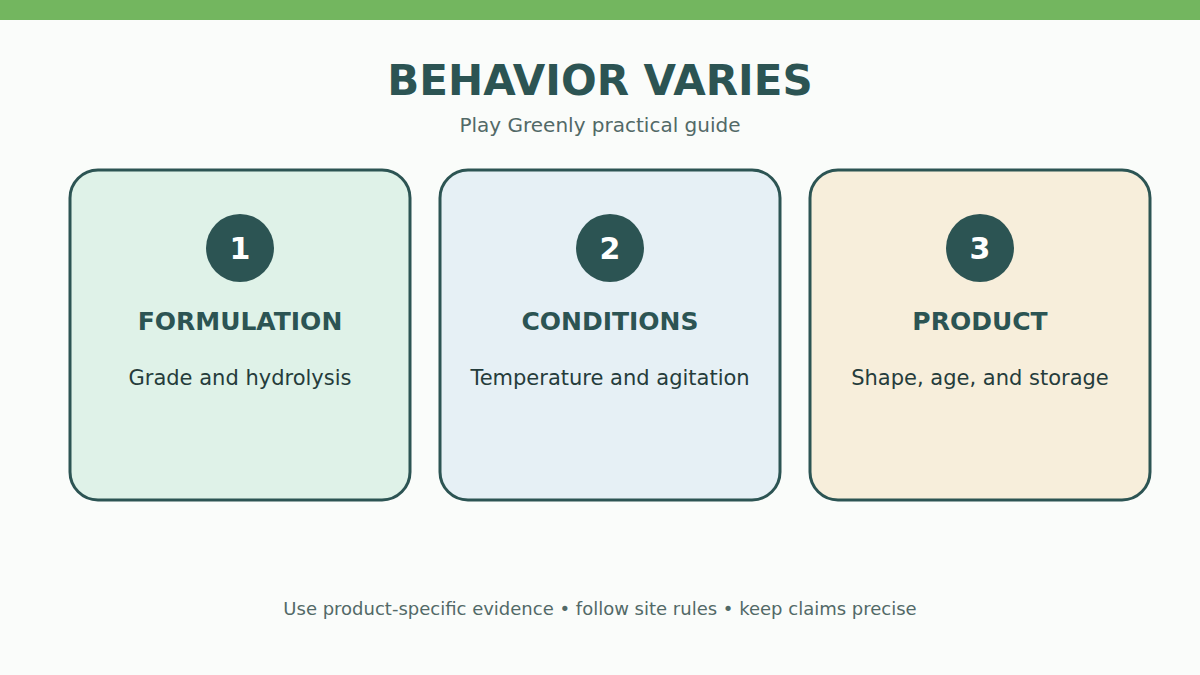
For golf content, that supports two editorial rules:
- Do not borrow a generic polymer property and turn it into a finished-product guarantee.
- Do not promise a universal dissolve timeline unless the product has current, product-specific testing under the same conditions being described.
Play Greenly can explain that its documented formulation is practice-oriented and water-soluble, but the page should keep field caveats visible. Cold water, still water, salinity, product age, storage, and impact condition can all affect what a user observes.
Compostable is not the same as water-ready
ASTM D6400 covers plastics and products designed to be composted in municipal and industrial aerobic composting facilities. That is a valuable disposal context, but it is not a dock-use or open-water standard.
If a product claims compostability, the next question is "compostable where?" If the answer is an industrial facility, that claim should not be stretched into "safe for lakes." If the answer is home composting, the seller should still identify the standard, timeframe, and conditions.
A buyer's evidence checklist
Before choosing an alternative golf ball for water-adjacent practice, ask:
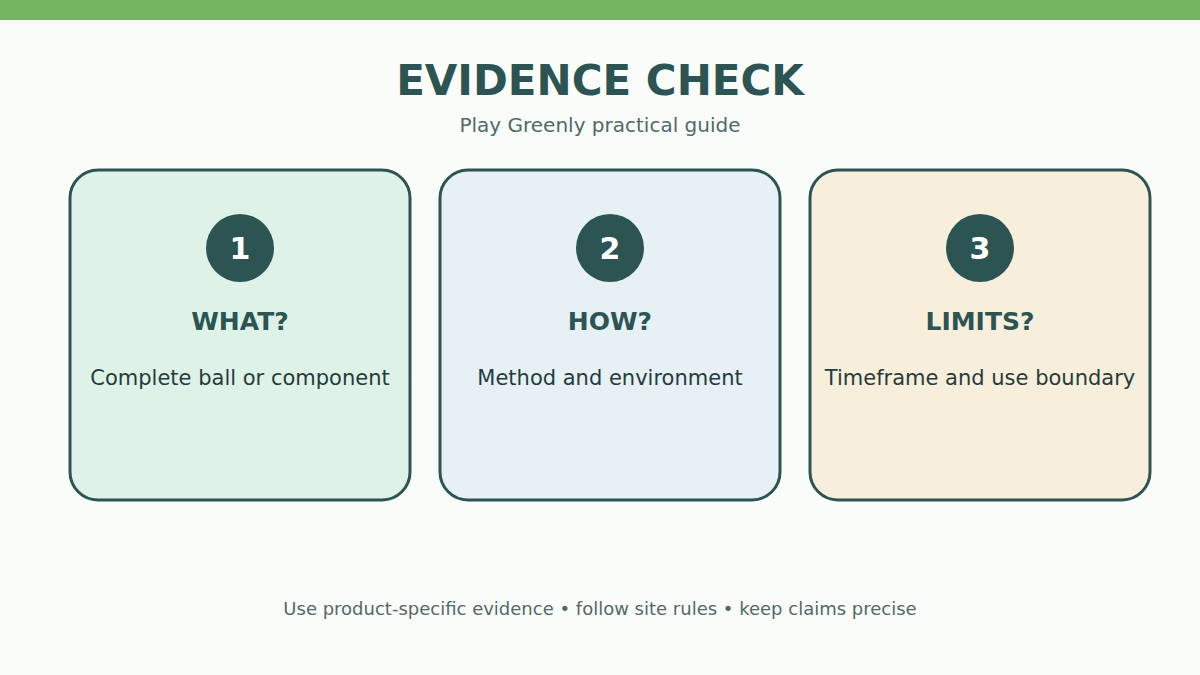
- Is the claim about the complete finished ball, the resin, the packaging, or one component?
- What test method or standard is named?
- What environment was tested: stirred freshwater, still freshwater, saltwater, soil, compost, or something else?
- What timeframe is supported, and is it a lab result or a field observation?
- Does the seller avoid unsupported phrases like "non-toxic," "ocean-safe," "zero impact," or "fish food"?
- Is the product clearly positioned for practice rather than official scoring play?
This checklist helps buyers compare evidence instead of slogans.
Where Play Greenly fits
Play Greenly golf balls are recreational practice balls for controlled sessions where the user wants a lower-persistence alternative to conventional balls. Use this evidence-led claim path:
- Use "water-soluble practice golf balls" as the primary descriptor.
- Explain that supplier-summary lab evidence reported rapid dissolution under specified stirred freshwater conditions.
- Keep local permission, wildlife, retrieval, and session-size guardrails in the article.
- Avoid unqualified "biodegradable," "non-toxic," "safe for all water," "leaves no residue," and "fish food" claims.
That language is less flashy, but it is more useful and easier to substantiate.
Related Play Greenly guides
- Play Greenly water-soluble practice golf balls
- Do fish eat golf balls?
- Dissolvable golf balls for docks and marinas
- Are golf balls bad for lakes?
- Fish food golf balls: myth and materials
Frequently asked questions
Are biodegradable golf balls the same as water-soluble golf balls?
No. Biodegradable describes biological breakdown under conditions that should be specified. Water-soluble describes dissolution in water. Some products may be both in a qualified way, but the evidence has to say so.
Is compostable proof that a golf ball is safe for lakes?
No. Compostability standards are tied to composting conditions, not open-water use. A compostable claim should not be treated as permission to hit balls into a lake.
What should I look for before buying dissolvable golf balls?
Look for complete-product evidence, the test environment, a realistic timeframe, storage instructions, and clear limits on where the product is intended to be used.
Can Play Greenly say "biodegradable"?
Only with qualification that matches the evidence. "Water-soluble practice golf balls" with source-backed conditions is safer than a broad unqualified biodegradable claim.
Are water-soluble golf balls official golf balls?
Do not assume that. Unless a product is separately represented as conforming equipment, treat water-soluble balls as practice products, not official scoring balls.