A resort, marina, camp, or waterfront venue can turn a short golf activation into a memorable guest activity. The operational risk is that the activity feels casual enough for staff to skip the basics: permission, boundaries, ball count, cleanup, claim discipline, and documentation.
This SOP-style checklist is for venues that are considering a controlled, supervised water-adjacent practice activity with water-soluble practice golf balls. It is not a permission slip for public waterways, restricted shorelines, sensitive habitat, boats, swimmers, or wildlife areas.
Quick answer
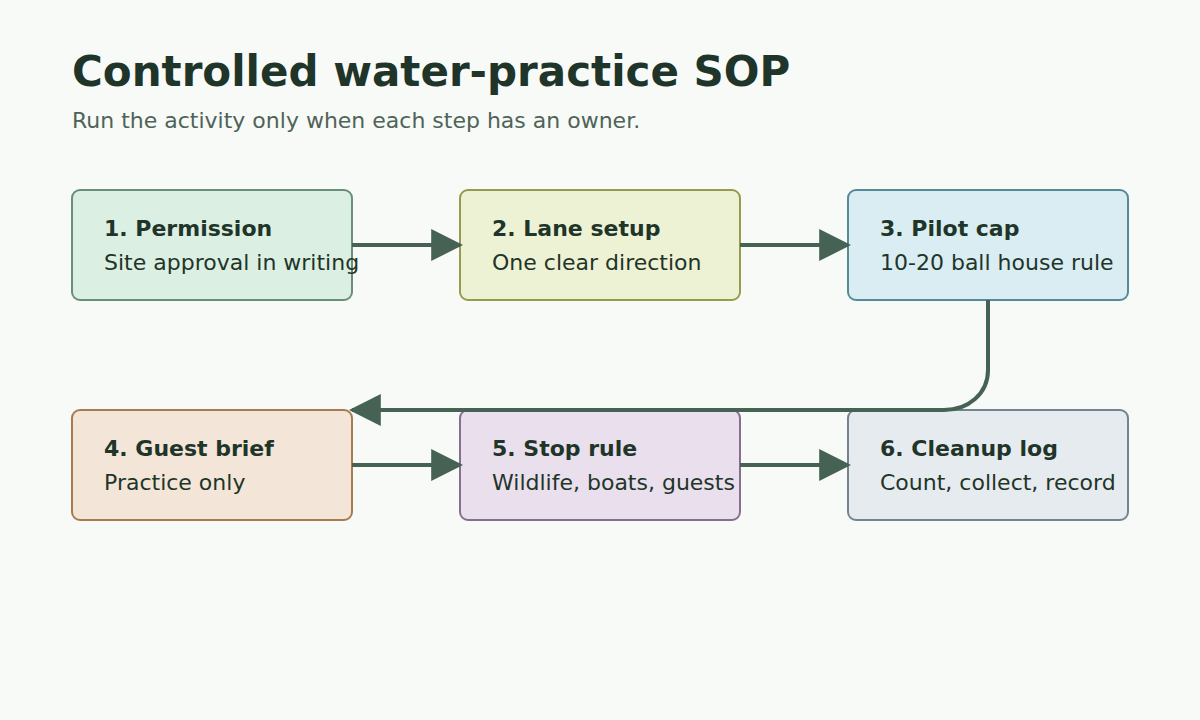
Before running a resort or marina golf activity, assign one staff owner, confirm site permission, mark a hitting lane, set a small ball count, brief participants on practice-only use, document water and weather conditions, and collect visible debris or packaging afterward.
For Play Greenly, the defensible product language is narrow: practice-oriented water-soluble golf balls for controlled sessions. Do not say "safe for all water," "fish food," "zero impact," "non-toxic," or "approved for official play" unless separate current evidence supports that exact claim.
The one-page SOP
Use this as the staff run sheet:
- Name the activity owner and backup.
- Confirm written permission from the property, course, marina, camp, or event operator.
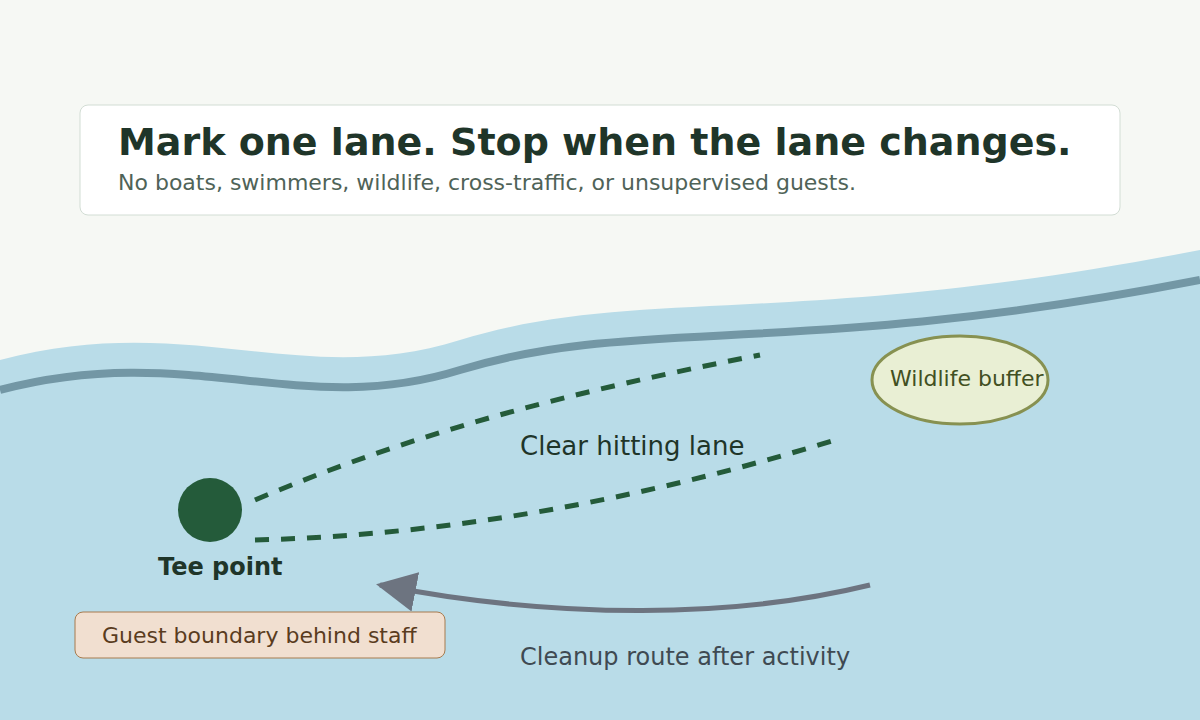
- Pick one hitting direction with no people, boats, swimmers, wildlife, shoreline plants, docks in active use, or protected areas inside the lane.
- Set a session cap before the activity starts. A 10-20 ball pilot is a conservative house rule, not a universal safety threshold.
- Keep conventional golf balls out of the activity area.
- Explain that the balls are practice products, not official scoring balls and not wildlife feed.
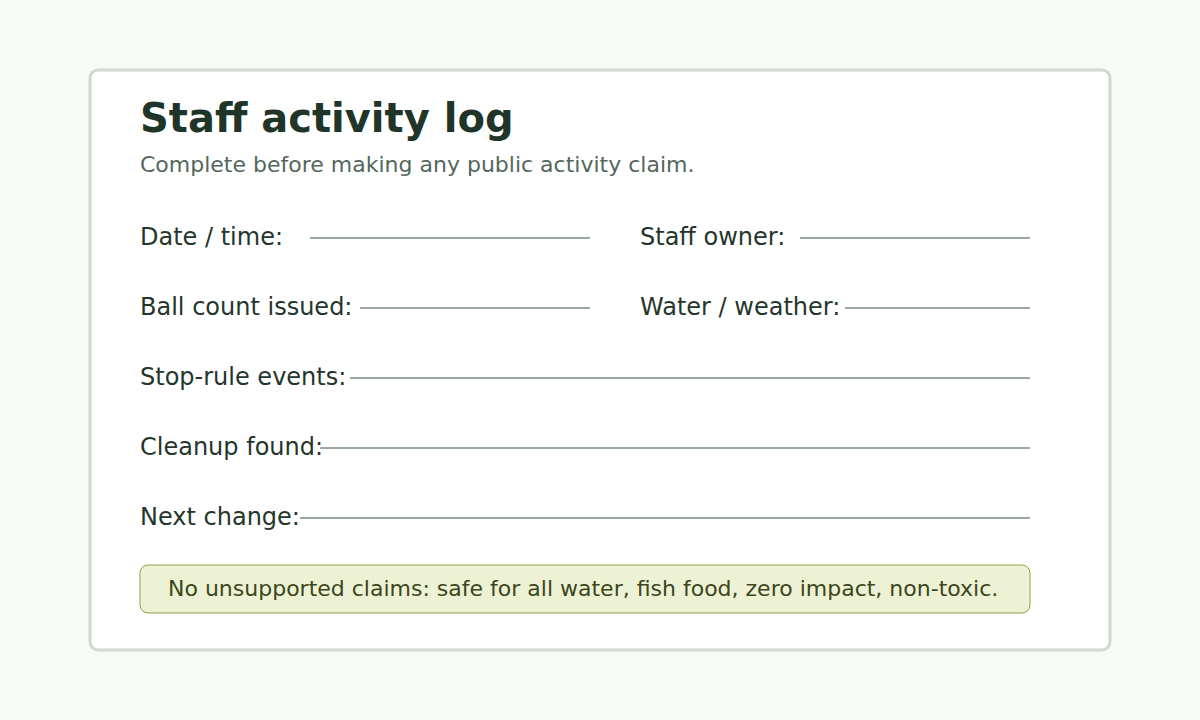
- Record date, time, weather, water movement, water temperature if available, approximate ball count, and cleanup observations.
- Stop immediately if wildlife enters the lane, guests move into the area, visibility drops, or staff cannot supervise.
- Collect packaging, tees, visible fragments, signage, and any stray conventional balls that can be retrieved safely.
- Save the staff log before writing any public environmental claim about the activity.
Why venue permission comes first
Water-adjacent activities are local. A product type does not override property rules, marina policies, boating traffic, protected habitat, or event insurance requirements. NOAA's Marine Debris Program frames prevention as a core strategy, and prevention starts with keeping materials, packaging, and activity debris from entering waterways unnecessarily.
That means the venue should approve the plan before the product is introduced. The strongest guest experience is a controlled demonstration, not open-ended hitting into any visible water.
How to choose the activity zone
Pick a small area that staff can see from one position. The best zone has:
- a fixed hitting mat or tee point;
- a clearly marked cone or rope boundary;
- one direction of play;
- no cross-traffic from carts, pedestrians, boats, kayaks, or swimmers;
- enough distance from wildlife, reeds, protected shoreline, and maintenance equipment;
- a safe cleanup path after the activity.
Golf-course water features also have maintenance needs. USGA guidance on course ponds notes that pond health and water quality require active management. Use that as a reminder: the water feature is managed infrastructure, not a blank backdrop.
How to brief guests
Keep the script short:
"This is a supervised practice activity using water-soluble practice balls. Please hit only from the marked spot, only when staff says the lane is clear, and only the ball handed to you. These are not wildlife food, not official scoring balls, and not a reason to hit into any water outside this activity."
That wording sets expectations without making unsupported environmental promises.
What to document
Borrow the discipline of a quality-assurance log without pretending a guest activity is a scientific study. EPA's participatory science QA resources emphasize planning, transparent methods, and documentation when people collect environmental observations. For a venue, the practical version is simpler:
- who supervised;
- where the activity occurred;
- how many balls were issued;
- what water and weather conditions were observed;
- whether wildlife, boats, or swimmers entered the area;
- what cleanup found;
- what staff would change next time.
This log protects the venue from vague memory and protects marketing copy from invented claims.
Where Play Greenly fits
Play Greenly can support controlled resort, marina, and event activities where the goal is lower-persistence practice compared with conventional balls that are hard to retrieve. The current claim boundary remains conditional: supplier-summary lab evidence reported rapid dissolution under specified stirred freshwater conditions, while field conditions can differ.
Use Play Greenly for practice activations, demos, and supervised guest experiences. Do not use the product description to bypass local permission, make wildlife-safety claims, promise a universal dissolve timeline, or run unsupervised contests near water.
Related Play Greenly guides
- Play Greenly water-soluble practice golf balls
- Dissolvable golf balls for docks and marinas
- How to test water-soluble golf balls before an event
- Fish food golf balls: myth and materials
- /blog/eco-friendly-golf-tournament
Frequently asked questions
Can a resort run this activity anywhere there is water?
No. The site operator still needs permission, supervision, a clear hitting lane, and a stop rule for wildlife, guests, boats, swimmers, and weather.
How many balls should a marina or resort use for a pilot?
Start with 10-20 balls as a conservative planning rule. That is an operating limit, not a scientific safety threshold.
Are water-soluble practice balls official golf balls?
Do not assume that. Treat them as practice products unless separate conforming-equipment evidence is provided.
Can staff call the balls fish food?
No. Water-soluble does not mean edible or suitable for wildlife. Staff should avoid fish-food language.
What should the venue save after the activity?
Save the staff log, ball count, cleanup notes, photos of the setup if approved by the venue, and any incident or stop-rule notes.