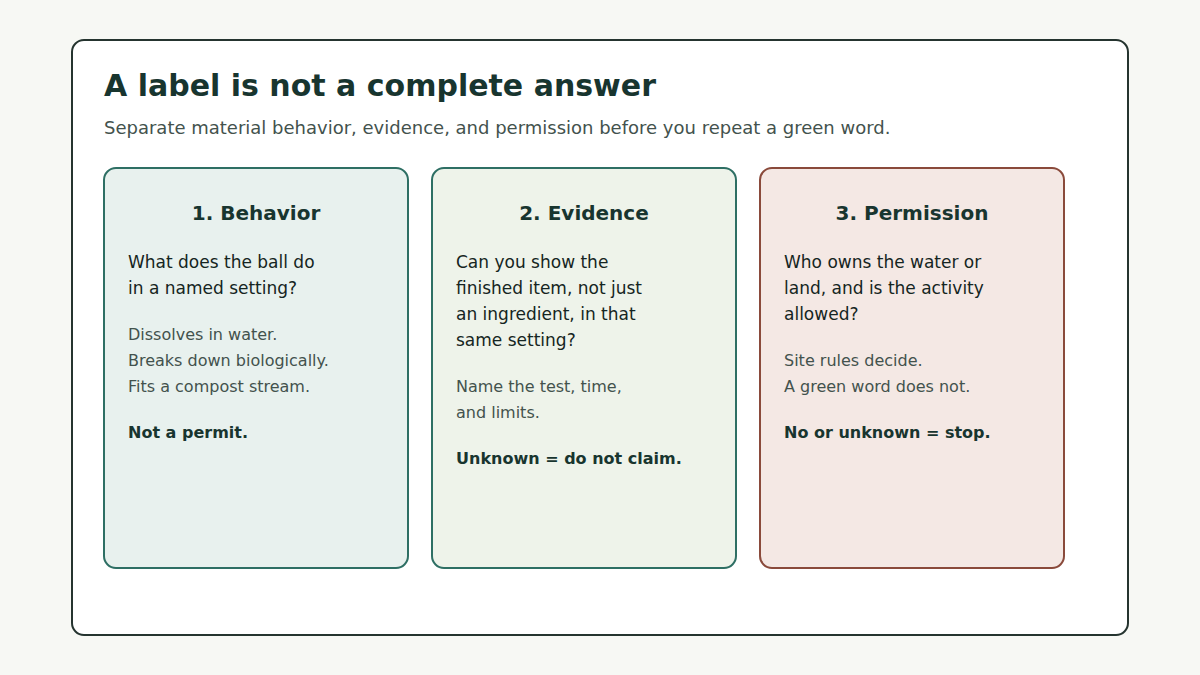
Shoppers, event hosts, and staff meet the same cluster of words on golf-ball boxes, Amazon titles, and older web pages: biodegradable, dissolvable, water-soluble, compostable, eco-friendly, ocean-safe, non-toxic, and fish food. Those words are not synonyms. A label can name a material behavior. It cannot prove a general environmental benefit, grant a permit, or turn a practice ball into wildlife feed.
Quick answer
Read golf-ball environmental labels as questions, not as permission slips.
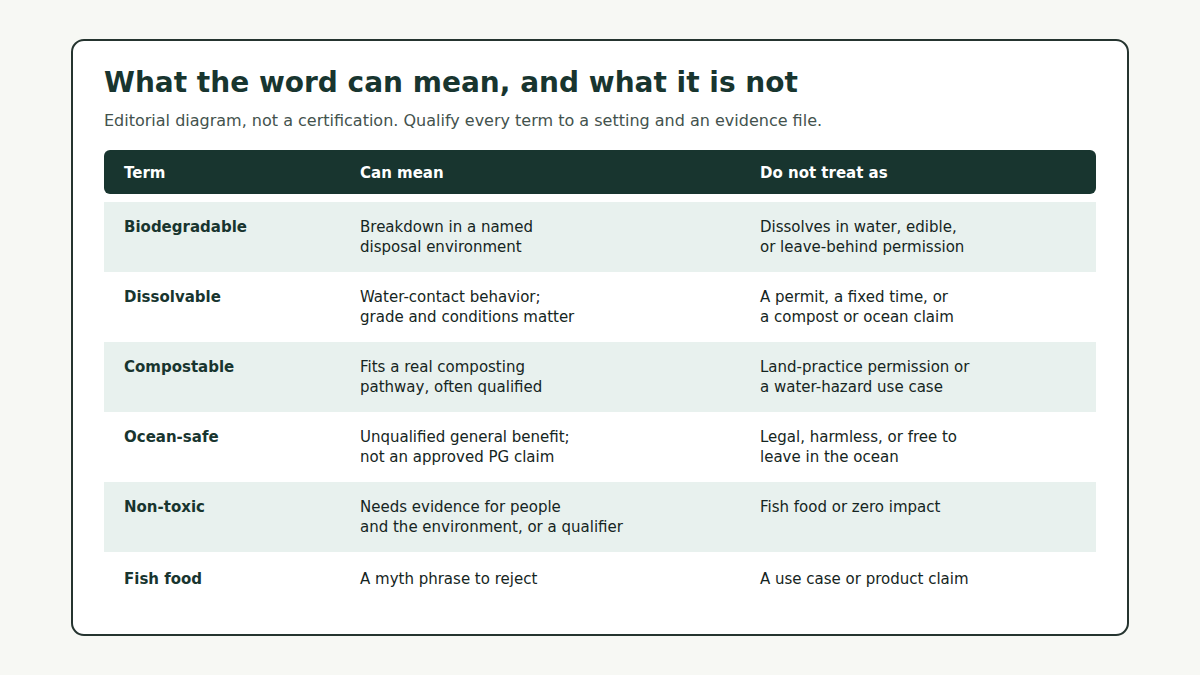
- Biodegradable and dissolvable are different claims. One is about biological breakdown under stated conditions. The other is about dissolving in water.
- Compostable is a disposal-system claim. It is not a water-practice claim.
- Ocean-safe, eco-friendly, non-toxic, and fish food are high-risk phrases unless a specific, substantiated meaning is sitting next to them.
- Play Greenly's product is a controlled-use water-soluble practice ball for permitted water-adjacent settings. It is not a tournament ball, not a compost-in-the-rough ball, and not an ocean-dumping or wildlife-feed ball.
A golf-ball label can name a material behavior. It cannot prove a general environmental benefit, a permit, or a wildlife-feed result.
Why this glossary exists
Search demand on playgreenly.com still mixes fish-food, dissolve, biodegradable, ocean, and water-use queries. The site already has a comparison of biodegradable versus water-soluble labels, a dissolve-in-water FAQ, a fish-food myth article, a land-practice FAQ, and pond-permission FAQs. None of those pages is a claim decoder.
This page does not replace those jobs. It is the dictionary that sits beside them. Use it when you need to interpret a word before you repeat it, print it on a sponsor board, or treat it as a reason to hit a ball into water.
It is also a claim-control page. Older Play Greenly copy still uses "ocean-safe" in a product-page title. This glossary does not treat that phrase as an approved product claim.
How to read any environmental golf-ball claim
The Federal Trade Commission Green Guides, 16 CFR Part 260, are the U.S. marketing-claim framework this glossary uses. They are guides, not a product test and not a local water permit.
Three rules travel with every term below:
- Identify the claim. What would a reasonable reader take the word to mean in this context?
- Ask for the setting. Landfill, home compost, industrial compost, freshwater, seawater, turf, and a storage closet are different environments.
- Ask for the evidence. The FTC says environmental claims often need competent and reliable scientific evidence, and that marketers must substantiate every reasonable interpretation before they make the claim.
If you cannot name the setting and the evidence, do not treat the word as settled.
The terms
Biodegradable
What people hear: it will disappear, quickly, wherever it lands, without harm.
What the Green Guides require: an unqualified degradable or biodegradable claim should be backed by competent and reliable scientific evidence that the entire item will completely break down and return to nature within a reasonably short period of time after customary disposal. For items that enter the solid-waste stream, the Guides say an unqualified degradable claim is deceptive if the item does not completely decompose within one year after customary disposal. Unqualified degradable claims for items customarily sent to landfills, incinerators, or recycling facilities are treated as deceptive because those locations do not present conditions for complete decomposition within one year.
Use it only when: you can name the environment, the time window, and the evidence for the finished item, not just a raw ingredient.
Do not use it to mean: dissolves in water, safe to leave on a course, edible, ocean-safe, or compostable.
Dissolvable / water-soluble
What people hear: it vanishes on contact with any water, including lakes and oceans, so leaving it is fine.
What it can mean: some practice golf balls are designed so the finished ball, or a stated portion of it, dissolves in water. Manufacturer literature on polyvinyl alcohol (PVOH / PVA) treats solubility as grade- and condition-dependent. Hydrolysis, temperature, agitation, and formulation change the result. Kuraray's PVOH FAQ describes dissolving procedures that differ for fully hydrolyzed versus partially hydrolyzed grades, including heating steps. That is resin-handling guidance. It is not a seawater field result for a finished golf ball.
Use it only when: you mean water-contact behavior under stated conditions, and you keep permission and retrieval as separate questions.
Do not use it to mean: biodegradable, compostable, non-toxic, fish food, legal to hit into a waterway, or a fixed dissolve time.
Compostable
What people hear: I can throw it in the rough, a backyard pile, or a lake and it becomes soil.
What the Green Guides require: a compostable claim should have competent and reliable scientific evidence that all materials in the item will break down into usable compost in a safe and timely manner in an appropriate composting facility, or in a home compost pile or device. Claims should be qualified if the item cannot be home-composted, if landfill disposal would mislead about the benefit, or if composting facilities are not available to a substantial majority of consumers where the item is sold.
Use it only when: a real composting pathway exists for that item.
Do not use it to mean: a golf ball is for land practice, water practice, or wildlife feeding. Play Greenly's land-practice FAQ already says a water-soluble practice ball is not a compost-in-the-rough product.
Eco-friendly / green / ocean-safe / ocean-friendly
What people hear: far-reaching environmental benefits, and sometimes no negative impact.
What the Green Guides require: unqualified general environmental-benefit claims are difficult to interpret. In many cases they likely convey specific and far-reaching benefits and may convey that the item has no negative environmental impact. Because it is highly unlikely marketers can substantiate all reasonable interpretations, the Guides say marketers should not make unqualified general environmental-benefit claims. Qualifications must be clear, prominent, and limited to a specific substantiated benefit. The Guides' "eco-friendly" brand-name example is treated as deceptive unless those conditions are met.
"Ocean-safe" is not a defined Green Guides term. On a golf ball it can be read as legal to hit into the ocean, harmless to marine life, and acceptable to leave behind. This package does not make those claims. Play Greenly should not use ocean-safe as an approved product claim here.
Use a qualified specific benefit instead: for example, a water-soluble practice ball for a permitted, controlled water-adjacent activity, with retrieval preferred.
Do not use these words as: a beach-range license, a wildlife-safety certificate, or a substitute for local rules.
Non-toxic
What people hear: safe for people, pets, fish, and the environment, with no further limits.
What the Green Guides require: a non-toxic claim likely conveys that a product is non-toxic both for humans and for the environment generally. Marketers should have competent and reliable scientific evidence for that reading, or should clearly and prominently qualify the claim.
Use it only when: the finished product has that evidence, including the environment the reader will assume.
Do not use it to mean: edible, fish food, or "no impact if left in water."
Fish food
What people hear: the ball is supposed to be eaten, and that is the environmental benefit.
What it is: a marketing and search phrase, not a recognized environmental-claim category in the Green Guides. Play Greenly's fish-food article treats it as a myth to stop, not a use case. Dissolves in water is not the same as edible. Do not imply or encourage ingestion by fish or wildlife.
Use it only when: you are naming the myth so you can reject it.
Do not use it as: a product claim, a sponsor line, or a reason to skip retrieval.
A practical decoder
Before you repeat a label, run this check:
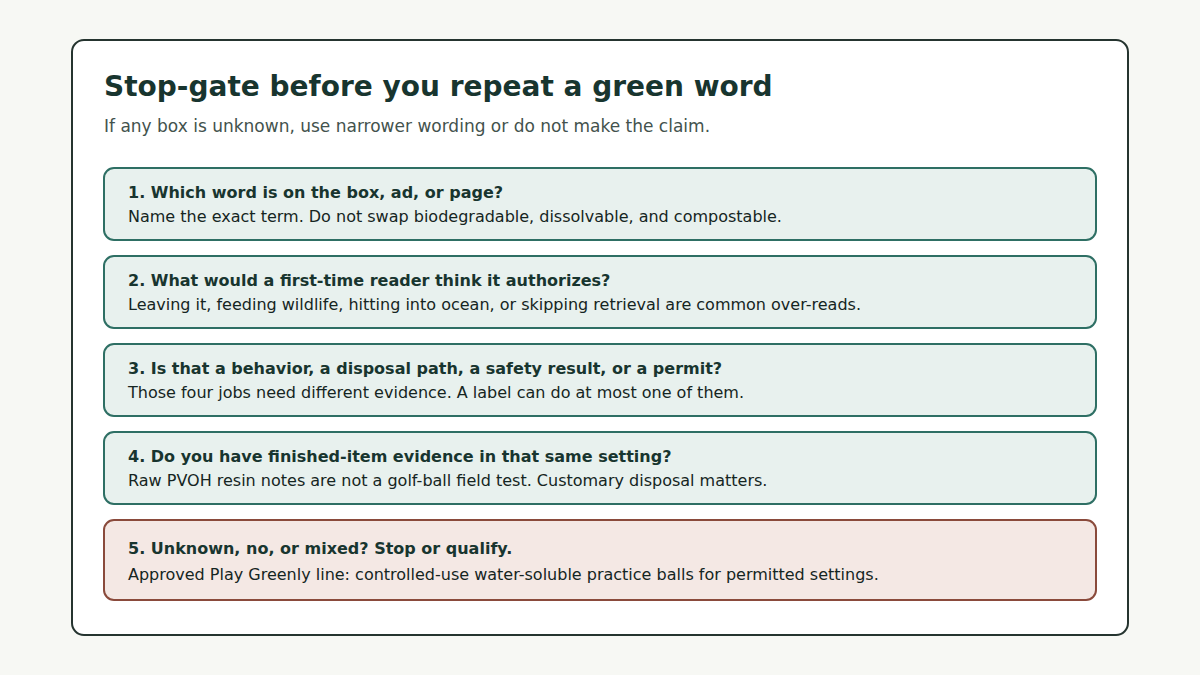
- Which word is on the box, ad, or page?
- What would a first-time reader think it authorizes?
- Is that meaning a material behavior, a disposal pathway, a safety result, or a permission?
- Do you have evidence for the finished item in the setting you are talking about?
- If any answer is unknown, use narrower wording or do not make the claim.
Play Greenly's approved product sentence for this package is: controlled-use water-soluble practice golf balls for permitted water-adjacent settings. That sentence is positioning, not a general environmental-benefit claim.
What this glossary does not do
It does not certify Play Greenly or any other brand as biodegradable, compostable, ocean-safe, non-toxic, fish food, zero-impact, or tournament legal. It does not assign a dissolve time in freshwater or seawater. It does not convert conventional-ball marine-debris research into a license to leave a different product in the water. NOAA describes plastic as the most prevalent marine-debris type it tracks; that is a debris fact, not a product endorsement.
Older Play Greenly pages, including the composition article and the live product-page title, still mix these terms. If those pages conflict with this glossary, treat this glossary as the stricter decoder until a human-approved rewrite ships. Do not copy "guilt-free," "leave no harm behind," "safe for marine life to eat," or a 2-to-6-week dissolve promise from older copy.
Limitations
This article is a marketing-claim glossary, not legal advice, not a water-use permit, and not a laboratory report. The Green Guides help marketers avoid deceptive environmental claims under Section 5 of the FTC Act; they do not confer rights and do not bind the FTC or the public. State and local water, litter, and composting rules still control the activity. Raw PVOH resin behavior is not finished-ball field behavior. Retrieval and site permission remain the conservative practice even when a label sounds green.
Frequently asked questions
What is the difference between biodegradable and dissolvable golf balls?
Biodegradable is a breakdown claim that depends on organisms and the disposal environment. Dissolvable or water-soluble describes dissolving in water. A ball can be marketed as one, the other, both, or neither. Do not treat the words as interchangeable.
Are ocean-safe golf balls a real product class?
Treat ocean-safe as an unapproved general environmental-benefit phrase unless a specific, substantiated claim is in front of you. This glossary does not use it as a Play Greenly product claim.
Can I call a water-soluble golf ball compostable?
Not from water-solubility alone. Compostable is a separate Green Guides claim with its own evidence test and facility-availability qualifications.
Does non-toxic mean fish can eat the ball?
No. Non-toxic, if used at all, needs evidence for humans and the environment generally, or a clear qualification. It is not a wildlife-feed claim.
What should Play Greenly say instead of eco-friendly or ocean-safe?
Say what the product is for: a controlled-use water-soluble practice ball for permitted water-adjacent settings. Then point to the permission, retrieval, and event-test pages for the operating job.
Related Play Greenly pages
- Biodegradable vs. Water-Soluble Golf Balls
- Are There Golf Balls That Dissolve in Water?
- Fish Food Golf Balls
- Are Biodegradable Golf Balls for Land Practice?
- Can You Hit Water-Soluble Golf Balls Into a Pond?
- Play Greenly biodegradable golf balls
Sources
- https://www.ecfr.gov/current/title-16/chapter-I/subchapter-B/part-260
- https://www.ftc.gov/business-guidance/resources/environmental-claims-summary-green-guides
- https://www.ftc.gov/news-events/topics/truth-advertising/green-guides
- https://poval.kuraray.com/en/faq/kuraray-poval-faq/
- https://marinedebris.noaa.gov/
- Play Greenly brand guide, Google Doc 1g66rSkZ9q76BUaPk5Yq5zt8WlU94bYA1z5_VIpZ9ALo, Prepared August 5, 2026.