Quick Answer
You can create temporary basketball court lines on a gym floor only after the facility owner or floor manager approves the method. Use official basketball diagrams as a layout reference, but do not present temporary tape as competition-approved, safe for every floor, slip-proof, residue-free, or damage-free. For finished maple floors, Maple Flooring Manufacturers Association guidance is especially strict: tape can affect traction and may pull up finish when removed. When in doubt, use a facility-approved non-tape method or do not mark the floor.
Start With the Floor Owner
Before measuring a single line, identify who controls the floor. That might be a school athletic director, facilities manager, recreation director, flooring contractor, or venue owner.
Ask for approval on four points:
- Which marking method is allowed on this exact surface?
- Which areas can be marked?
- How long can the markings stay down?
- Who is responsible for inspection, removal, and cleanup?
Do not assume a tape product is acceptable because it says gym floor or residue-free on the package. Facility approval matters more than label shorthand.
Use Official Diagrams as References, Not Promises
Basketball court markings vary by rules body and level of play. FIBA references a 28 m by 15 m court with 5 cm lines. NCAA resources publish their own court diagram for college play. Youth, PE, camp, 3x3, and half-court activities often use modified spaces.
For a temporary setup, decide which line set you actually need:
- boundary lines for a teaching court;
- a half-court station;
- free-throw lane and free-throw line;
- a three-point arc only if the activity needs it;
- safe buffer zones around walls, bleachers, doors, and spectators.
If the session is recreational, say that. Do not call the temporary layout regulation, certified, or competition-ready unless the governing body, venue, and event rules have approved it.
Tape Risk on Finished Gym Floors
Finished maple floors need extra caution. MFMA warns against using masking, theatrical, construction, electrical, duct, adhesive, or other tape to mark temporary court boundaries on finished maple floors. Its concern is not only residue. Tape can change traction and removal can pull away layers of floor finish.
That does not mean every non-maple surface has the same risk, and it does not mean a coach should improvise. It means the decision belongs with the floor owner, maintenance guidance, and product instructions for the exact surface.
A Safer Temporary Basketball Line Workflow
Use this sequence:
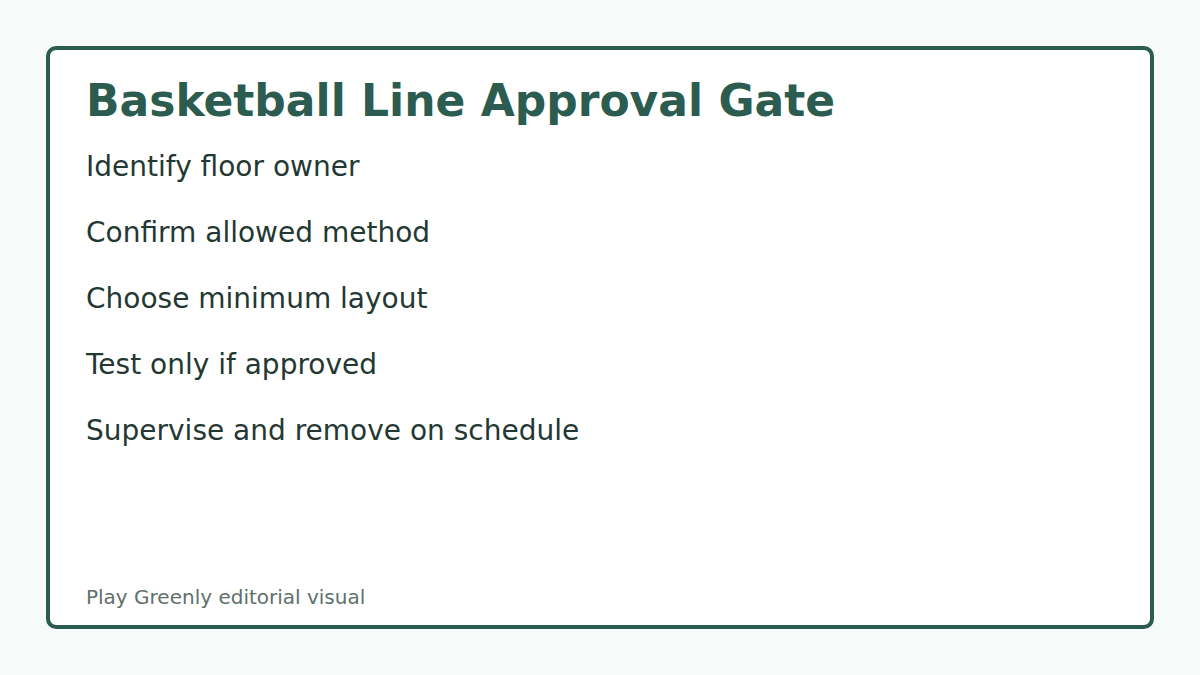
- Confirm the surface type and floor-maintenance rules.
- Get written or documented approval for the marking method.
- Choose the smallest layout that supports the activity.
- Measure from a clear centerline or baseline reference.
- Mark a small hidden test area only if the floor owner allows testing.
- Check traction, edge lift, visibility, and trip hazards before play.
- Assign one adult to inspect lines during the activity.
- Remove markings on the approved schedule.
- Inspect for residue, finish lift, discoloration, or adhesive transfer.
- Record what worked before repeating the setup.
What to Mark for Common Basketball Uses
For a PE shooting station, you may only need a free-throw line, a simple lane reference, and a safe rebound area.
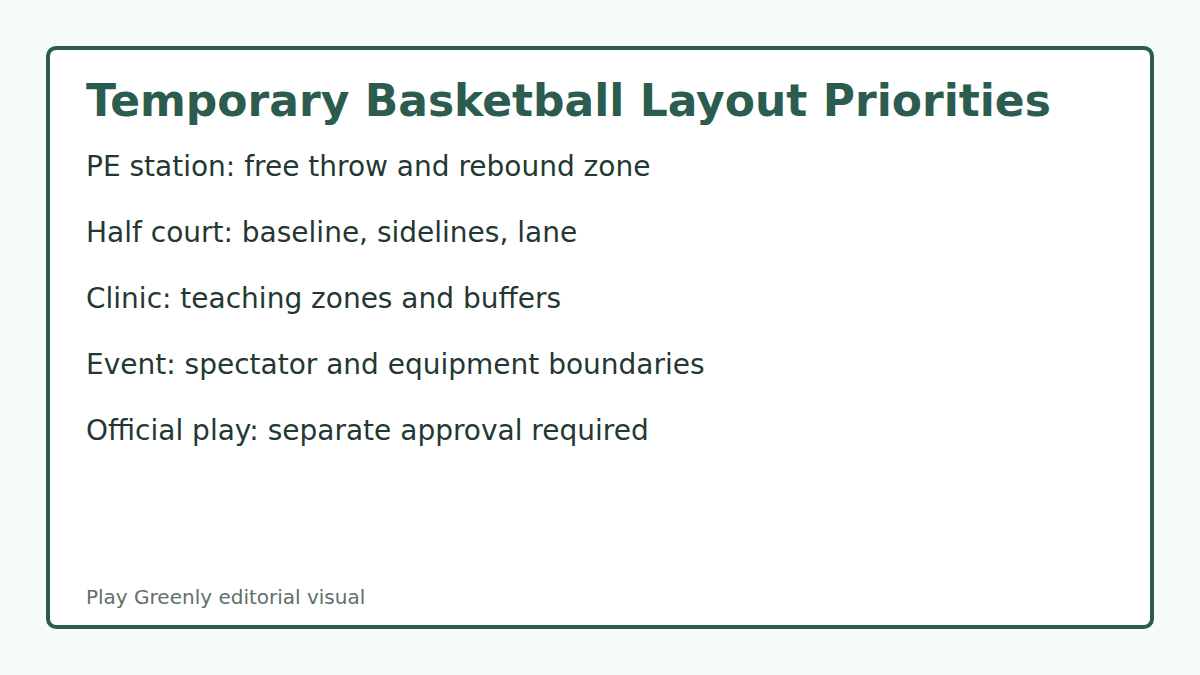
For a camp half-court, prioritize one baseline, two sidelines, a free-throw lane, and a clear three-point or no-three-point decision.
For a small-sided clinic, mark teaching zones and safety buffers instead of trying to force a full regulation court into a room that does not fit.
For any public event, add spectator and equipment boundaries so the basketball lines do not invite play into doors, mats, cords, bleachers, or walls.
Cleanup Checklist
Before the event starts, decide how the marks will come up. Keep the approved removal instructions with the setup notes.
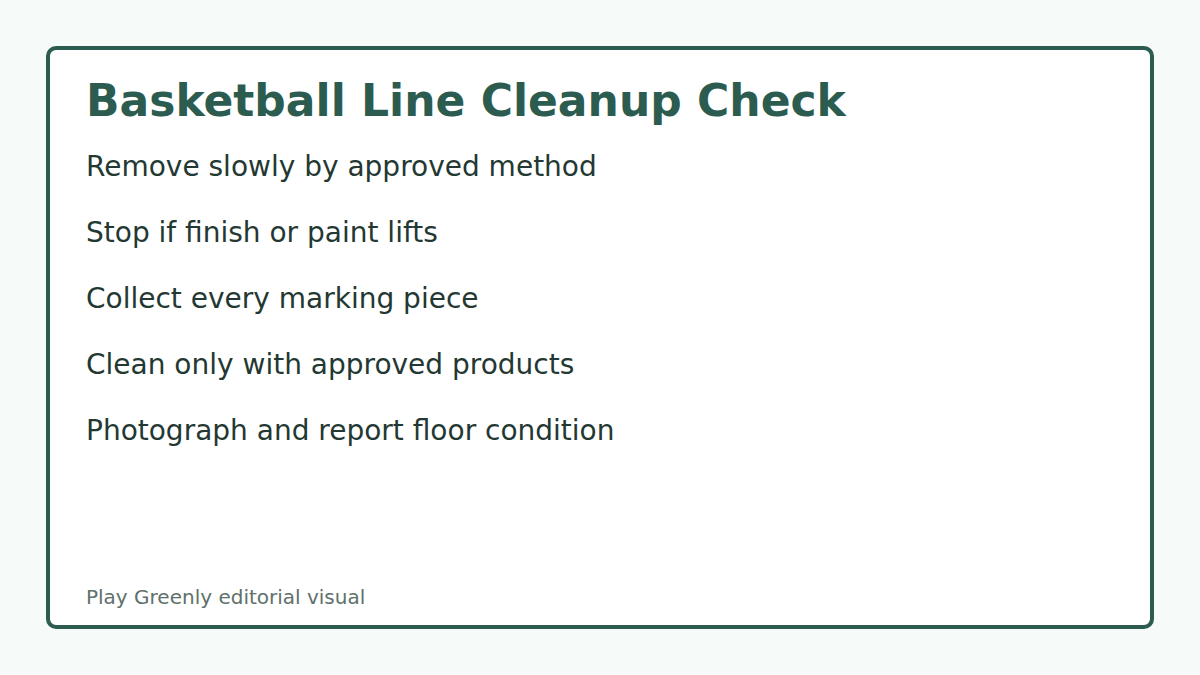
After play:
- remove slowly and at the angle recommended by the floor owner or product instructions;
- stop if finish, paint, or coating lifts;
- collect every piece of tape or marking material;
- clean only with approved products;
- photograph the floor after removal;
- report any residue or finish issue immediately.
What Not to Claim
Avoid these phrases unless the exact surface, product, governing body, and facility owner support the statement:
- safe for every gym floor;
- residue-free in all conditions;
- will not damage finish;
- no slip risk;
- competition-approved;
- official court;
- environmentally harmless;
- no cleanup needed.
Better wording is narrower: facility-approved temporary basketball layout, test-before-use setup, supervised temporary play, and cleanup-ready line plan.
Related guides
- Sports Floor Marking Tape Guide
- Temporary Sports Floor Line Marking Checklist
- Temporary Pickleball Lines on Gym Floors
- Temporary Volleyball Court Lines on Gym Floors
Frequently asked questions
Can I use tape for temporary basketball court lines on a gym floor?
Only if the facility owner or floor manager approves that exact tape and method for that exact surface. Finished maple floors need special caution, and MFMA guidance warns against tape for temporary boundaries.
Are temporary basketball lines official for games?
Not automatically. Official use depends on the governing body, event rules, venue approval, and exact court markings. Treat temporary layouts as recreational or instructional unless approved otherwise.
What basketball lines should I mark first?
Mark only what the session needs. A PE station may need fewer lines than a full court. A camp half-court may need boundaries, a lane, and a clear three-point decision.
How do I reduce floor-damage risk?
Start with facility approval, follow the floor-maintenance guidance, test only if allowed, supervise the markings during play, remove on schedule, and inspect after cleanup.
Should I promise residue-free cleanup?
No. Cleanup depends on surface, finish condition, marking material, dwell time, temperature, removal method, and maintenance rules.