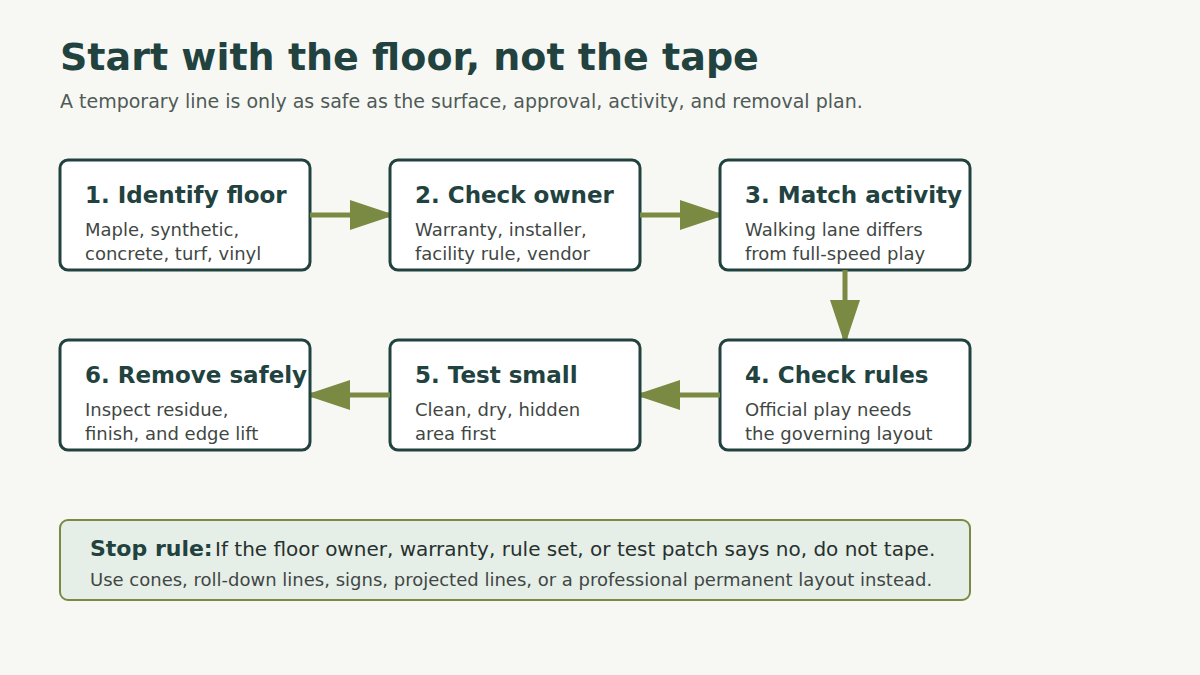
Quick Answer
Temporary sports floor lines should start with the floor, not the tape. On finished maple gym floors, the Maple Flooring Manufacturers Association recommends against adhesive tape for temporary court boundaries because removal can damage finish and tape can change playing-surface traction. For non-maple or approved surfaces, use only the floor owner's accepted product, test a small area first, keep lines flat and visible, and remove them on the schedule the product and facility allow.
Who This Guide Is For
This checklist is for coaches, PE teachers, event hosts, rec-center staff, and facility managers who need a temporary basketball, volleyball, pickleball, futsal, classroom game, or activity boundary without turning a quick setup into a floor-repair problem.
It is not a substitute for the facility's flooring warranty, athletic association rules, or a flooring professional's advice. If a floor owner, refinisher, manufacturer, league, or sanctioning body says no tape, that answer controls.
Why Temporary Lines Go Wrong
Most line-marking mistakes happen before the first piece of tape goes down. A coach sees a roll that says "floor marking tape," assumes all gym floors behave the same, and applies it to a finished wood court. Then the event ends, the tape comes up, and the finish comes with it.
The second risk is player movement. A line that is thicker, slicker, tackier, or raised compared with the surrounding playing surface can affect starts, stops, pivots, and foot contact. OSHA's walking-working-surface rule is not a sports rule, but its basic discipline is relevant for any organized activity space: walking surfaces should be kept clean, orderly, dry, and free of hazards.
The safer operating question is not "Which tape sticks best?" It is "What line method is allowed on this exact surface for this exact activity window?"
The Floor-First Decision Tree
Use this sequence before buying or applying anything:
- Identify the surface.
Finished maple, synthetic sport floor, sealed concrete, rubber tile, carpet tile, turf, vinyl, laminate, and temporary roll-out flooring all have different finish, adhesive, and traction risks.
- Check the floor owner's rule.
Ask for the facility's approved temporary-marking method. If the floor warranty, owner, installer, or maintenance vendor rejects adhesive tape, do not override that with a product claim.
- Match the marking to the activity.
A walking lane, classroom boundary, low-speed skills station, full-speed basketball line, and volleyball attack line do not create the same traction or visibility needs.
- Check the rule set only when needed.
Official competition lines must follow the relevant governing body's court dimensions and marking requirements. A practice drill can use simplified temporary lines as long as the organizer labels them as practice-only.
- Test and remove.
On an approved non-critical surface, test a small hidden area, apply to a clean and dry floor, inspect for edge lift, and remove within the accepted time window.
What Different Sources Actually Say
- Source — What It Helps You Decide — What It Does Not Prove
- MFMA tape position — Whether adhesive tape belongs on finished maple athletic flooring — That every non-maple surface is safe for every tape
- 3M floor marking tape data — Surface preparation and product-specific use conditions for industrial floor-marking tape — That a tape is approved for finished gym maple or sanctioned sport play
- NFHS basketball diagram — High-school court reference lines and layout context — That a temporary taped court is rule-compliant
- FIBA equipment rules — International basketball line width and equipment layout context — That a local temporary setup is approved
- USA Volleyball rulebook — Volleyball court and boundary-line requirements — That any tape product is safe for a specific floor
- OSHA 1910.22 — General hazard-control discipline for walking-working surfaces — A sports-specific approval or product endorsement
When Tape Is the Wrong Tool
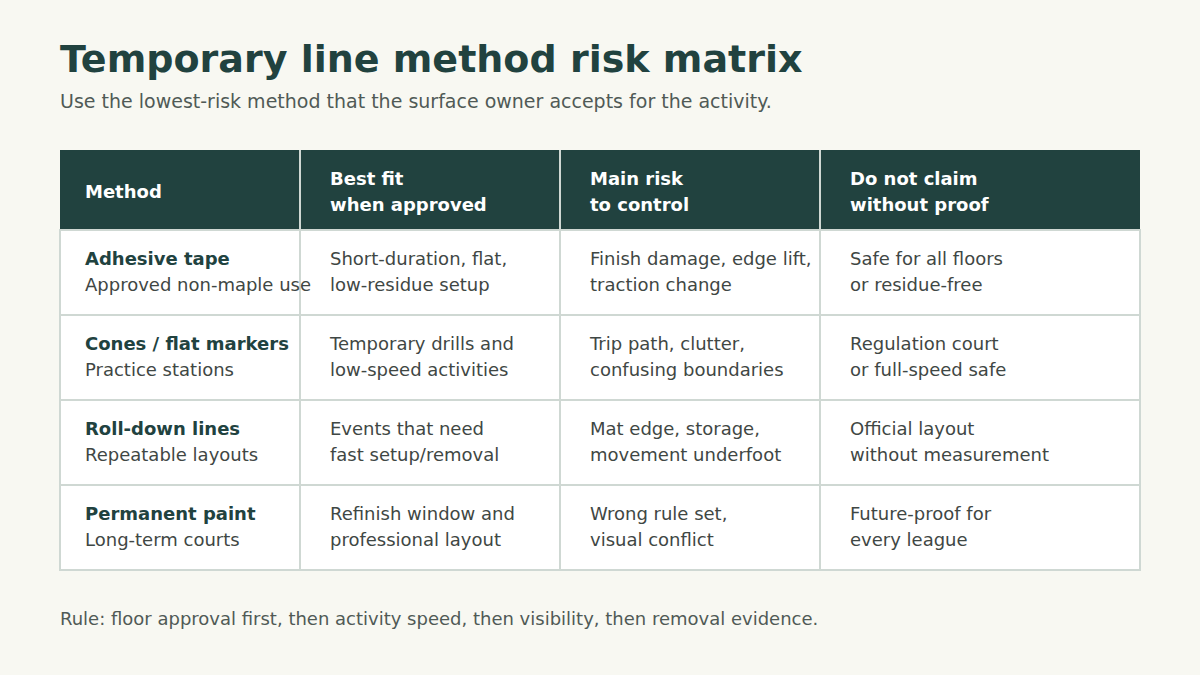
Avoid adhesive tape when the surface is finished maple, newly refinished, uncured, waxed, dusty, wet, uneven, already peeling, under warranty restrictions, or used for full-speed cutting and pivoting unless the facility has explicitly approved that product and method.
Also avoid tape when the line would cross a doorway, ramp, mat edge, drain, cable path, spill-prone zone, or transition between surfaces. A temporary activity line should not create a new trip edge or draw people toward an unsafe route.
Better alternatives may include cones, flat markers, roll-down court lines, non-adhesive boundary strips, projected lines, magnetic systems on compatible surfaces, removable signs, or a professionally painted permanent multi-sport layout during scheduled maintenance.
If The Facility Allows Temporary Tape
Use a controlled process:
- Get written acceptance for the exact surface and product.
- Clean and dry the floor first; do not trap dust, moisture, wax, or grit.
- Keep line widths and colors clear enough for the activity.
- Avoid overlaps, wrinkles, doubled edges, and loose ends.
- Walk the route before play starts and after warmups.
- Stop if edges lift, adhesive transfers, or the line feels slick.
- Remove slowly within the approved window.
- Document the product, location, date, and any residue or finish issue.
This is an operations checklist, not a guarantee. Even products marketed for clean removal can behave differently on an old finish, a contaminated floor, or an unapproved surface.
Basketball, Volleyball, and Multi-Sport Lines
For official basketball, line dimensions come from the competition rule set. NFHS materials describe high-school court markings and boundary context, while FIBA's equipment document specifies 50 mm basketball court lines for its rules environment. NBA, NCAA, local youth leagues, and facility-specific programs can differ.
Volleyball has its own court dimensions and boundary requirements. USA Volleyball publishes current indoor rulebooks; use those for sanctioned play rather than copying a generic internet diagram.
For camps, PE classes, parties, or practice stations, simplified temporary lines can be useful, but call them practice markings. Do not claim they create a regulation court unless the layout was checked against the applicable rule set.
A Safer Setup Checklist
Before setup:
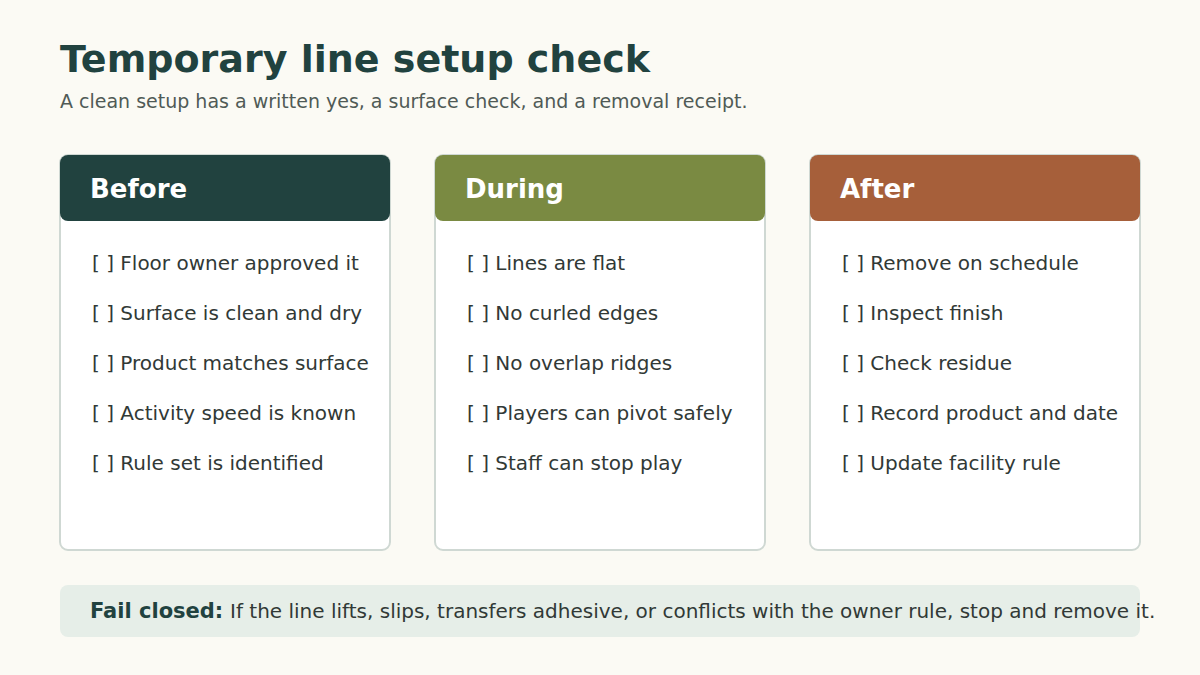
- Floor owner approval exists for the exact method.
- Surface is clean, dry, cured, and in good condition.
- Product use case matches the surface and activity.
- Activity speed, footwear, and pivoting demands are understood.
- Participants have enough clear space outside the boundary.
During use:
- Lines are visible without being confusing.
- No lifted corners, curled edges, wrinkles, or overlaps.
- No slippery residue, wet spots, dust, or grit on the line.
- Coaches and staff know the line is temporary and practice-only when applicable.
After use:
- Lines are removed within the approved window.
- Floor is inspected under normal lighting.
- Residue or finish changes are documented.
- The facility rule is updated if the method caused a problem.
Where Play Greenly Fits
Play Greenly should use this page as a sports-operations education piece, not as a broad claim that a tape is always safe, eco-friendly, damage-free, or competition-approved. It can support coaches and event hosts who need clearer setup discipline across temporary activities, while linking readers to Play Greenly's broader game, event, and water-practice planning resources.
For any Play Greenly product or future sports-marking offer, the public wording should stay specific: name the intended surface, use case, limitations, setup steps, and removal conditions. Avoid "safe for all floors," "no residue guaranteed," "approved for every gym," and "regulation court" unless those claims are backed by the exact product, surface, and rule authority.
Internal Links To Add
- Sports Floor Marking Tape Guide: /blog/sports-floor-marking-tape-guide
- 7 Backyard Golf Games for Beginners: /blog/backyard-golf-games-for-beginners
- Plan an Eco-Friendly Golf Tournament: /blog/eco-friendly-golf-tournament
- What Can an Eco Golf Event Sponsor Say on Signs?: /blog/eco-golf-event-sponsor-claims
- Products: /products
- Contact Play Greenly: /contact-us
Suggested SEO Fields
Frequently asked questions
Can you use tape for temporary gym floor lines?
Sometimes, but not by default. MFMA recommends against adhesive tape on finished maple athletic floors. For other surfaces, use only the facility-approved product and process.
Is painter's tape safe for gym floors?
Do not assume that. Finished athletic floors can be damaged by adhesive tape, and a low-tack product still may not match the floor finish or player-traction needs.
What tape should I use for basketball court lines?
For sanctioned play, start with the governing rule set and the facility's floor rules. For practice-only markings, use the floor owner's approved method and label the layout as temporary.
How do you keep temporary lines from becoming a trip hazard?
Apply only to clean, dry, smooth approved surfaces; avoid overlaps and wrinkles; inspect for lifted edges before and during use; remove the line if it curls or transfers adhesive.
What should Play Greenly avoid claiming?
Avoid universal claims such as safe for all floors, no residue guaranteed, regulation court, eco-safe in every setting, or approved by all leagues unless exact evidence exists.