Quick Answer
Choose water-soluble golf balls when the session is recreational, controlled, and water-adjacent, and when the property owner or venue allows the activity. For Play Greenly, the approved product positioning is a PVA-based, water-soluble practice golf ball built for the ocean and other bodies of water. That is a use-case and product-design statement. It is not a permit, a wildlife-feed claim, a compostability claim, a tournament claim, or a universal promise that every ball disappears on the same timeline in every setting.
If you only remember one rule, make it this: pick for the setting, then verify the claim.
1. Start With the Setting
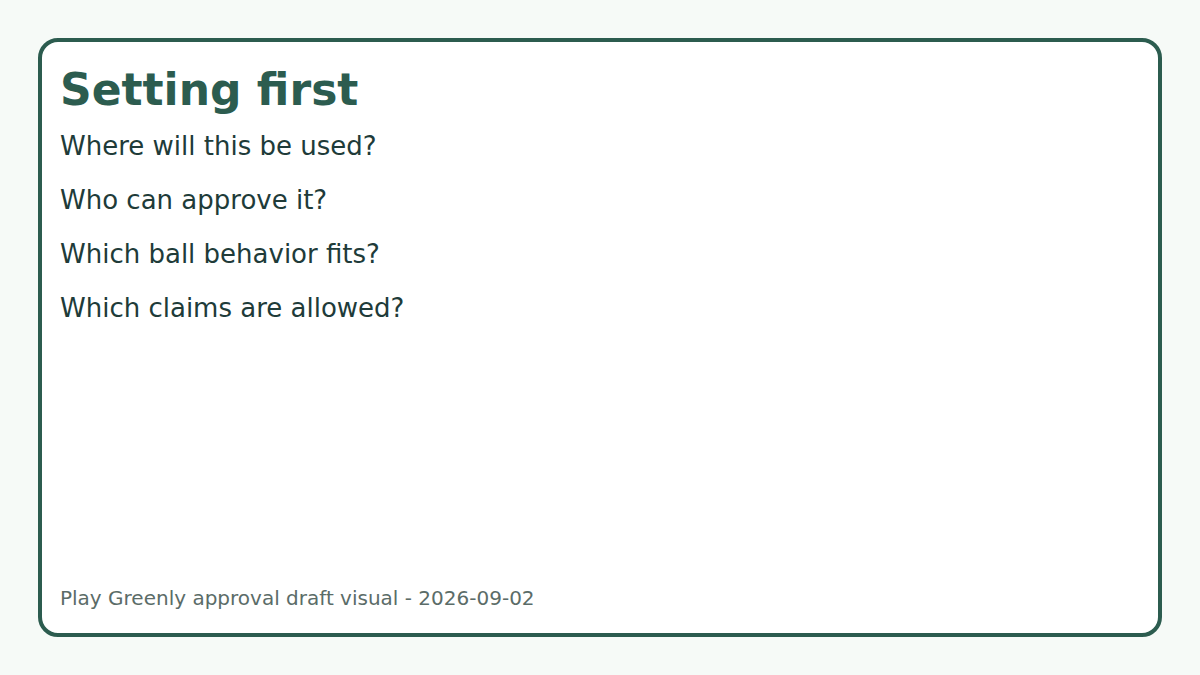
The right ball for a backyard net, a grass range, a dock, a marina activity, and a formal round is not necessarily the same ball. Before comparing labels, write down where the ball will be hit, who controls that location, what cleanup or retrieval is expected, and whether the session is practice, event entertainment, or formal scoring.
For a water-adjacent practice session, Play Greenly's claim map allows ocean-safe and water-use language, including "safe for the ocean and other bodies of water" and "built for the ocean, lakes, rivers, ponds, and docks." Keep the companion qualifier visible: these are practice and novelty balls, not tournament balls.
2. Separate Four Different Claims
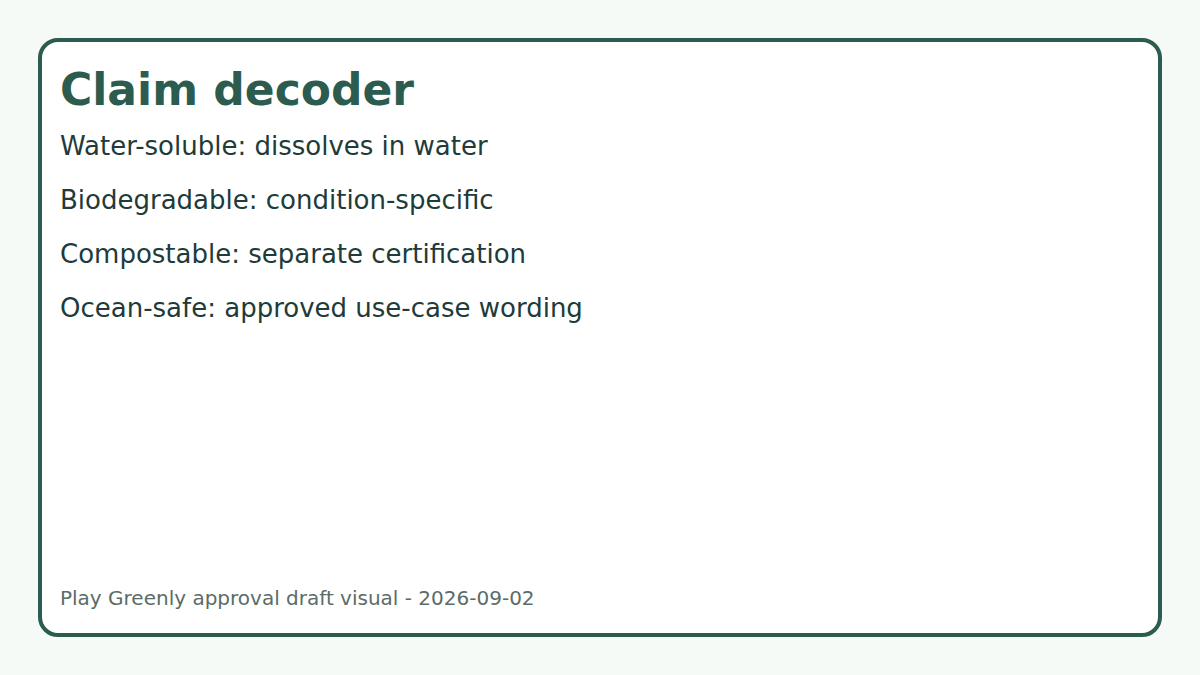
"Water-soluble" says the material is designed to dissolve in water. "Biodegradable" says a material can break down biologically under defined conditions. "Compostable" is a separate claim that usually depends on a recognized test method and facility conditions. "Ocean-safe" is Play Greenly's approved brand/use-case language, not a marine-biodegradation certification.
Those distinctions matter because broad environmental marketing claims can mislead when they are not qualified. The FTC Green Guides and 16 CFR Part 260 are the right guardrail: say the specific product attribute, the setting, and the limitation.
3. Check the Evidence Behind the Dissolve Claim
The current Play Greenly Claims Map records supplier-summary lab testing that reported about 90% dissolution by day 7 and complete dissolution by day 10 under controlled slow-moving fresh-water conditions: 10-20 C, 300 rpm stirring, and 1.5 L water changed daily.
That evidence supports a controlled lab statement. It should not be turned into a universal lake, ocean, pool, salinity, winter, hot-weather, field, or event-day guarantee. If the reader needs certainty for a public event, marina activation, or brand-sponsored activity, the draft should send them to a pre-event test and venue approval, not to a blanket promise.
4. Do Not Use Water as a Disposal Plan
Water-soluble practice balls are for controlled use where the activity is allowed. They are not a disposal method for ordinary golf balls.
The reason is practical. Peer-reviewed coastal research reported 50,681 retrieved golf balls, about 2.5 tons of debris, from Monterey Bay area waters. NOAA's marine-debris frame also points toward prevention before cleanup. That does not mean every pond has the same evidence profile, and it does not make any one product a permit. It means the responsible buying question is: "How do I prevent uncontrolled durable debris in the first place?"
5. Use a Five-Question Buying Checklist
First, is this practice or formal play? If it is formal play, check the rules and conforming-ball requirements separately.
Second, is the location private or explicitly approved? Product wording does not override a park, beach, course, marina, lake association, or event contract.
Third, is the ball water-soluble because of documented product evidence, or is the page leaning on vague eco language?
Fourth, does the seller qualify dissolve timing with actual conditions, or imply a universal disappear-by-date guarantee?
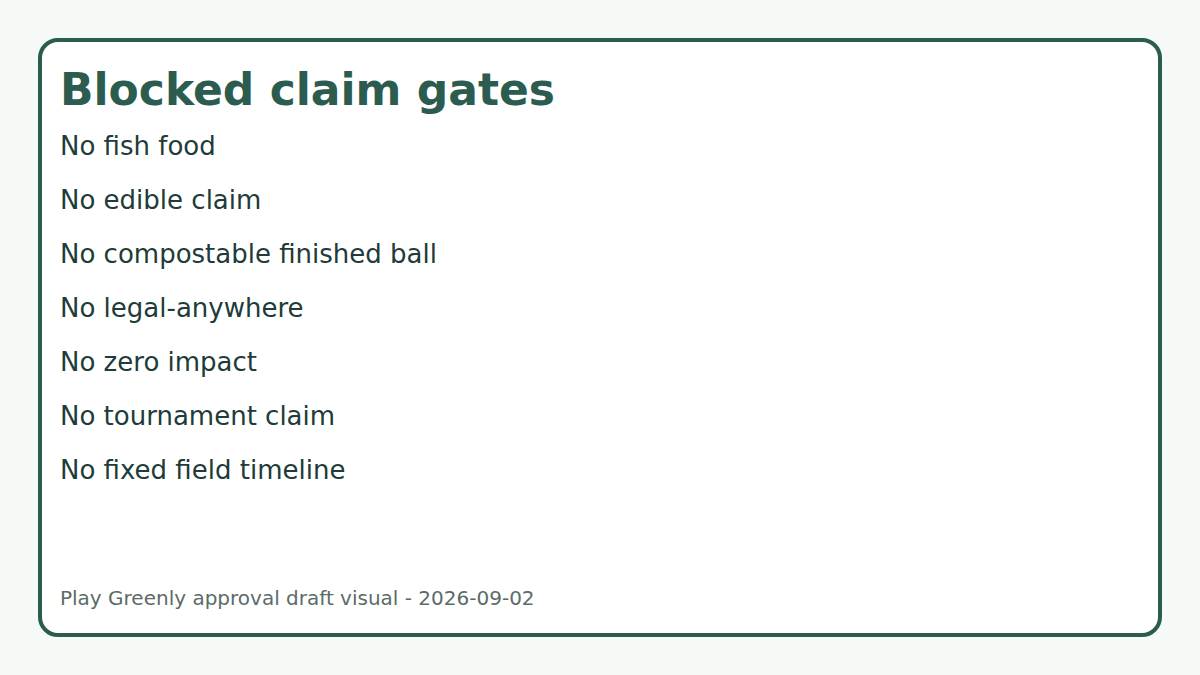
Fifth, does the seller avoid risky shortcuts such as fish food, edible, compostable finished ball, zero impact, leaves no trace, legal anywhere, or tournament-ready?
6. Where Play Greenly Fits
Play Greenly should be presented as a water-adjacent practice option for people who want a real-feeling golf-ball experience where ordinary durable balls do not belong. The correct bridge is not "hit anything anywhere." The correct bridge is "controlled practice, approved setting, clearer claim."
Good internal links from this article:
- Biodegradable golf balls hub: https://www.playgreenly.com/biodegradable-golf-balls
- Are there golf balls that dissolve in water?: https://www.playgreenly.com/blog/are-there-golf-balls-that-dissolve-in-water
- Do Golf Balls Dissolve in the Ocean?
- Fish Food Golf Balls: https://www.playgreenly.com/blog/fish-food-golf-balls
- Do Golf Balls Sink or Float?: https://www.playgreenly.com/blog/do-golf-balls-sink-or-float
- Pond-use FAQ: https://www.playgreenly.com/blog/hit-water-soluble-golf-balls-pond
- Event test guide: https://www.playgreenly.com/blog/test-water-soluble-golf-balls-before-event
- Claims glossary: https://www.playgreenly.com/blog/golf-ball-environmental-claims-glossary
Frequently asked questions
Are water-soluble golf balls the same as biodegradable golf balls?
No. Water-soluble describes how the product is designed to dissolve in water. Biodegradable describes breakdown under defined biological conditions. A page can use both words only when the evidence supports the exact statement being made.
Are Play Greenly golf balls fish food?
No. Water-soluble does not mean edible or wildlife feed. Do not feed wildlife with any golf ball.
Can I use water-soluble golf balls anywhere there is water?
No. Use them only in private or approved settings and follow local rules. The product claim is not permission.
Are they tournament balls?
Treat them as practice/novelty balls. Formal-play requirements should be checked through the governing bodies' equipment rules and conforming-ball resources.
How fast do they dissolve?
The Claims Map records supplier-summary lab testing of about 90% dissolution by day 7 and complete dissolution by day 10 under specified stirred fresh-water lab conditions. Field timing varies.