Quick Answer
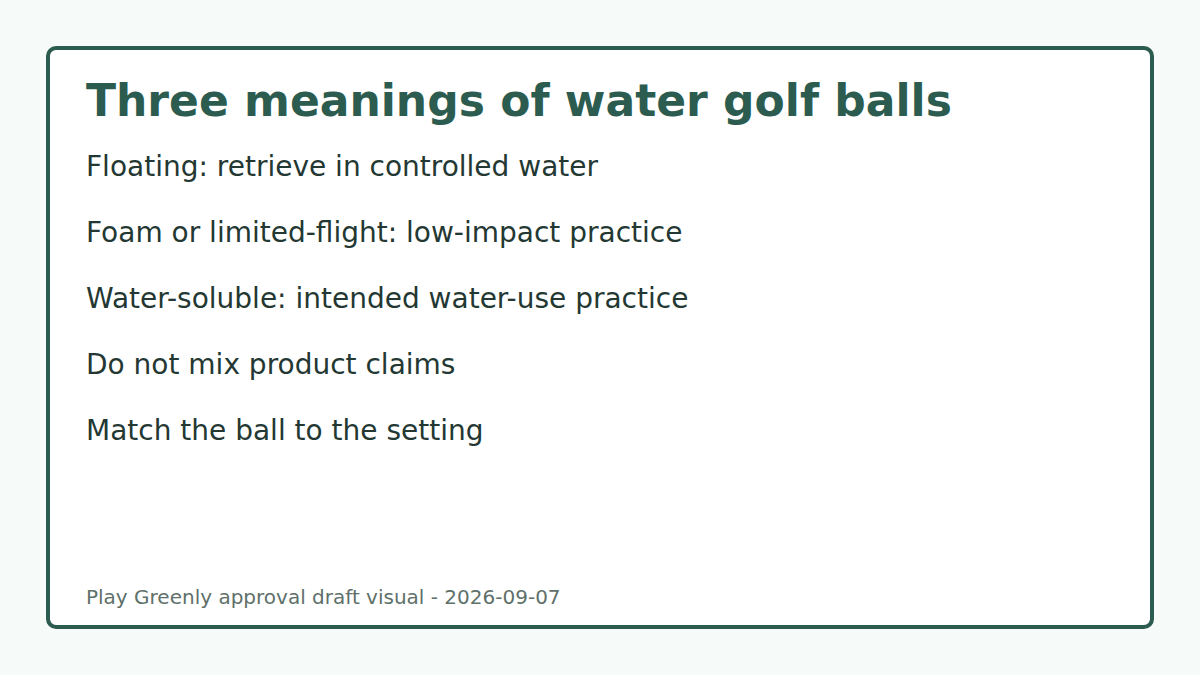
"Water golf balls" usually means one of three things: floating practice balls for retrieval, foam or plastic limited-flight balls for low-impact practice, or water-soluble practice balls designed for use around water. Play Greenly's product lane is the third category: PVA-based, water-soluble practice golf balls built for the ocean and other bodies of water. That does not make every water shot legal, feed wildlife, or prove a fixed outdoor disappearance timeline.
Why the Term Gets Confusing
Buyers use "water golf balls" in different ways. Some want a ball they can retrieve from a pool or pond. Some want a soft practice ball that will not travel far. Some want a ball that is designed to reduce long-term persistence if the intended use is near water.
Those jobs overlap in search results, but they are not the same product claim. The safest buying decision starts with the setting: where the ball will be hit, whether retrieval is expected, who owns the water or land, and what evidence supports the product wording.
The Three Main Types
- Type — Main job — What to check — Claim boundary
- Floating practice balls — Retrieval from pools, ponds, or controlled water features — Whether the ball floats, how far it travels, and whether the owner allows the activity — Floating does not mean biodegradable, safe for wildlife, or legal to hit anywhere
- Foam or plastic limited-flight balls — Backyard, indoor, garage, coach, or camp practice — Distance, impact risk, durability, and surface safety — Soft or limited-flight does not mean water-soluble or environmentally substantiated
- Water-soluble practice balls — Water-intended practice around oceans, lakes, rivers, ponds, docks, and marinas — Material evidence, dissolution conditions, use permission, and claim limits — Water-soluble is not fish food, compost certification, legal permission, or a guaranteed field timeline
Where Play Greenly Fits
Play Greenly should be positioned as a water-soluble practice option, not as every kind of "water golf ball." The current Claims Map approves this default product description: PVA-based, water-soluble practice golf balls designed to reduce long-term persistence compared with conventional golf balls.
The same Claims Map approves the water-use case: Play Greenly balls are built for the ocean and other bodies of water, including lakes, rivers, ponds, docks, and marinas. That is approved brand language, but it is not a marine-biodegradation certificate and it is not permission to hit into any public or private waterway.
What the Lab Evidence Supports
The current Play Greenly evidence map identifies the tested sample as PVA, polyvinyl alcohol, a water-soluble polymer. It also records a supplier laboratory simulation of slow-moving fresh water where the ball dissolved about 90% by day 7 and completely by day 10 under the stated test conditions: 10 to 20 degrees Celsius, 300 rpm stirring, and 1.5 liters of water changed daily.
Use that evidence carefully. It supports a controlled-test result and a water-soluble product description. It does not support a promise that every lake, ocean, soil, pool, marina, or weather condition will produce the same timeline.
Why Conventional Balls Are Different
Conventional lost golf balls can become marine or freshwater debris when they accumulate where they are not retrieved. NOAA's Marine Debris Program describes marine debris as human-made material that is intentionally or accidentally disposed of or abandoned in the marine environment. A peer-reviewed coastal golf-course debris study indexed by PubMed reported golf balls collected from coastal environments over a multi-year period.
That evidence is useful context for why water-intended practice products exist. It should not be stretched into a claim that any alternative product has zero impact or can be used without retrieval, permission, or site rules.
A Buyer Decision Rule
Use this short rule:
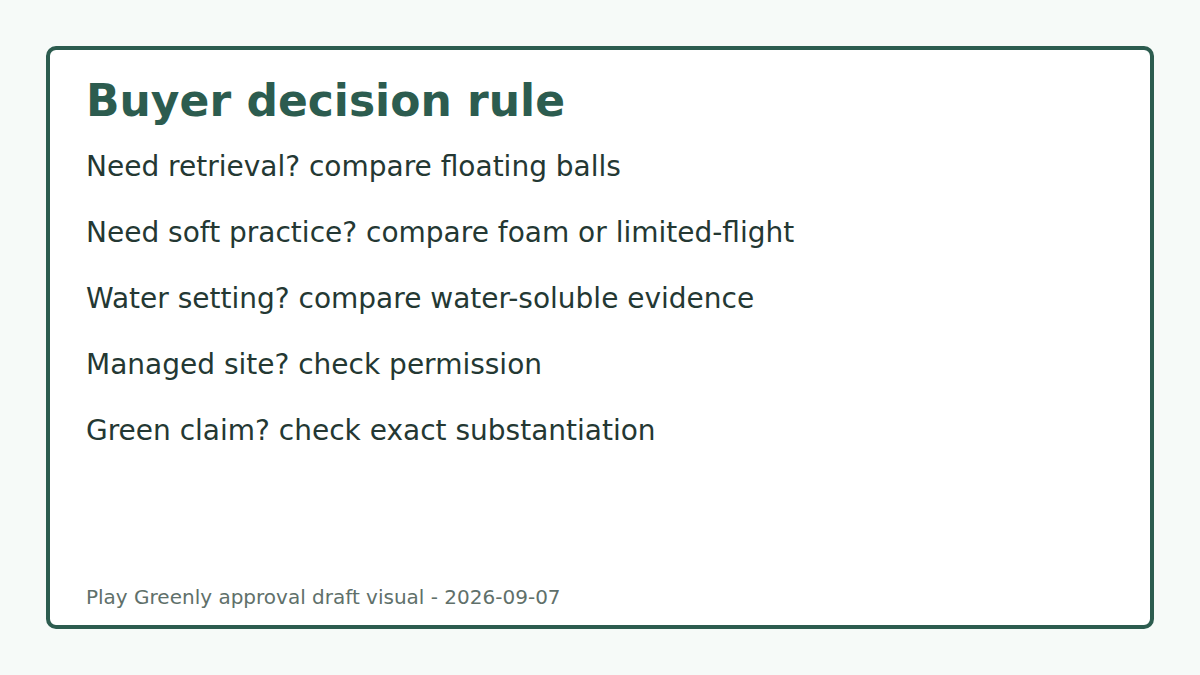
- If you need retrieval from a controlled water feature, compare floating practice balls.
- If you need low-impact practice away from water, compare foam or limited-flight practice balls.
- If the intended setting is ocean, lake, river, pond, dock, or marina practice, compare water-soluble practice balls and read the claim limits.
- If the setting is public, protected, private, permitted, or managed, check the owner's or authority's rule before hitting.
- If a product says biodegradable, eco-friendly, compostable, fish-safe, or non-toxic, look for exact substantiation and limitations.
Green Claims Need Specific Support
The FTC Green Guides, codified at 16 CFR Part 260, warn marketers not to overstate environmental attributes and to keep qualifications clear, prominent, and understandable. They also say broad environmental benefit claims can imply far-reaching benefits that are hard to substantiate.
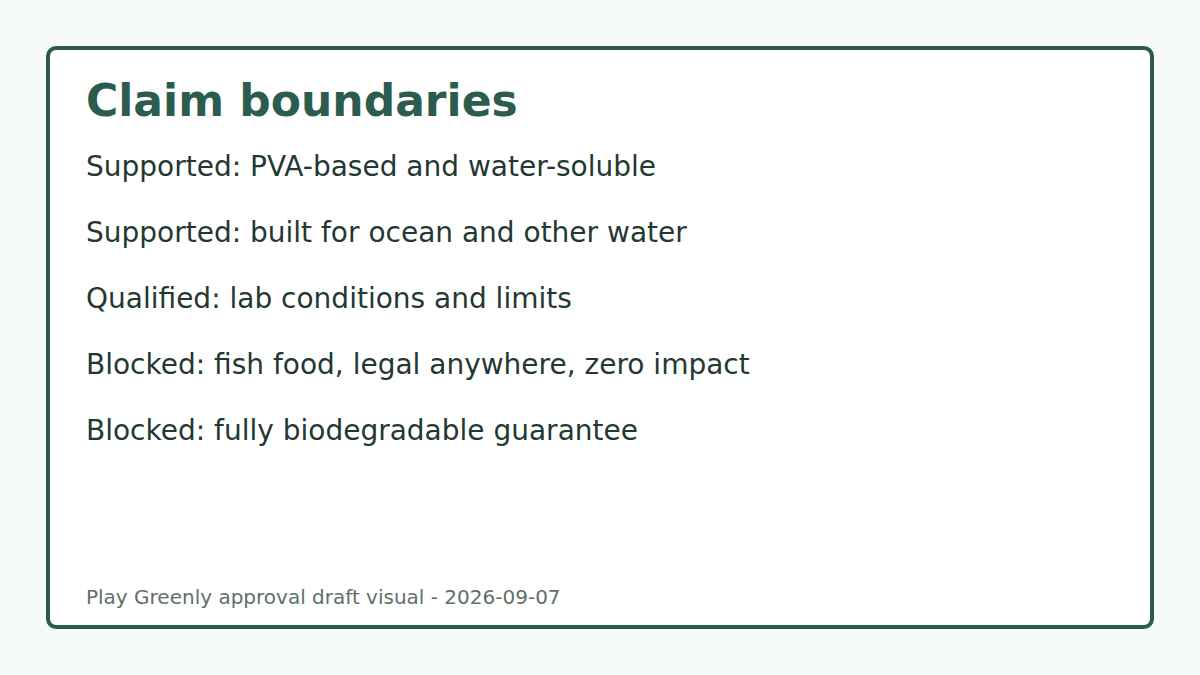
For this article, that means "water-soluble" and "built for water use" are stronger than vague claims like "fully biodegradable," "leaves no trace," or "safe for every ecosystem." A good product page should explain the material, the test conditions, the setting, and what the evidence does not prove.
What Not to Claim
Do not claim:
- fully biodegradable as a finished-ball scientific guarantee;
- compostable golf ball;
- fish food, edible, fish-safe, or wildlife feeding;
- marine biodegradable certification;
- microplastic-free;
- zero impact or leaves no trace;
- legal to hit anywhere;
- tournament conforming;
- guaranteed disappearance in a fixed outdoor timeline.
Better wording is narrower: water-soluble practice golf balls, built for water use, with a controlled fresh-water test result and clear limitations.
Related guides
- Biodegradable Golf Balls
- How to Choose Water-Soluble Golf Balls for Responsible Water Practice
- Do Golf Balls Dissolve in the Ocean?
- Do Golf Balls Sink or Float?
- Are Eco Golf Balls Safe for Fish and Oceans?
- Golf Ball Environmental Claims Glossary
Frequently asked questions
Are water golf balls the same as biodegradable golf balls?
No. "Water golf balls" is an ambiguous buyer phrase. It may refer to floating balls, foam practice balls, or water-soluble practice balls. Check the product evidence before treating it as a biodegradation claim.
Do Play Greenly balls dissolve in water?
The current evidence map supports water-soluble PVA-based practice balls and a supplier laboratory simulation in slow-moving fresh water. The controlled result should be described with its test conditions and should not be promised as a universal outdoor timeline.
Are water-soluble golf balls fish food?
No. Play Greenly's Claims Map blocks fish-food, edible, fish-safe, and wildlife-feeding claims. Water-soluble is not the same thing as food.
Are water golf balls legal to hit into lakes or oceans?
A product attribute does not create legal or site permission. Check the landowner, facility, waterway authority, event rule, and local context before hitting any ball into water.
Which water golf ball should I buy?
Match the product to the job. Use floating balls when retrieval is the point, foam or limited-flight balls for low-impact practice, and water-soluble practice balls when the intended setting is water use and the claim evidence fits.