A good backyard golf game does not need a perfect lawn, expensive training gear, or a group of experienced players. It needs one safe swing direction, targets everyone can understand, and rules that reward progress instead of punishing beginners.
This guide gives you seven formats you can set up with common household markers. Most work with putting or short, controlled chip-style motions. If your space is small, use putting only. If you are using a specialty practice ball, follow its label and keep the activity inside a private, permitted area. Beginners who want a formal rules introduction can use the USGA Rules 101 course, which the USGA describes as appropriate for newcomers.
Start with the three-zone rule
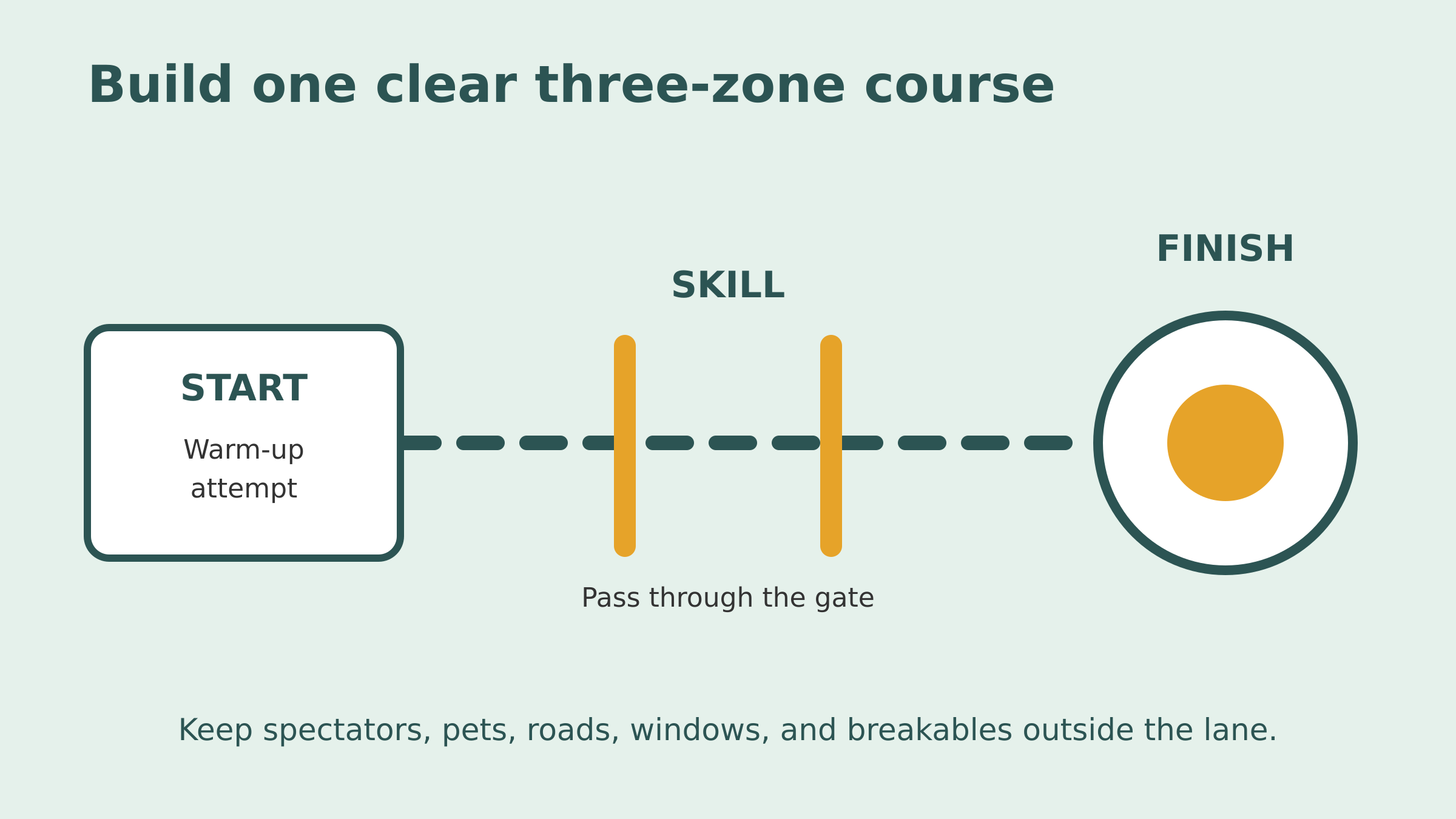
Build the course in three zones: start, skill, and finish. The start zone gives each player one warm-up attempt. The skill zone adds a gate, line, or obstacle. The finish zone uses a clear target such as a towel, bucket, hoop, or chalk circle.
Keep spectators, pets, windows, roads, and breakable objects outside the playing lane. Only the active player should hold a club. Everyone else stands behind the marked start line. If the lane stops being clear, pause the game.
7 backyard golf games for beginners
1. Three-Zone Target Trail
Place a starting mat, a gate made from two cups, and a final target. Each player gets three turns. Award three points for the final target, two for passing through the gate, and one for a safe attempt that stays in the marked lane.
Why beginners like it: every turn can earn something, and the visible sequence makes the game easy to learn.
Easy variation: move the gate wider for new players and narrower for experienced players. Change difficulty by target size before changing swing distance.
2. Around-the-Yard Putting Loop
Choose four flat stations around the yard or patio. Use a towel, coaster, paper plate, or chalk circle as each target. Players complete the loop in order and record how many attempts they need.
Keep it friendly by setting a maximum of three attempts per station. If a player does not finish, they take the maximum and move on. That prevents one station from stalling the whole group.
For another low-pressure format, see Play Greenly’s guide to fun golf games at home.
3. Closest Without Crossing
Mark a line on the ground. Players try to stop the ball as close as possible without crossing it. This format rewards touch, not power, and it works well in compact spaces.
Use three rounds. In round one, everyone plays from the same spot. In round two, beginners move closer. In round three, let each player choose a distance. Choosing the right challenge becomes part of the game.
4. Backyard Golf Bowling
Arrange six lightweight cups or recycled cardboard pins in a triangle. Players putt toward the formation and score one point for each pin touched. Reset after every player so the conditions stay consistent.
Avoid glass, ceramic, or heavy targets. The point is a satisfying visual result, not a hard collision. Putting is the safest default when people or property are nearby.
5. Team Scramble Relay
Split into small teams. Everyone takes one turn from the start. The team chooses the best result and continues from there. Rotate the first player each round so no one becomes the permanent lead.
Scramble formats can help mixed-skill groups because the team shares the outcome. Keep the order predictable and use the same number of turns for each player.
If you want a larger event format, adapt the planning ideas in Play Greenly’s lower-waste tournament checklist.
6. Call-the-Target
Set out three targets with different point values. Before each turn, the player calls the target they intend to hit. A successful called shot earns the full value; a ball that reaches another target earns one participation point.
Calling the target makes the game feel strategic without requiring advanced technique. It also helps hosts see whether the challenge is too easy or too hard.
7. Beat Your Baseline
Give every player three warm-up attempts and record the best result. Then play two scored rounds. The goal is to match or improve the personal baseline, not beat another person.
This works especially well for first-time players or groups with a wide skill range. Celebrate a more controlled roll, a straighter line, or a target reached from the same distance. Do not promise that a backyard game will improve on-course scoring; treat it as recreation and practice.
How to score fairly
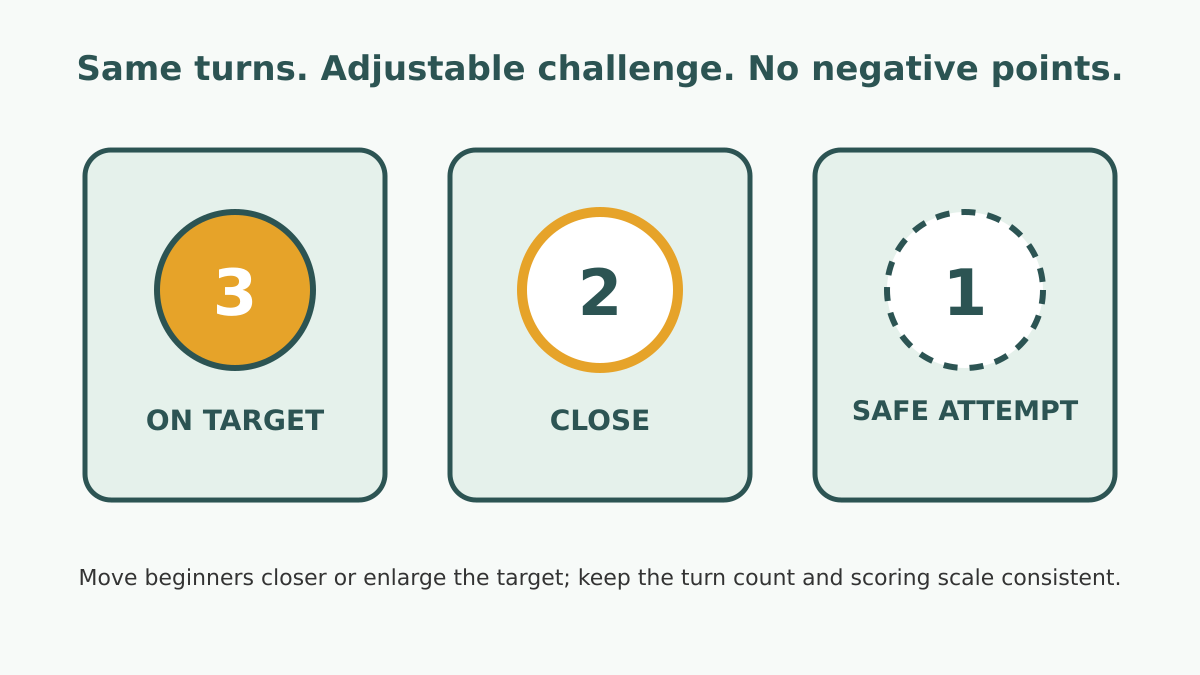
Use the same number of turns, not necessarily the same distance. Beginners can move closer or use a larger target. Experienced players can move back or use a smaller target. Keep the scoring scale identical so everyone can follow the game.
A simple system is three points for on target, two for close, and one for a safe attempt. Avoid negative points. A beginner should not finish a first round with a discouraging total simply because the challenge was set for someone else.
How to keep the game moving
Decide the order before starting. Prepare the next ball while another player retrieves theirs, but never step into the playing lane. Set a maximum number of attempts per station. When it is safe and respectful, let the ready player go next instead of enforcing ceremony.
The R&A describes ready golf as a collection of practices that can support pace of play when used safely and responsibly.
For a backyard version, the key rule is simpler: play only when the lane is clear. Speed never outranks safety.
The 10-minute host checklist
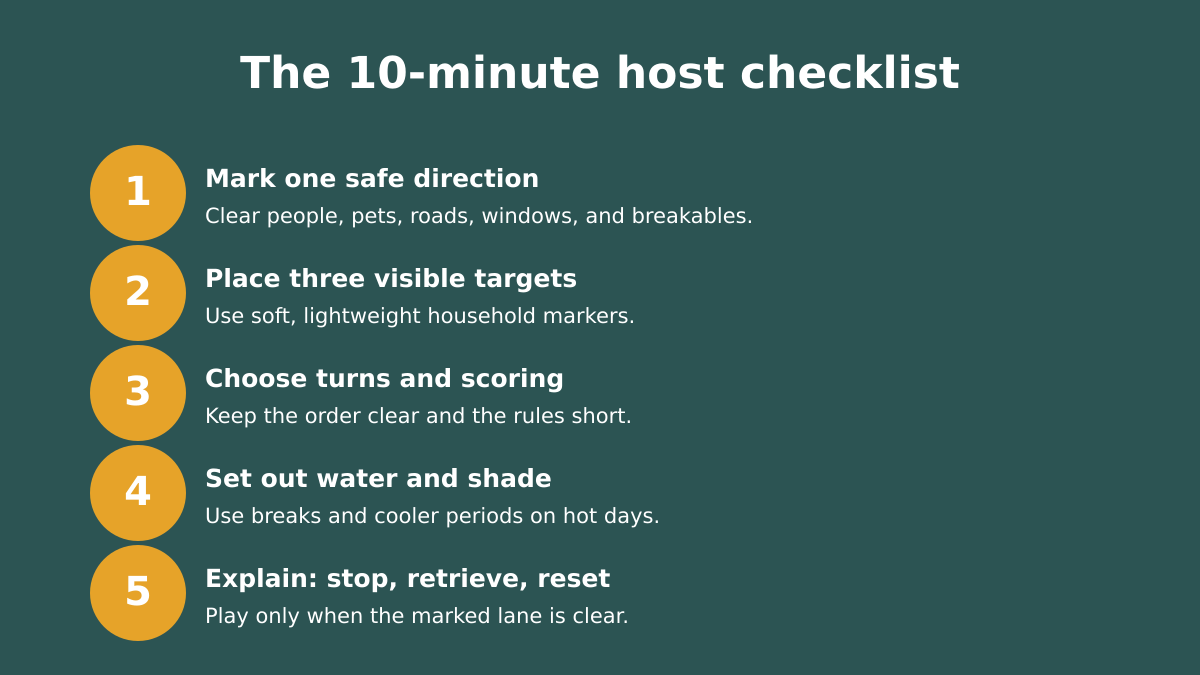
First, mark one safe direction of play. Second, place three visible targets. Third, choose turn order and scoring. Fourth, set out drinking water and identify a shaded break area. Fifth, explain the pause rule: stop, retrieve, reset.
On hot days, move the activity to a cooler part of the day, use shade, take breaks, and keep water available. The CDC recommends staying cool, staying hydrated, and planning outdoor activity for cooler periods when possible.
Stop play for lightning, poor visibility, an obstructed lane, or any situation where a player cannot control the setup. This article is general recreational guidance, not medical or site-specific safety advice.
What equipment do you need?
You can start with one putter, a practice ball suitable for the location, and household target markers. Towels, paper plates, painter’s tape, cardboard cups, and hoops all work. Use soft or lightweight markers and remove them when finished.
Play Greenly offers practice-focused golf products for casual settings; check the current product page and package directions before choosing where and how to use them.
Do not assume that any ball makes a shot permitted in a public waterway or shared space. Check property rules and local requirements. For water-adjacent questions, use Play Greenly’s location checklist.
For product care and expected behavior, review the current explainer before play.
A simple game plan to copy
For four players, set up the Three-Zone Target Trail, Closest Without Crossing, and Backyard Golf Bowling. Give each player three turns at each station. Score 3–2–1, allow closer starts for beginners, and cap each station at five minutes.
That produces a short rotation with visible variety: direction, touch, and target control. Finish with Beat Your Baseline so each player has a personal result to celebrate.
The best backyard golf game is the one people want to play again. Keep the lane clear, the rules short, and the scoring generous. Then change only one variable at a time—distance, target size, or turn count—so the next round feels fresh without becoming confusing.
Frequently asked questions
Can beginners play backyard golf without chipping?
Yes. Every game in this guide can be converted to putting only. Putting is the preferred option when space is limited or people and property are nearby.
How big should a backyard golf target be?
Start large enough that a beginner can succeed within three attempts. Reduce the target size only after the group understands the game.
How long should each game last?
Five to ten minutes per station is usually enough for a casual group. Use a turn cap rather than a time promise if player count or space varies.
Can children join?
Use age-appropriate supervision, keep clubs out of inactive players’ hands, and place all spectators behind the start line. Follow the equipment manufacturer’s age and safety instructions.
Can I hit balls toward a pond or lake?
Do not assume permission. Use only a private or explicitly approved setting, follow product directions, and check applicable property and local rules. The safer default is a dry-land target course.