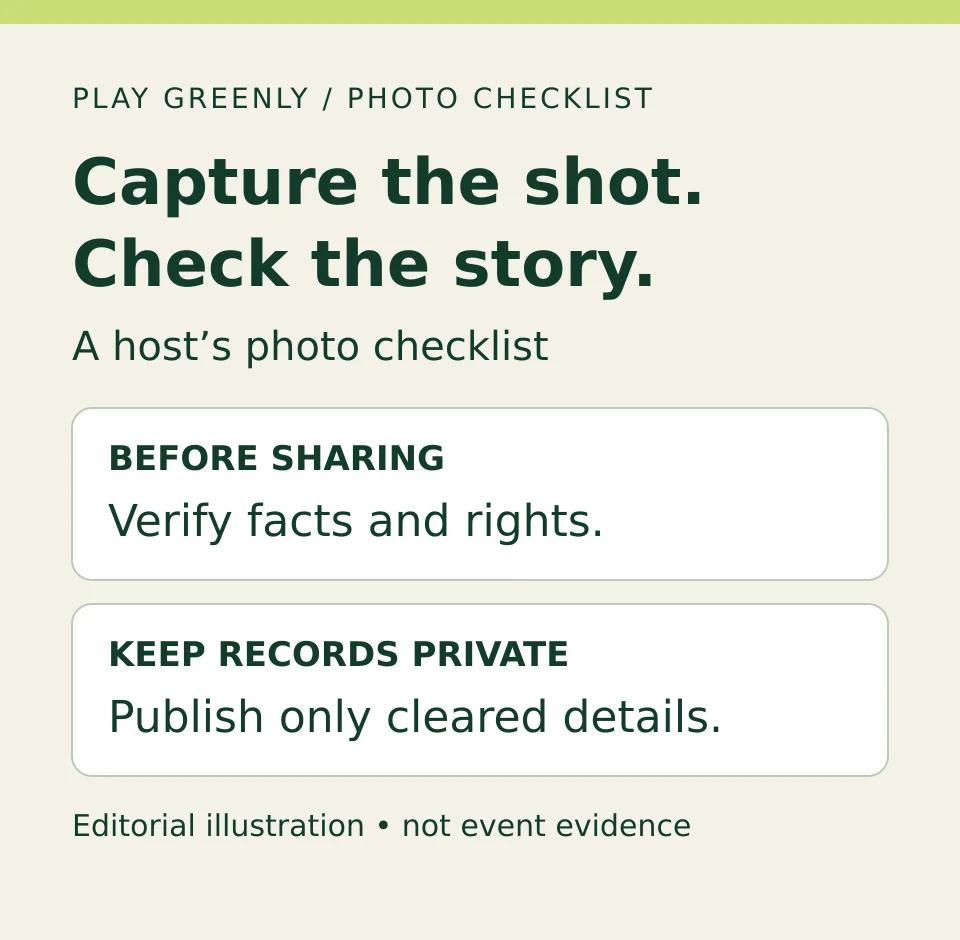
For an event host, a useful golf photo shows what happened and a useful caption explains it accurately. Before sharing, check the activity permission, the right to use the image, the people and information visible in it, and the product wording. Keep private permission records out of the frame. A photograph cannot establish a product's environmental performance or make a water shot lawful.
Play Greenly makes PVA-based, water-soluble practice golf balls built for the ocean and other bodies of water. Use only in private or approved settings and follow local rules. They are not tournament balls, fish food, or a permit. This checklist helps a host or photographer prepare a truthful gallery for review.
Keep permission records behind the camera
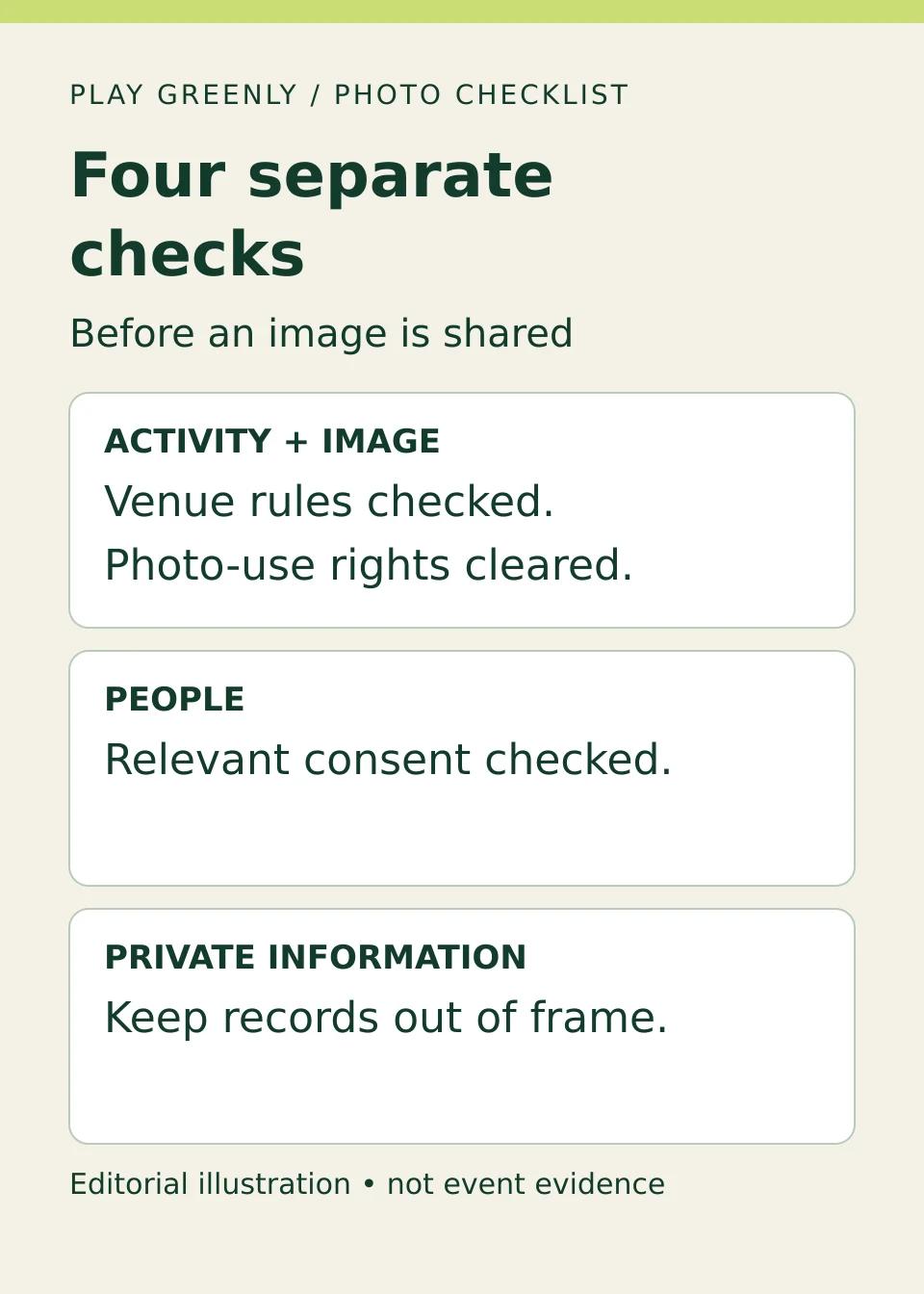
Confirm that the venue allows the planned activity and that applicable rules have been checked before arranging a shoot. Record the decision privately with the event organizer. A venue's consent does not settle every legal question, and a caption saying “permission granted” does not override local restrictions. Start with our water-practice permission guide if the activity itself is still undecided.
Do not photograph an approval email, signature, phone number, guest list, access code, or private permit as proof for a public gallery. A staff member or sign in the background is not proof of permission either. A simple, verified caption can explain that a session was approved without identifying a private individual. Name a venue only when that public use is cleared.
Check image-use rights separately. The U.S. Copyright Office explains that photographs can be protected by copyright and that owners have rights including reproduction and public display, subject to limitations. Agree with the photographer on the intended channels, edits, credit, and any paid use. Hiring someone, receiving a file, or crediting them is not a substitute for checking the agreement.
For this host checklist, also confirm the appropriate consent or release for recognizable participants and the venue's filming rules. These are separate checks from the photographer's copyright. If someone does not want to appear, select another frame or crop them out without misrepresenting the activity. Avoid recognizable children unless the necessary guardian permission and event policy are confirmed. Requirements vary; this checklist is not a jurisdiction-specific legal opinion.
Build a useful shot list
Plan coverage around the session rather than staging a fixed sequence for the camera. Our event-planning checklist covers the wider host plan. For the gallery, consider these four views:
- Station context: the designated hitting area and the space kept clear around it. Keep the photographer outside the swing path and out of the landing area.
- Product and storage: the actual product used, with unused balls kept dry. Use current packaging if packaging appears; do not substitute another product or invent a certification badge.
- The activity: a genuine practice shot from the designated position, captured only when the activity and photography are safe and authorized.
- Closeout: dry unused stock packed away and any safe recovery that actually happened. Do not enter water, lean over an unsafe edge, or delay leaving a hazardous area to create a retrieval photo.
There is no requirement to retrieve a ball before photographing the first swing. There is also no requirement to publish a retrieval photograph when doing so would be unsafe or misleading. A host can keep an accurate closeout record without making every operational record public.
NOAA's marine-debris guidance tells boaters to secure trash and says small debris recovery should be done carefully and safely. It also warns against garbage disposal in U.S. waters and at sea. That guidance does not classify this particular activity as lawful or exempt, and it does not certify a golf ball. Do not turn unused stock disposal into a celebratory “empty the tote” shot.
An illustration can explain a checklist, but it cannot prove an event occurred. Label generated illustrations as illustrations. Do not present a generated splash, staged recovery, or edited scene as documentary product evidence.
Write the caption from verified facts
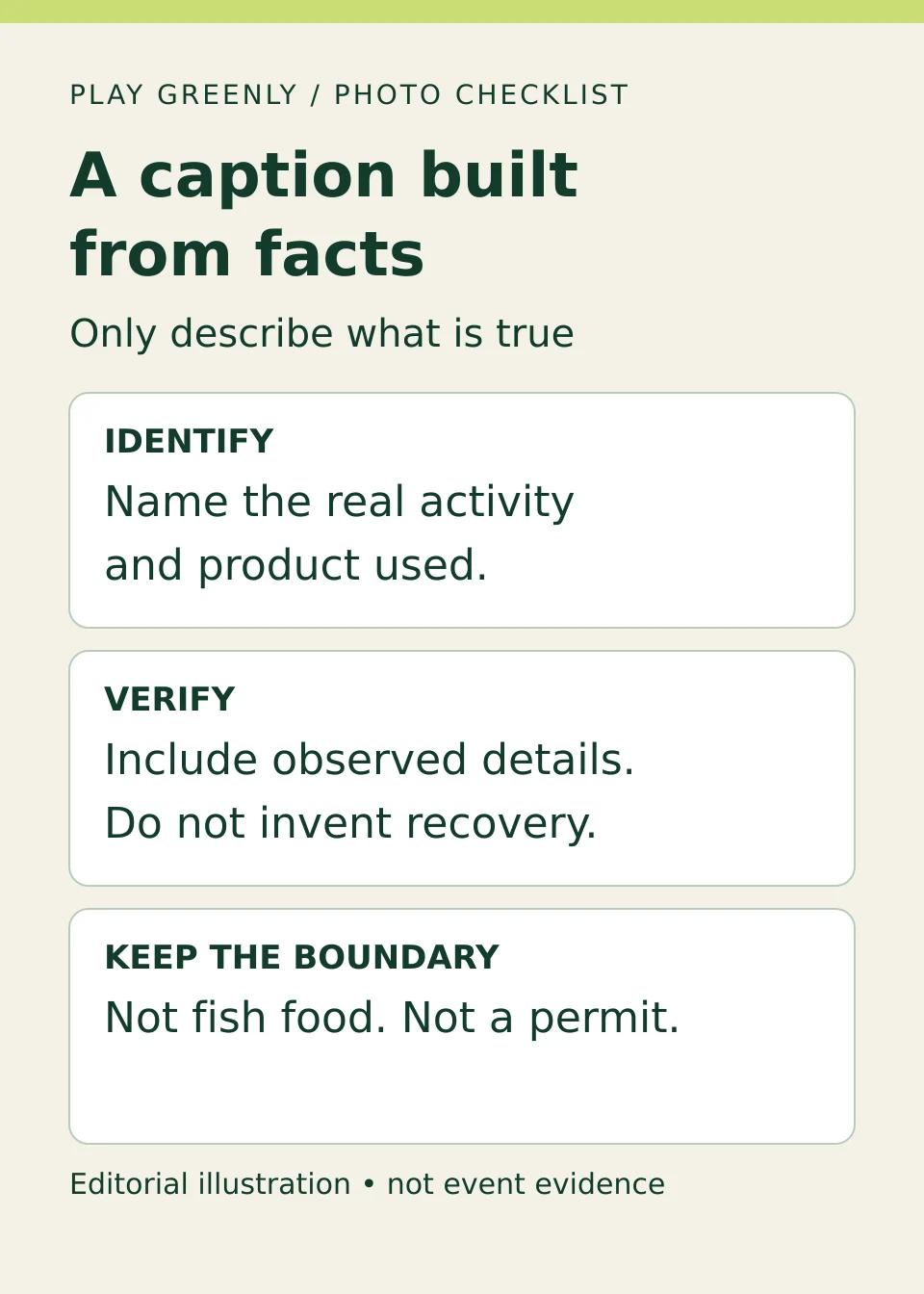
Use three parts: identify the activity and product, add relevant verified context, and state the applicable use boundary. Only describe recovery or storage practices that occurred. If you cannot verify a detail, leave it out rather than fill in the story from a photograph.
Adaptable example, only when each detail is true:
“A supervised practice session with Play Greenly water-soluble golf balls at a venue-approved station. Unused balls stayed dry, and safely reachable balls were recovered under the venue plan. Use only in private or approved settings and follow local rules. Not tournament balls. Not fish food. Not a permit.”
If recovery was not observed, remove the recovery sentence. Do not write “every ball recovered” without a record that supports it. If a sponsorship, gift, or other commercial relationship needs disclosure, send the exact relationship and proposed wording through the applicable review before posting; this template does not supply that clearance.
Keep jokes away from unsupported product promises. “Feeding the fish,” “gone in two weeks,” “zero impact,” and “certified marine biodegradable” are not supported captions for this product. Our fish-food explanation answers that recurring misconception, and the materials guide gives more context on product composition.
Ocean-safe remains approved brand language for the intended water use-case. It is not a marine-biodegradation certificate or permission to hit anywhere. Do not expand it into a wildlife-feeding claim or a guarantee of no environmental impact. Field dissolution results vary with temperature, water movement, salinity, storage, and ball condition; a photograph provides no measured dissolution timeline.
Give the image useful alt text
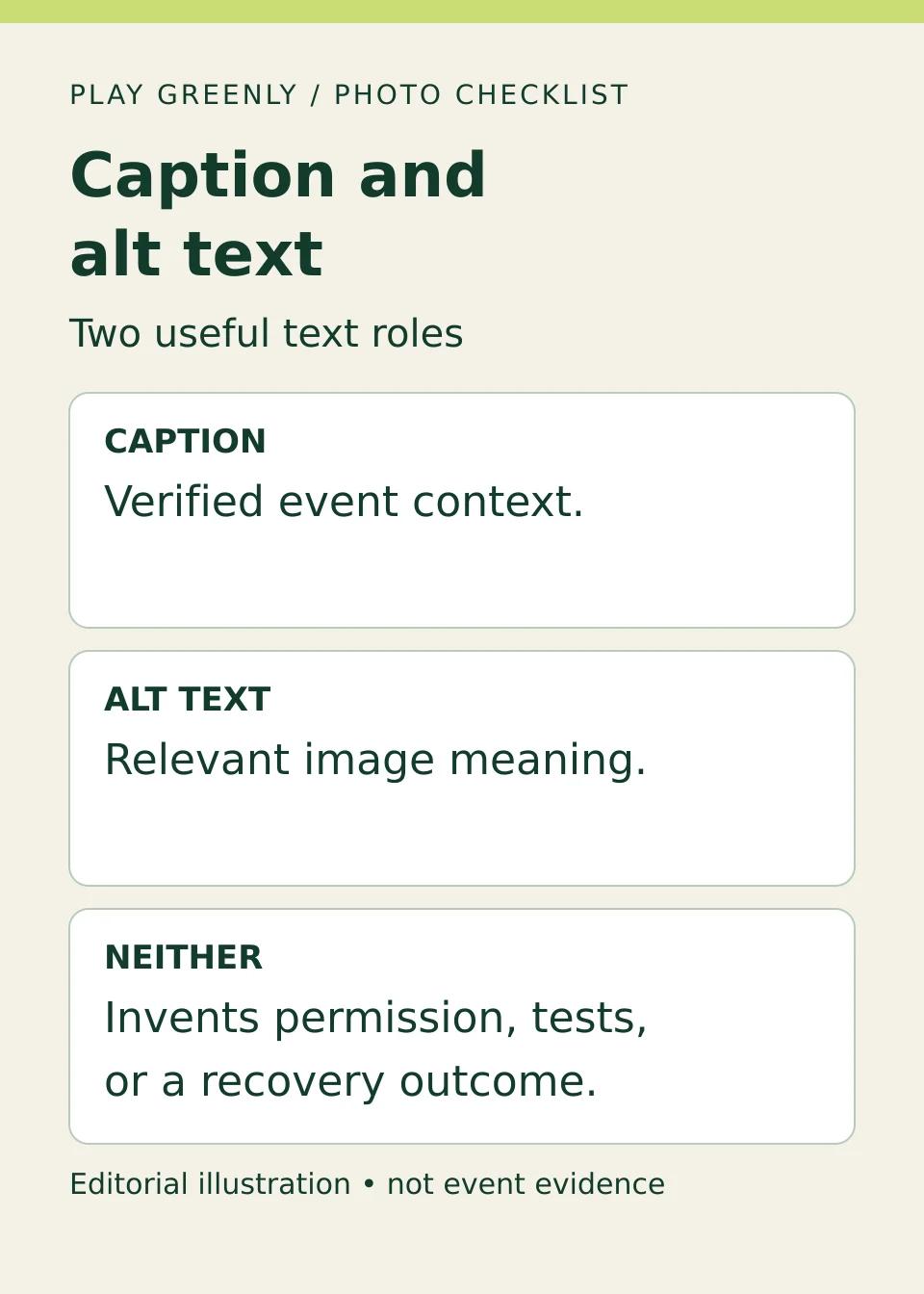
Alt text and captions have different jobs. A caption can provide verified event context; alt text conveys the image's relevant meaning in its page context. W3C's informative-image guidance explains that a text alternative should communicate the information or meaning displayed visually. It need not describe every detail or repeat nearby text.
For a photograph showing a player and a closed tote, a useful example is: “Golfer at a marked practice station beside a closed equipment tote.” Use that only if it matches the selected image and its purpose.
“Permissioned, ocean-safe golf with guaranteed retrieval” is a poor substitute. Permission, environmental performance, and a future recovery outcome are not established by that picture. Put relevant verified context in the surrounding text; do not load it into alt text as if it were visible evidence.
For a diagram, describe the decision it explains. The checklist illustration on this page can use: “Check activity permission, image rights, participant consent, and private information before sharing.” The same information also appears in the article so readers do not have to inspect small text in a picture.
Review the whole frame before sharing
Check the crop, background sign, overlay, caption, alt text, and thumbnail together. Hold the image if it reveals private records, includes a person whose appearance is not cleared, uses a photograph outside the agreed rights, or implies a product result you cannot support. A misleading sign in the background still needs attention even when the caption is accurate.
Choose another frame or make a transparent, non-misleading edit where appropriate. Do not edit out facts that materially change what viewers understand about the activity. Recheck the final exported version, not just the original file. Keep the approved file and wording together so a later repost does not inherit a rejected caption.
For product selection and the intended water use-case, visit Play Greenly water-soluble practice golf balls. Product choice, activity permission, and permission to publish the image remain separate decisions.
Keep one review record with the final export
Use this private working record to keep the selected image and its wording together. It is an editorial handoff aid, not a release form or permission to publish. Store underlying agreements and consent records separately with restricted access; the public gallery should not include this record.
- Export and version: [exact filename and revision]; list the crop, overlay and thumbnail being reviewed.
- Intended use: [specific channel, placement and organic or paid use]; check that the image agreement covers it.
- Separate checks: [activity permission], [photographer rights], [participant consent] and [venue filming rules]; mark each confirmed, unresolved or not applicable with a reason. Keep private evidence references out of the public copy.
- Caption and support: [exact caption]; mark which details are observed or otherwise verified. Remove unsupported recovery, permission or product-result statements.
- Alt text: [exact text for this image in this placement]; check that it conveys the relevant meaning without inventing facts or repeating the whole caption.
- Export review: [background, visible people, private information, overlays and metadata checked]; note any edit that could change what the scene implies.
- Decision and scope: [hold, changes requested, or approved for the stated use], [reviewer role and review date], and [next check if something changes]. A blank or unresolved check stays on hold under this workflow.
Fictional example: a host has cleared a photograph for the event recap on its own website, but a proposed caption says “every ball recovered” without a supporting record. Mark the package “changes requested,” remove that sentence, and review the corrected export and caption together. Do not treat the earlier image clearance as approval of the unsupported wording.
If someone later wants to use the same image in a paid ad, make a new record for that proposed use and verify the rights and approvals again. A recap approval does not establish paid-ad rights. A changed crop, overlay, caption or channel also needs review of the changed package; keep the previous version identifiable so it cannot be mistaken for the approved export.
Questions hosts ask
Must we show the written permission in the gallery?
No. Verify and retain it privately. Do not expose signatures, contact details, or access information. A public caption can state relevant verified context without publishing the underlying document.
Does venue approval let us use any photographer's image?
No. Check the photographer's agreement and the intended use separately. Also review participant consent and venue filming rules; one permission does not replace the others.
Can a photo prove how quickly the ball dissolves?
No. A single frame does not measure a dissolution rate or establish the conditions of a test. Avoid a fixed field timeline in the caption or overlay.
Do we need to stage a retrieval photo?
No. Show only what actually happened and only when safe. Record closeout honestly; never create a risky or fictitious scene to complete a gallery.
Should alt text repeat the entire caption?
Usually it should provide the image's relevant information in context, without unnecessarily repeating nearby text. Use the selected image and its purpose to decide what a reader needs.