Slug: what-are-biodegradable-golf-balls-made-of
Meta description: Biodegradable golf balls can use different material systems, from water-soluble polymers to plant-based fillers. Here is how to read the label without assuming ocean-safe, fish-food, or tournament-ball claims.
Quick Answer
Biodegradable golf balls are not one standard material. Some are conventional-style balls with polymer and rubber components, some use plant-based or mineral fillers, and some practice balls use water-soluble polymers such as PVA/PVOH. The label only tells you where to start. To judge the claim, check the whole product, the setting, the disposal conditions, and whether the seller has evidence for the exact wording being used.
Why the Material Label Is Not Enough
"Biodegradable golf ball" sounds like a simple material category, but it usually mixes three different questions:
- What is the ball made from?
- Where is it intended to be used?
- What claim is the seller actually making?
Those questions matter because a material name does not automatically prove a use case. A water-soluble practice ball is different from a conforming tournament ball. A plant-based filler is different from evidence that the whole item breaks down in a specific environment. A biodegradable claim is different from a fish-food, ocean-safe, non-toxic, compostable, or leave-it-behind claim.
For Play Greenly, the useful positioning is narrow: water-soluble practice balls for controlled, permitted practice settings. Do not read that as a universal permission to hit balls into public water, leave materials behind, feed wildlife, or replace a conforming ball in formal play.
The Main Material Buckets
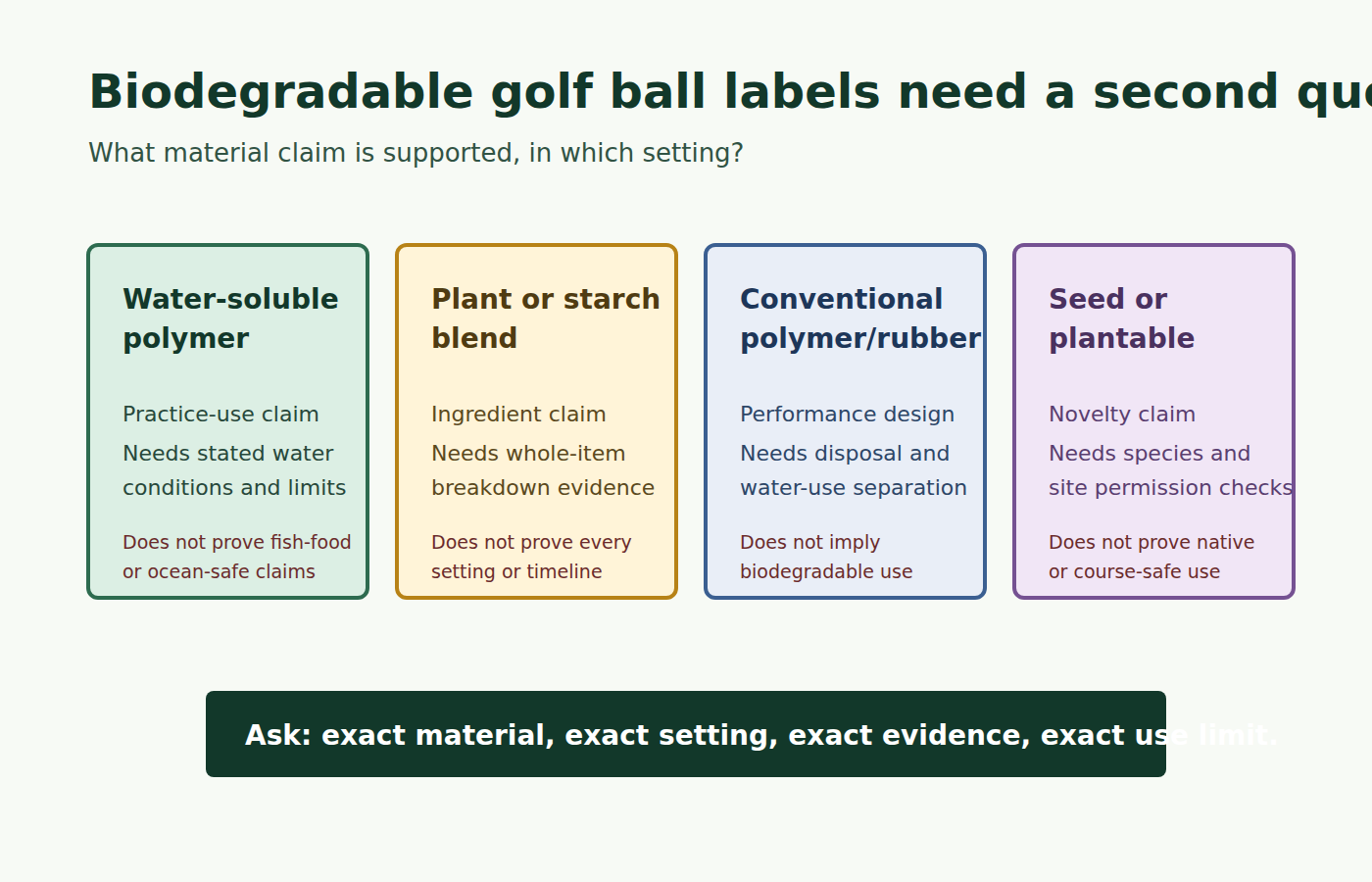
Use this as a buying and copy-review framework, not as a universal chemistry chart.
| Material bucket | What it can mean | What it does not prove | | --- | --- | --- | | Water-soluble polymer practice ball | A ball designed to lose structure in water under stated conditions | Ocean-safe, fish-food, non-toxic, tournament-legal, or safe to leave anywhere | | Plant-based or starch-filled ball | Some portion of the formulation comes from plant-derived or biodegradable ingredients | That the entire ball biodegrades quickly in every setting | | Conventional-style polymer/rubber golf ball | Durable core and cover materials designed for performance | Biodegradable disposal or water-practice suitability | | Seed or plantable novelty ball | A ball marketed with seed or planting language | Native-plant suitability, invasive-species safety, course permission, or product-wide biodegradation |
The safest buyer question is not "is it biodegradable?" It is: "What material claim is supported for this exact ball, under which conditions, and what use does the seller say it is not for?"
What PVA or PVOH Means
PVA/PVOH stands for polyvinyl alcohol, a synthetic polymer widely described as water-soluble. That makes it relevant to water-soluble practice products, but it does not make every product containing it the same.
The degree of hydrolysis, molecular weight, additives, thickness, temperature, agitation, and water conditions can all affect how a product behaves. So the stronger public claim is not "PVA is harmless" or "PVA disappears anywhere." The stronger claim is specific: the product is a water-soluble practice ball, and its use should follow the seller's tested conditions and the site's permission rules.
How to Read a Biodegradable Golf Ball Claim
Before you buy, approve event copy, or write a product page, check four gates:
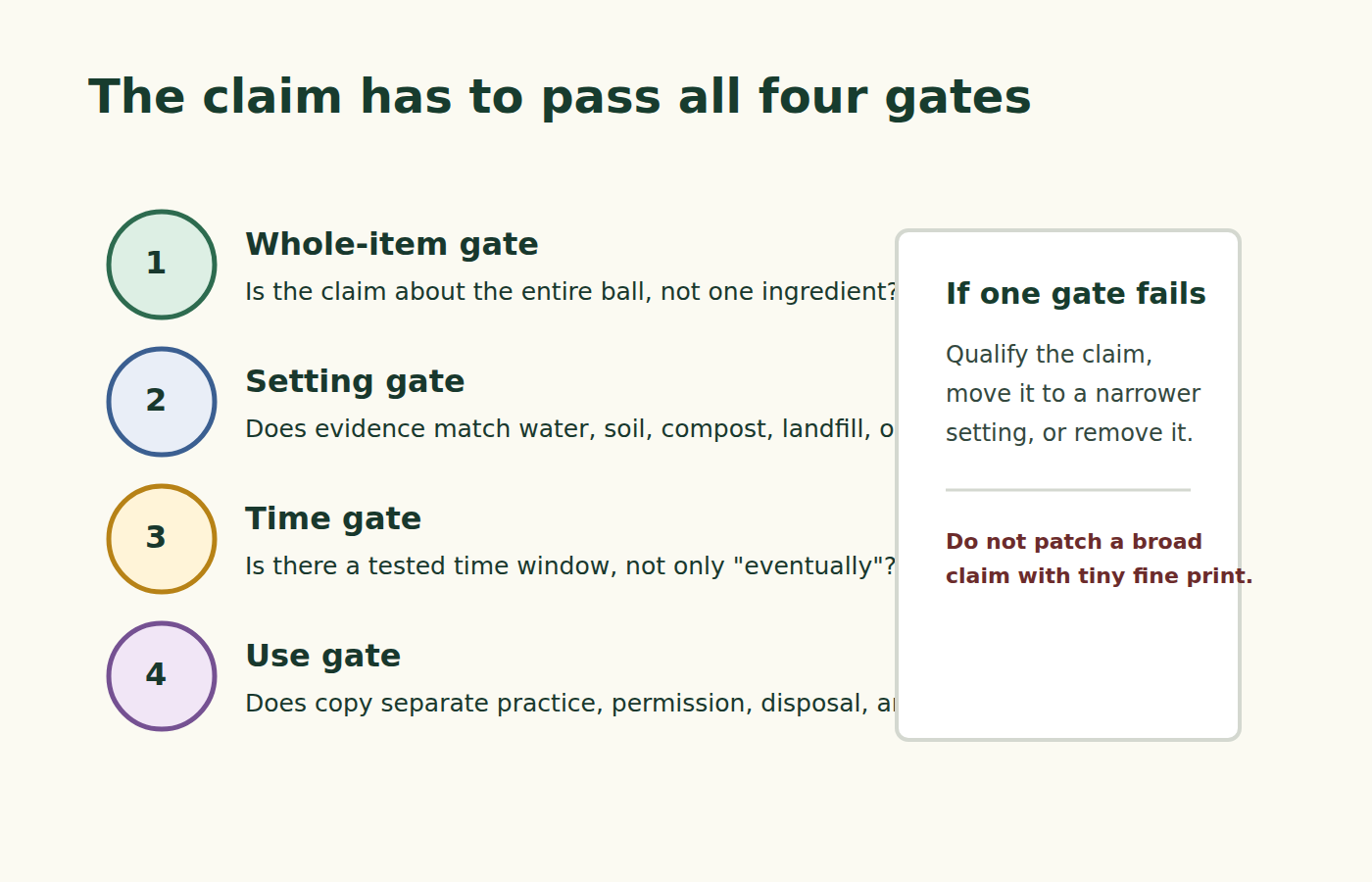
- Whole-item gate: Is the claim about the entire ball, or only an ingredient?
- Setting gate: Does the evidence apply to water, soil, compost, landfill, course turf, or another specific setting?
- Time gate: Does the seller give a tested time window, or only a vague "eventually" claim?
- Use gate: Does the seller clearly say whether the ball is for practice, formal play, public water, wildlife feeding, or leave-behind disposal?
FTC environmental-marketing guidance is useful here because it pushes marketers to identify both express and implied claims and to support reasonable consumer takeaways. If the label can reasonably imply "safe for every ecosystem," "compostable in the rough," or "breaks down quickly anywhere," the wording needs tighter qualification.
Where Play Greenly Fits
Play Greenly should avoid broad material shorthand when the use case is more precise. Better wording:
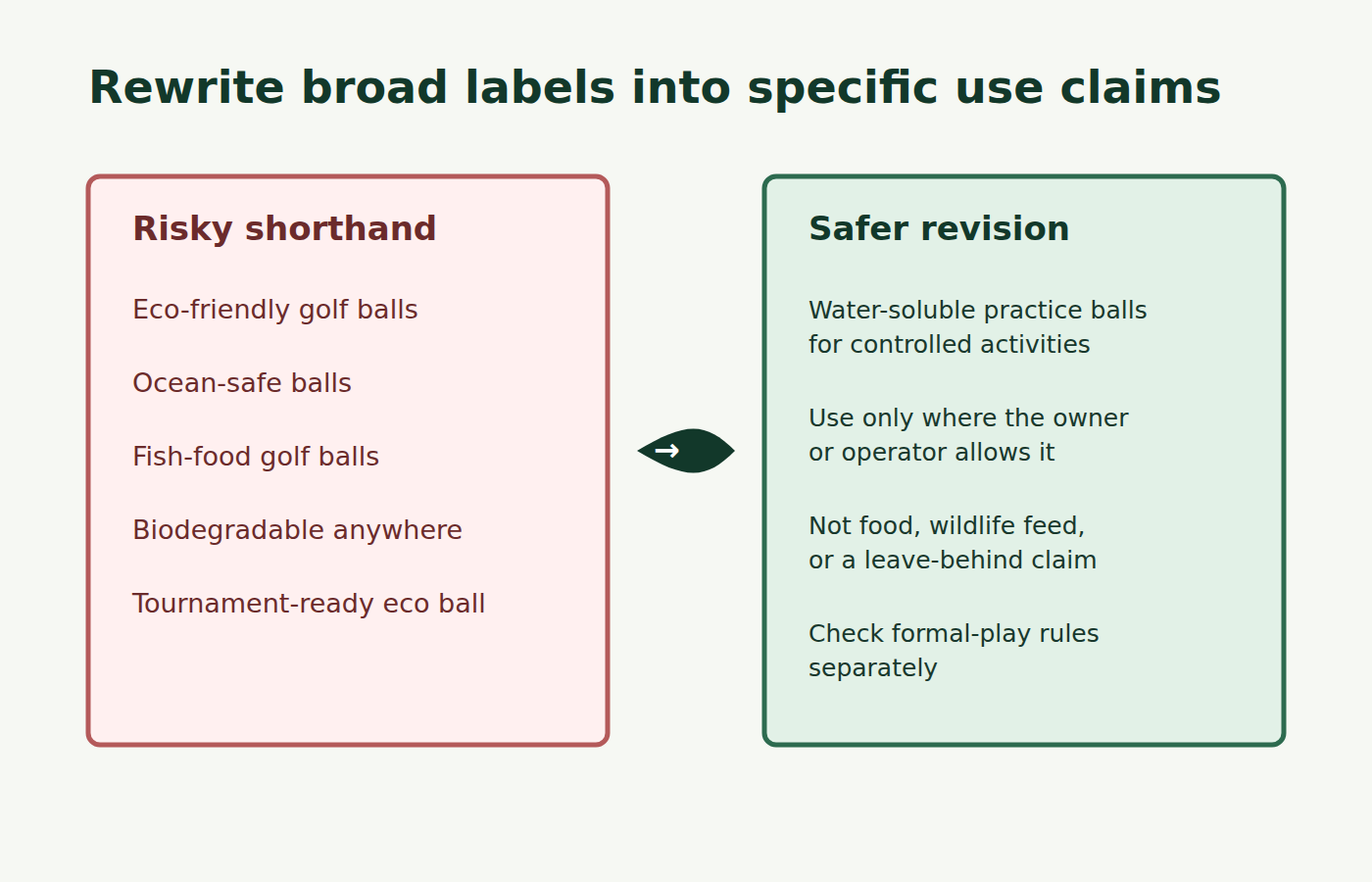
"Water-soluble practice balls for controlled, permitted activities."
Avoid:
- "Ocean-safe golf balls"
- "Fish-food golf balls"
- "Non-toxic golf balls"
- "Hit anywhere"
- "Leave no trace"
- "Biodegradable anywhere"
- "Compostable in the rough"
- "Tournament-ready biodegradable balls"
Those phrases either imply claims outside the current evidence boundary or mix material, permission, safety, and competition questions into one slogan.
What This Means for Different Buyers
For lake-house or dock practice:
Use water-soluble practice balls only where the owner or operator allows the activity. Keep the hitting area controlled, avoid wildlife-feeding language, and do not treat product type as public-water permission.
For events and resorts:
Ask for the exact material claim, expected use setting, quantity, cleanup plan, and post-event measurement plan. The EPA sustainable materials management hierarchy is a useful operating lens: reduce and control materials before celebrating disposal.
For formal rounds:
Check the current competition requirements and conforming-ball expectations. Material or environmental claims do not prove official-play status.
For product-page copy:
Name the product type and the limitation in the same paragraph. If the product is a water-soluble practice ball, say that. If a biodegradation claim depends on conditions, name those conditions or do not use the claim.
Buyer Checklist
Ask these questions before relying on a biodegradable golf ball claim:
- Is the ball for practice or official play?
- Is the material claim about the whole item?
- Does the seller identify the tested environment?
- Does the seller avoid fish-food, ocean-safe, non-toxic, and hit-anywhere language?
- Does the page explain what the product is not for?
- Does the event or venue allow the activity?
- Is disposal or cleanup described in practical terms?
Limitations and Counterargument
The strongest counterargument is that buyers use "biodegradable golf balls" as a normal shopping shorthand, so detailed material boundaries may feel slower than a simple label. That is true. But the simple label is exactly where confusion starts. It can hide whether the claim is about water solubility, biodegradation, plant ingredients, seed novelty, formal play, or disposal.
This article is a material-claim reading guide, not a chemistry certification, legal opinion, wildlife-safety assessment, or tournament-rules decision. Final public copy should be checked against the exact product formulation, test evidence, intended use setting, and current rules.
Frequently asked questions
Are biodegradable golf balls made of plastic?
Some golf balls use synthetic polymer materials, and some biodegradable or water-soluble practice products also use synthetic polymers. "Synthetic" and "water-soluble" are not the same as conventional durable plastic, but neither term proves a broad environmental outcome by itself.
Are water-soluble golf balls the same as biodegradable golf balls?
Not always. Water-soluble describes behavior in water. Biodegradable describes breakdown by biological processes under specific conditions. A product page should use the term supported by its actual evidence.
Does PVA mean the ball is safe for fish?
No. A material name does not prove a wildlife-feeding or ecosystem-safety claim. Avoid "fish food" and "safe for fish" wording unless the exact finished product has evidence for that claim.
Can biodegradable golf balls be used in tournaments?
Do not assume that. Official-play status depends on the applicable rules and conforming-ball requirements, not on an environmental material claim.
Should a seller say "eco-friendly biodegradable golf balls"?
Only with clear, prominent qualification tied to specific, supported benefits. Broad "eco-friendly" wording can imply far-reaching benefits that one product feature may not substantiate.
Sources Consulted
- https://www.ftc.gov/news-events/topics/truth-advertising/green-guides
- 16 CFR Part 260, Guides for the Use of Environmental Marketing Claims: https://www.ecfr.gov/current/title-16/chapter-I/subchapter-B/part-260
- https://pubchem.ncbi.nlm.nih.gov/compound/Poly_vinyl-alcohol
- https://www.epa.gov/smm/sustainable-materials-management-non-hazardous-materials-and-waste-management-hierarchy
- https://www.usga.org/equipment-standards/equipment-rules-2019/equipment-rules/part-4-rule-1-interpretations.html
- Play Greenly Brand, Ads and Marketing Operational Guide, Google Doc 1g66rSkZ9q76BUaPk5Yq5zt8WlU94bYA1z5_VIpZ9ALo, modified 2026-08-17T18:36:37Z