Slug: eco-golf-event-sponsor-claims
Meta description: Sponsor signs can support a lower-waste golf event, but broad green claims need proof. Use this copy checklist to keep Play Greenly event language specific, sourced, and permission-aware.
Quick Answer
An eco golf event sponsor can make specific, provable claims about the activity: controlled-use water-soluble practice balls, a marked hitting area, venue permission, retrieval-first rules, measured quantities, and clear post-event cleanup. Avoid broad claims like "zero impact," "ocean-safe," "non-toxic," "fish food," or "biodegradable anywhere" unless every reasonable takeaway is supported. For Play Greenly, the safer line is event-specific: "A controlled water-practice activation using water-soluble practice balls, with venue approval and cleanup rules."
Why Sponsor Copy Needs a Claim Gate
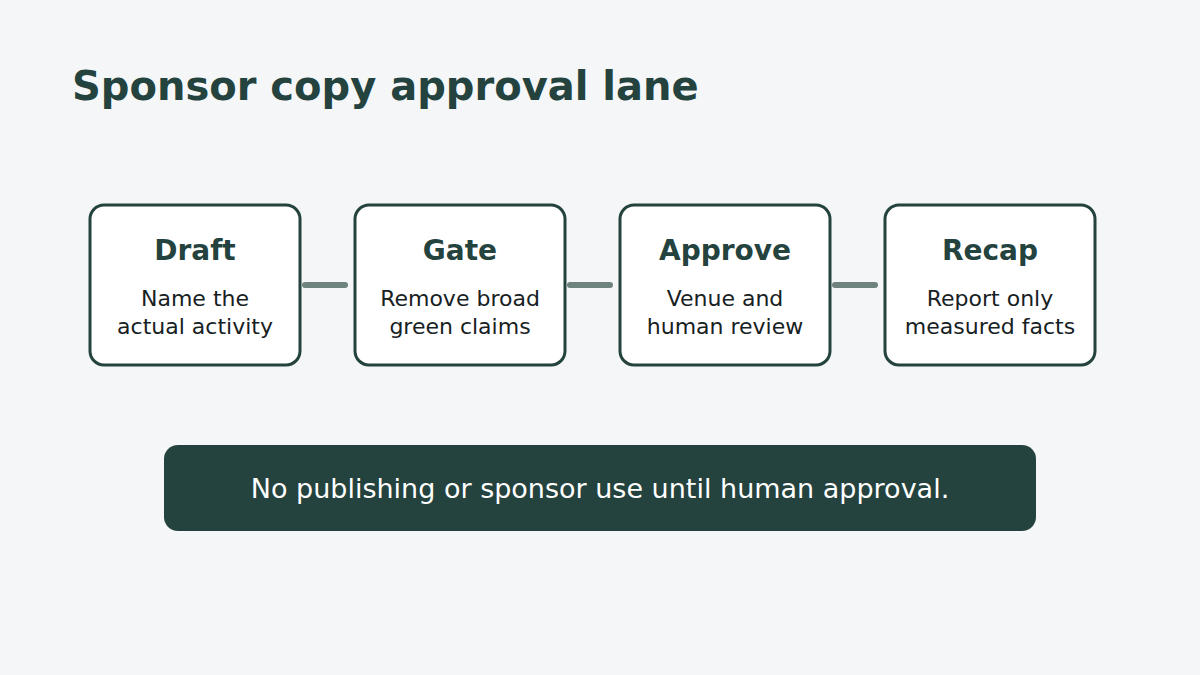
Golf-event signage is small, fast, and easy to overstate. A sponsor tent, tee sign, landing page, or registration email can turn a careful product into an unqualified environmental promise if it uses loose language.
The FTC Green Guides are the main U.S. reference for environmental marketing claim discipline. The current eCFR version of 16 CFR Part 260 says general environmental benefit claims can imply broad, difficult-to-substantiate meanings. The FTC's Green Guides page describes the guides as help for marketers avoiding misleading environmental claims.
That matters for golf because event copy often has three audiences at once:
- Players who want a quick reason to participate.
- Venue staff who need risk and cleanup control.
- Sponsors who want a credible sustainability association.
The right copy gives each audience a concrete action, not a vague halo.
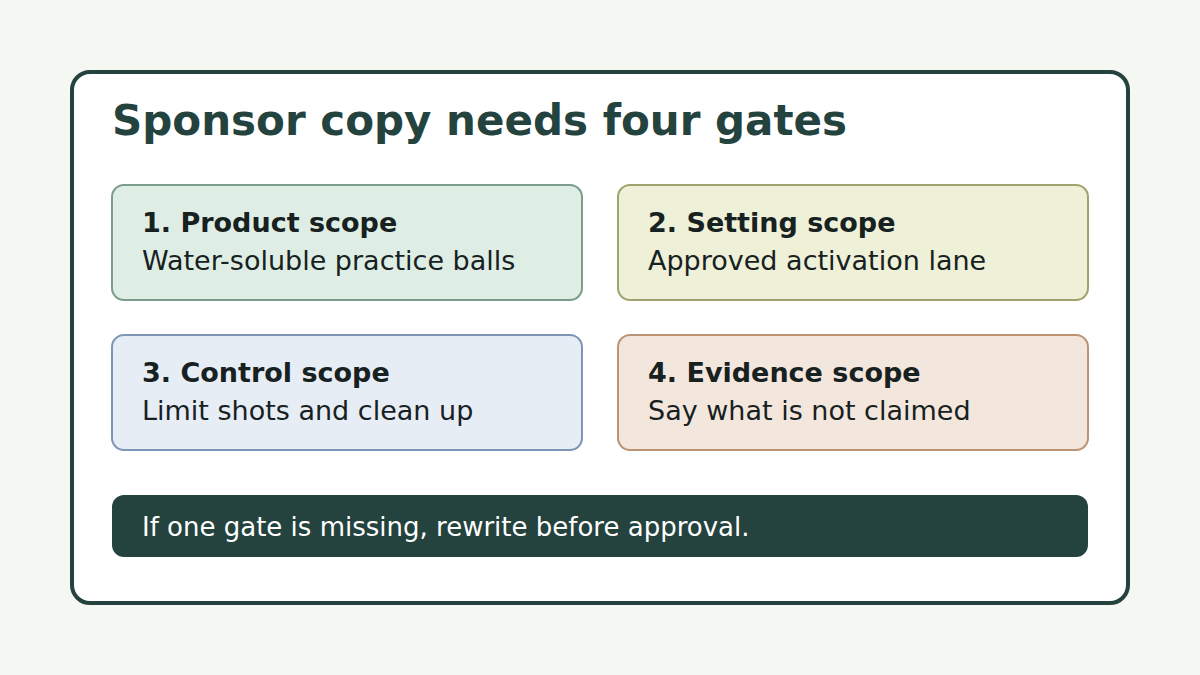
A Good Sponsor Line Has Four Parts
Use this structure before a sign, email, or landing page goes live:
- Product scope: what the product is, such as "water-soluble practice balls."
- Setting scope: where it is used, such as "in a marked activation lane approved by the venue."
- Control scope: what participants do, such as "limited shots, staff supervision, and cleanup check."
- Evidence scope: what is and is not being claimed, such as "not a tournament ball, legal opinion, wildlife-feed claim, or permission to hit into public water."
Quotable definition: A sponsor claim is approval-ready only when the wording names the product, setting, controls, and proof boundary in the same message.
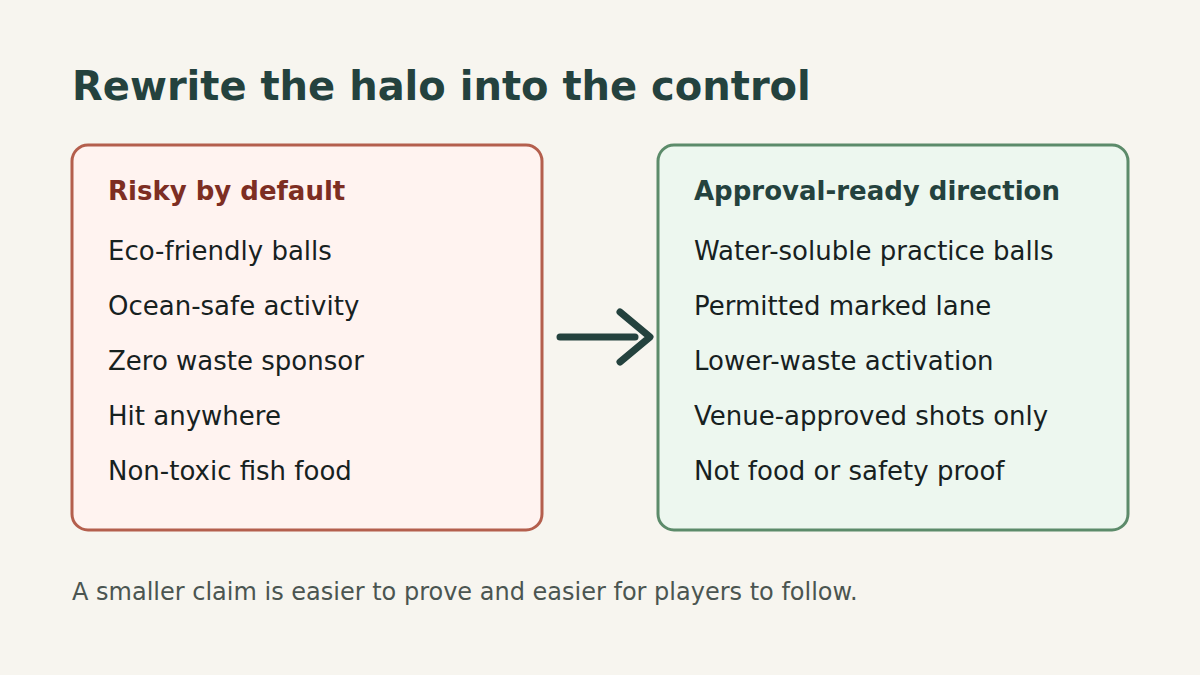
Copy That Usually Needs Rewriting
Avoid treating these as default event claims:
- Risky: Eco-friendly golf balls. Why: broad environmental benefit claim; may imply far-reaching benefits. Safer: water-soluble practice balls for a controlled event activity.
- Risky: Ocean-safe. Why: undefined and likely broader than the available evidence. Safer: designed for controlled, permitted water-adjacent practice.
- Risky: Non-toxic. Why: can imply safety for humans and the environment generally. Safer: use only the specific tested condition or avoid the claim.
- Risky: Fish food. Why: implies edible or wildlife-feeding use. Safer: not food; keep the activation controlled.
- Risky: Zero waste. Why: requires a full event waste system and measurement, not just one product swap. Safer: lower-waste activation with defined cleanup steps.
- Risky: Biodegradable anywhere. Why: biodegradable claims depend on conditions and disposal context. Safer: name the environment and evidence, or use water-soluble practice wording.
The EPA's sustainable materials management hierarchy emphasizes source reduction, reuse, recycling, composting, energy recovery, then treatment and disposal. That supports a practical event rule: start with fewer, controlled materials before celebrating disposal outcomes.
Event Copy Examples
Use these as starting points, then adjust for the actual venue and approval.
Ready for signage:
> Controlled water-practice activation: Play Greenly water-soluble practice balls, marked lane, limited shots, staff supervision, and cleanup check. Venue approval required.
Ready for registration:
> This optional activation uses Play Greenly water-soluble practice balls in a controlled area. It is not tournament play, a public-water permission, or a wildlife-feed activity.
Ready for sponsor recap:
> The sponsor supported a controlled, lower-waste golf activation with defined quantities, staff supervision, and cleanup documentation. No broad environmental benefit or legal-permission claim is being made.
Do not use:
> Hit ocean-safe balls anywhere with zero impact.
That line mixes a broad safety claim, a location permission claim, and an unsubstantiated outcome.
Where Play Greenly Fits
Play Greenly should be positioned as controlled-use water-soluble practice balls for permitted activities. That is different from official scoring, seed dispersal, land composting, public-water dumping, or a general "green ball" promise.
For posted rounds or formal competitions, a committee may require balls from the current conforming-ball list. The USGA describes conforming club and ball lists for equipment standards, and the USGA conforming-ball list identifies balls tested against the Rules of Golf. Sponsor copy should not imply that an environmental product claim proves competition status.
Sponsor Approval Checklist
Before finalizing signage or email copy, check:
- Does the copy name the activity as practice or activation, not official scoring?
- Does it say venue approval is required?
- Does it avoid "ocean-safe," "non-toxic," "fish food," "zero impact," and "hit anywhere"?
- Does it avoid unqualified biodegradable, compostable, recyclable, or eco-friendly claims?
- Does it describe controls: marked lane, quantity limit, staff supervision, and cleanup?
- Does it match the actual event plan and the products being used?
- Does the recap promise measurement only if the event will actually record it?
Limitations and Counterargument
The strongest argument against sponsor signage is that any environmental message can become a green halo. That is true when a sign says only "eco," "green," or "zero waste." It is not true for every message. A narrow sign that explains the controls, venue approval, and limits can reduce confusion because it tells participants what not to assume.
This article is a marketing-copy checklist, not legal advice. Local rules, venue contracts, waterbody restrictions, insurance requirements, tournament terms, and product evidence can change the final wording.
Frequently asked questions
Can we call the activation eco-friendly?
Only with clear qualification. A broad "eco-friendly" claim can imply more than one controlled activation proves. Use a specific line such as "controlled water-practice activation with water-soluble practice balls and cleanup checks."
Can the sponsor say zero waste?
Not from the ball choice alone. "Zero waste" needs an event-wide waste plan, measurement, and clear scope. If the event is not measuring diversion and leftovers, use "lower-waste activation" or describe the specific controls.
Can signage say biodegradable golf balls?
Use caution. Biodegradable and degradable claims depend on conditions and complete-item evidence. If the actual product and evidence are water-solubility based, say water-soluble practice balls instead.
Does venue approval replace claim substantiation?
No. Venue approval answers whether the activity is allowed at that site. It does not prove broad environmental, safety, disposal, or competition claims.
Should sponsor copy mention cleanup?
Yes. Cleanup makes the operational claim concrete and reduces the chance that players interpret the product as permission to leave materials behind.
Sources Consulted
- https://www.ftc.gov/news-events/topics/truth-advertising/green-guides
- 16 CFR Part 260, Guides for the Use of Environmental Marketing Claims: https://www.ecfr.gov/current/title-16/chapter-I/subchapter-B/part-260
- https://www.epa.gov/smm
- https://www.epa.gov/smm/sustainable-materials-management-basics
- https://www.usga.org/content/usga/home-page/equipment-standards/conforming-club-ball-lists.html
- https://www.usga.org/ConformingGolfBall/