By Play Greenly • Reviewed October 11, 2026
Plan a short waterfront golf activity around a clear guest experience: one supervised turn, a shared challenge, and a defined finish. Agree the site rules, waiting area, shot budget, weather shelter, and cleanup plan before opening. Keep unused balls dry and count what happened. Water-soluble product wording does not replace permission, supervision, or local requirements.
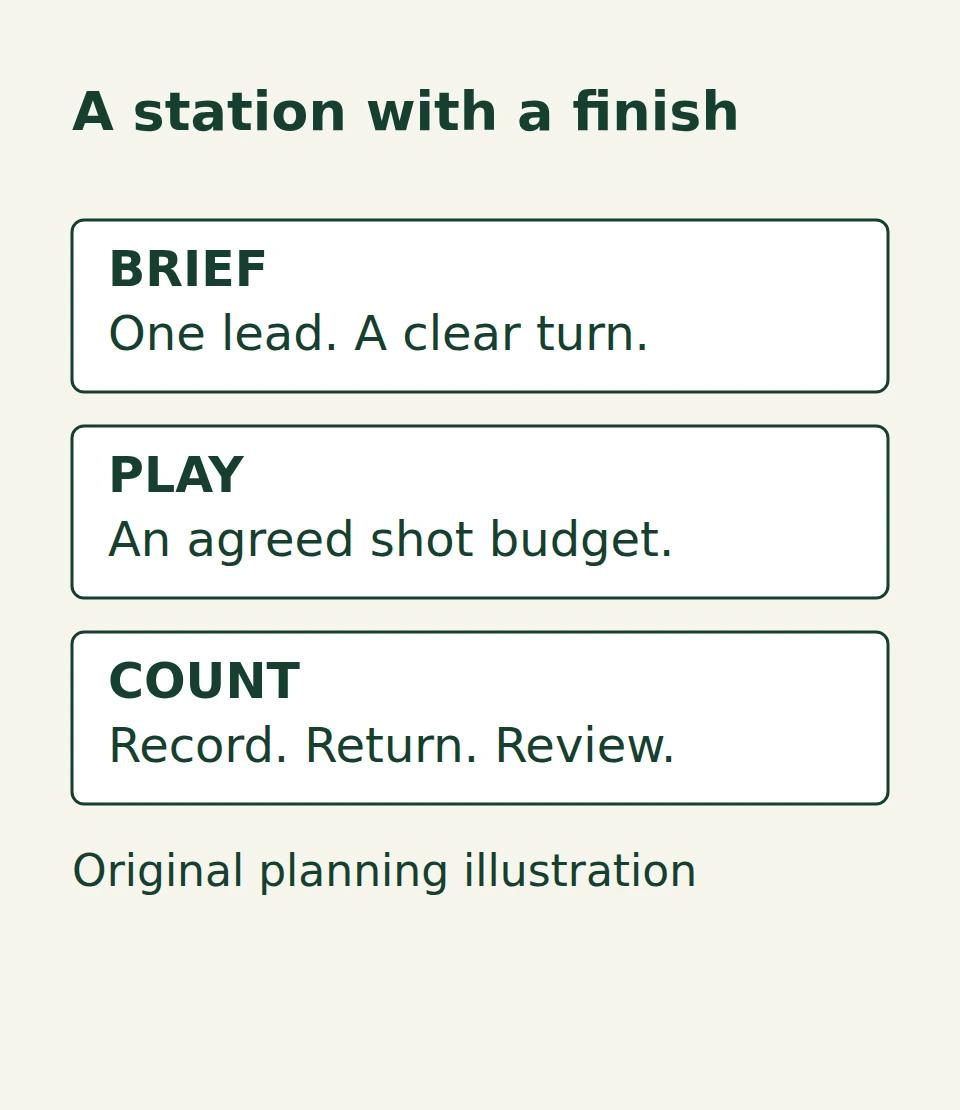
An original planning illustration of the station sequence: brief, play, count. It does not depict an actual venue or prove site approval.
Choose one job for the station
For a company outing, the job is to give colleagues a short shared activity without turning the waiting line into a second event. Choose one simple challenge and let guests opt out or take a non-swinging role, such as keeping score. Do not promise improved team performance or a therapeutic benefit; this is a proposed activity format.
A controlled station is a bounded activity with a named lead, a defined playing area, an agreed number of attempts, and a stop rule. Build it into the broader event plan rather than treating the water’s edge as an open driving range.
Use the golf tournament planning checklist to coordinate the station with the rest of the outing.
Agree the operating plan before opening
- Permission: identify the venue contact and any other authority whose rules apply. Confirm the activity location and applicable requirements. A property owner’s consent alone may not settle every local restriction.
- People: assign a station lead and a weather monitor. The weather monitor should have enough attention and authority to stop play; do not make a busy host responsible for every task at once.
- Space: have the venue approve the hitting direction, waiting area, swing clearance, accessible route, and retrieval approach. This article does not specify a safe setback distance or replace a site assessment.
- Materials: keep unused product sealed and dry. Issue a small working quantity; keep reserve inventory away from the water.
- End point: agree when the station closes, who counts stock, and who handles cleanup. An unused ball remains inventory.
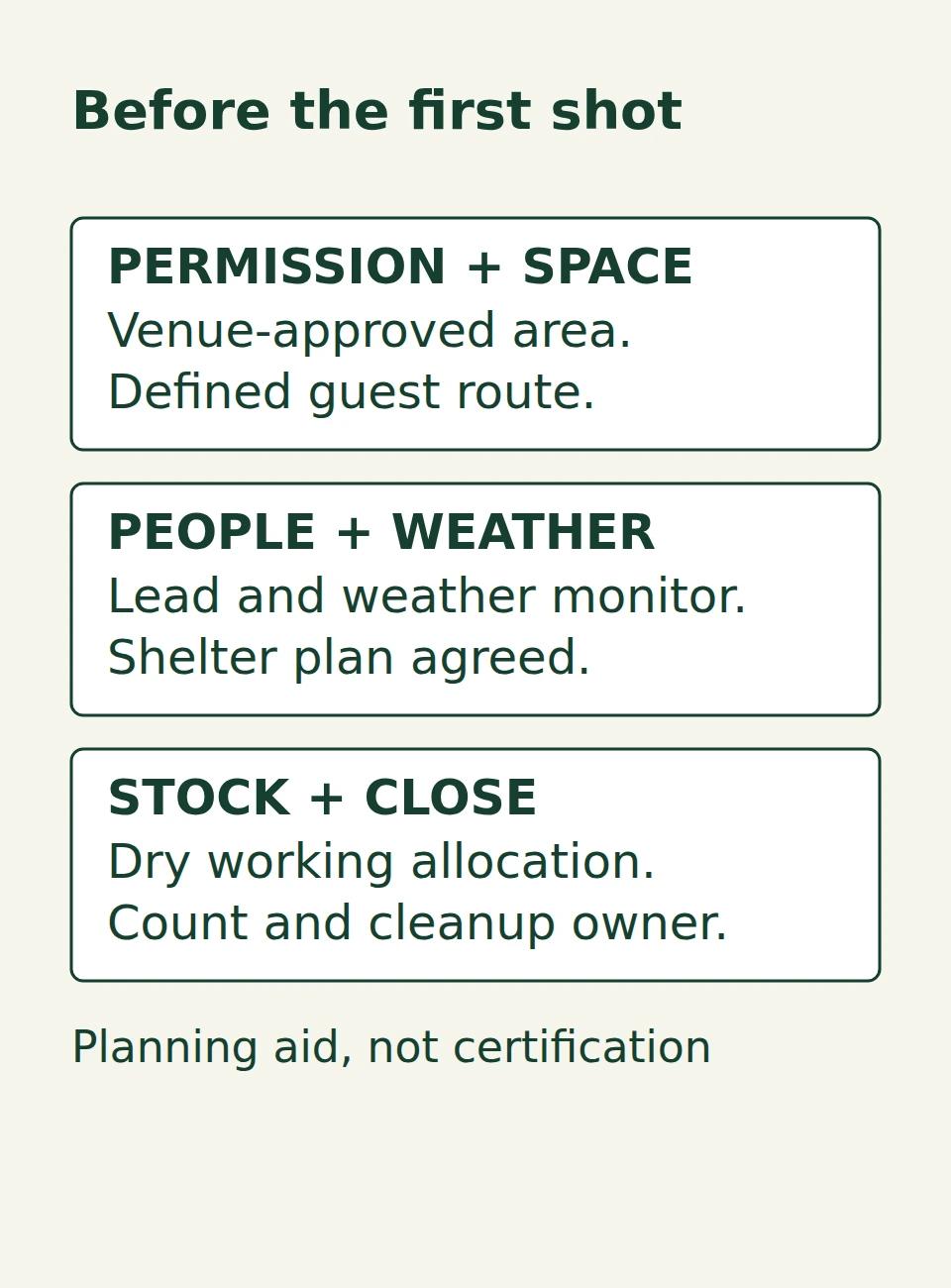
Opening checklist. All three decisions need an owner; the diagram is an editorial planning aid, not a site-safety certification.
Make the shot budget explicit
Use the event quantity guide for purchasing and capacity planning. For this station, write the agreed participant count, attempts per person, and demonstration allowance on the handoff sheet. Rehearse the turn length before advertising a capacity or queue time.
Illustrative planning example, not a recommended environmental limit: 24 participating guests × 2 attempts + 4 demonstration attempts = 52 balls allocated. This arithmetic does not establish that 24 guests can finish within 30 minutes, or that 52 shots are appropriate for a particular site. The venue may require fewer shots, a different format, or no water shots.
Give the lead a fixed allocation rather than an open tote. If time runs short, reduce turns or end the station; do not invent a finale that empties the reserve into water. Keep the detailed product rehearsal in the pre-event test guide.
Use a handoff card between guest groups
A rotation card is a short record of one group’s agreed turn and what the lead hands to the next shift. Use group labels instead of guest names. It is a proposed coordination aid, not a capacity test, attendance roster, permission form, or weather all-clear. Keep it with the station’s operating notes; do not publish filled records.
Copy these fields into a blank card and adapt them to the venue plan before opening:
- Group and planned slot: [group label] / [start–finish window; confirm after rehearsal].
- People and choices: [invited count] / [choosing to swing] / [choosing another role or opting out]. Do not record why someone opts out.
- Working allocation: [maximum attempts for this group] / [separately authorized demonstrations]. Keep reserve stock separate.
- Owners: [station-lead role] / [weather-monitor role] / [receiving-lead role]. Confirm who has stop authority.
- Observed activity: [attempts actually hit] / [dry, unissued returns] / [held or uncertain stock]. Use unknown when an observation is missing.
- Station state: [open, paused, or closed] / [reason] / [next action under the venue plan]. Record only after people are safe.
- Handoff: [time] / [outgoing role] / [receiving role’s acknowledgement] / [unresolved issue and owner]. Acknowledgement does not authorize reopening or release held stock.
Separate fictional example: Group A has six invited colleagues and a maximum of two attempts each, so its working allocation is 12 balls. Four colleagues choose to swing twice; two choose to watch. The lead records 8 hit and 4 dry, unissued returns: 8 + 4 = 12. No demonstrations or damaged stock occur in this example. These are invented numbers, not attendance, demand, throughput, or environmental results.
Do not transfer the two unused turns or four returned balls into extra shots for another group automatically. The station lead checks the agreed event allocation, available time, venue conditions, and operating plan first. If an observed count differs from the planned count, keep both and record the unresolved difference; do not convert a missing observation into zero.
If weather stops the rotation, stop and shelter immediately. Complete the card only once safe. A signed handoff, finished time slot, or balanced stock count is not an all-clear. Keep the next group waiting away from the activity until the venue’s restart conditions are met.
Give guests a short, factual brief
After the relevant permissions and checks are actually complete, adapt this script: “Wait here until the station lead invites your turn. Hit only from the marked area in the agreed direction. Please follow the attempt limit and keep unused balls on the table. If we call stop, put the club down and follow the lead’s instructions.”
For product questions, use the approved description: “Play Greenly makes PVA-based, water-soluble practice golf balls built for the ocean and other bodies of water.” Keep the boundary beside it: results vary with temperature, water movement, salinity, storage, and ball condition. Use only in private or approved settings and follow local rules. Not a tournament ball. Not fish food. Not a permit.
Do not add a universal disappearance deadline, wildlife-feeding claim, or finished-ball compostability certification. The approved ocean-safe brand wording describes the intended water use; it is not evidence of zero impact or a marine-biodegradation certificate. This checklist makes no field-dissolution measurement.
Write the shelter and restart rules in advance
The National Weather Service recommends a lightning safety plan for organized outdoor activities that identifies when to stop, where to shelter, when to resume, and who makes the decision. Its guidance says no place outside is safe when a thunderstorm is in the area. Stop immediately and move to a substantial building; a hard-topped metal vehicle with windows closed is an alternative when no substantial building is available. Small rain shelters and sheds are not safe lightning shelters.
Wait at least 30 minutes after the last thunder before resuming outdoor activity, and follow any stricter venue policy. A manager’s permission does not replace that waiting period. Do not delay sheltering to count stock, take photos, or retrieve balls.
For rain without a lightning threat, pause under the venue’s operating plan, protect unused stock if safe, and reassess the surface and guest route before reopening. Treat rain as a handling issue, not proof of how quickly a ball will dissolve.
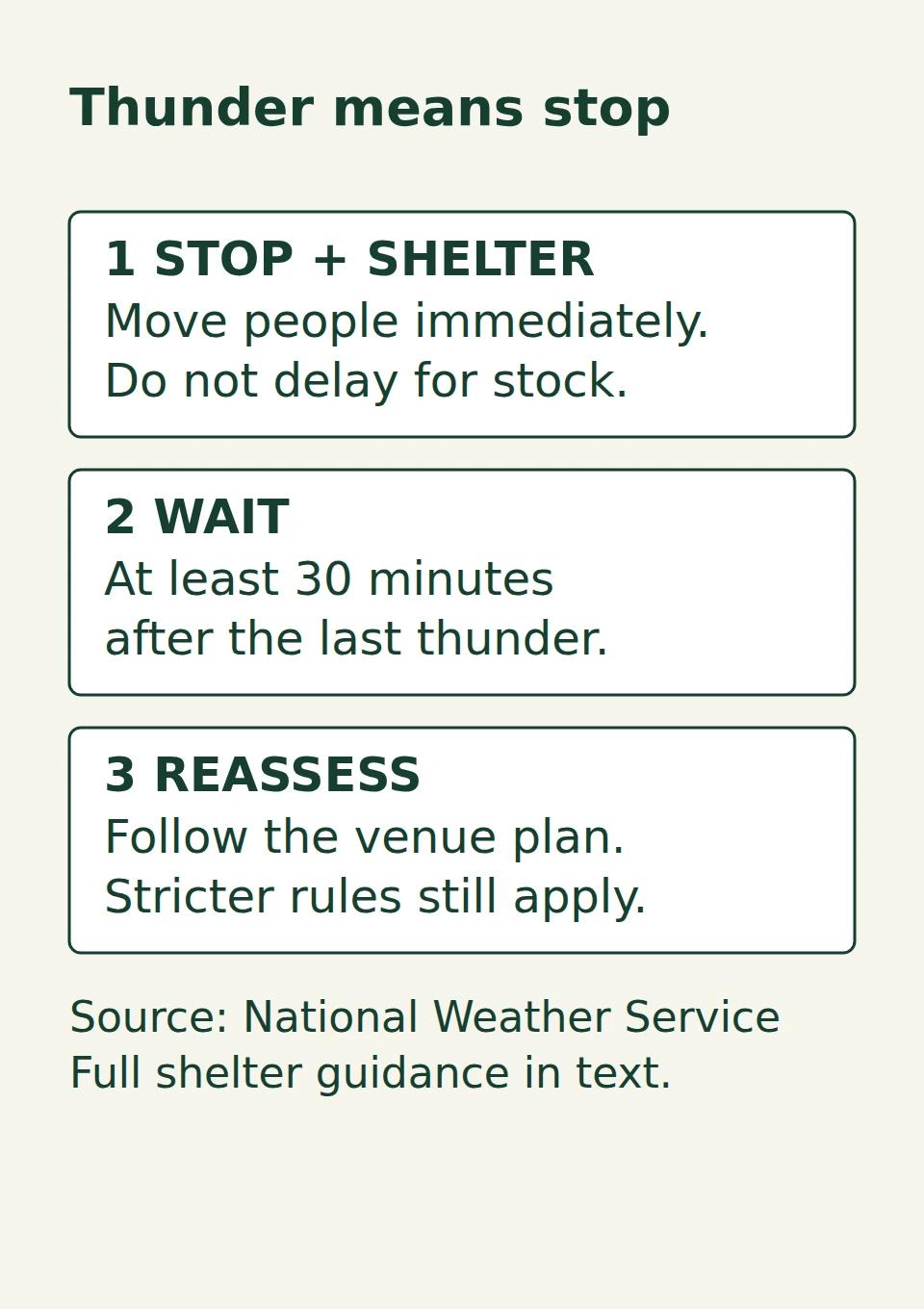
Weather decision aid based on NWS guidance. Follow stricter local procedures; move people to shelter before handling equipment.
Close with a count, not a disappearance claim
Use this example to distinguish stock accounting from environmental outcomes. The numbers below are invented for teaching and are not Play Greenly field-test results.
- Allocated — 52 — Starting station allocation
- Hit — 44 — Attempts recorded by the lead
- Unused, dry — 6 — Returned to inventory
- Damaged, unhit — 2 — Separated for handling guidance
- Recovered from hit balls — 8 — A subset of the 44 hit
The stock balance is 44 + 6 + 2 = 52. The 8 recovered balls are already part of the 44 hit, so do not add them again. The remaining 36 hit balls were not recovered in this illustrative log. That does not mean they dissolved, biodegraded, or caused no impact. Record a missing count as unknown rather than forcing the worksheet to balance.
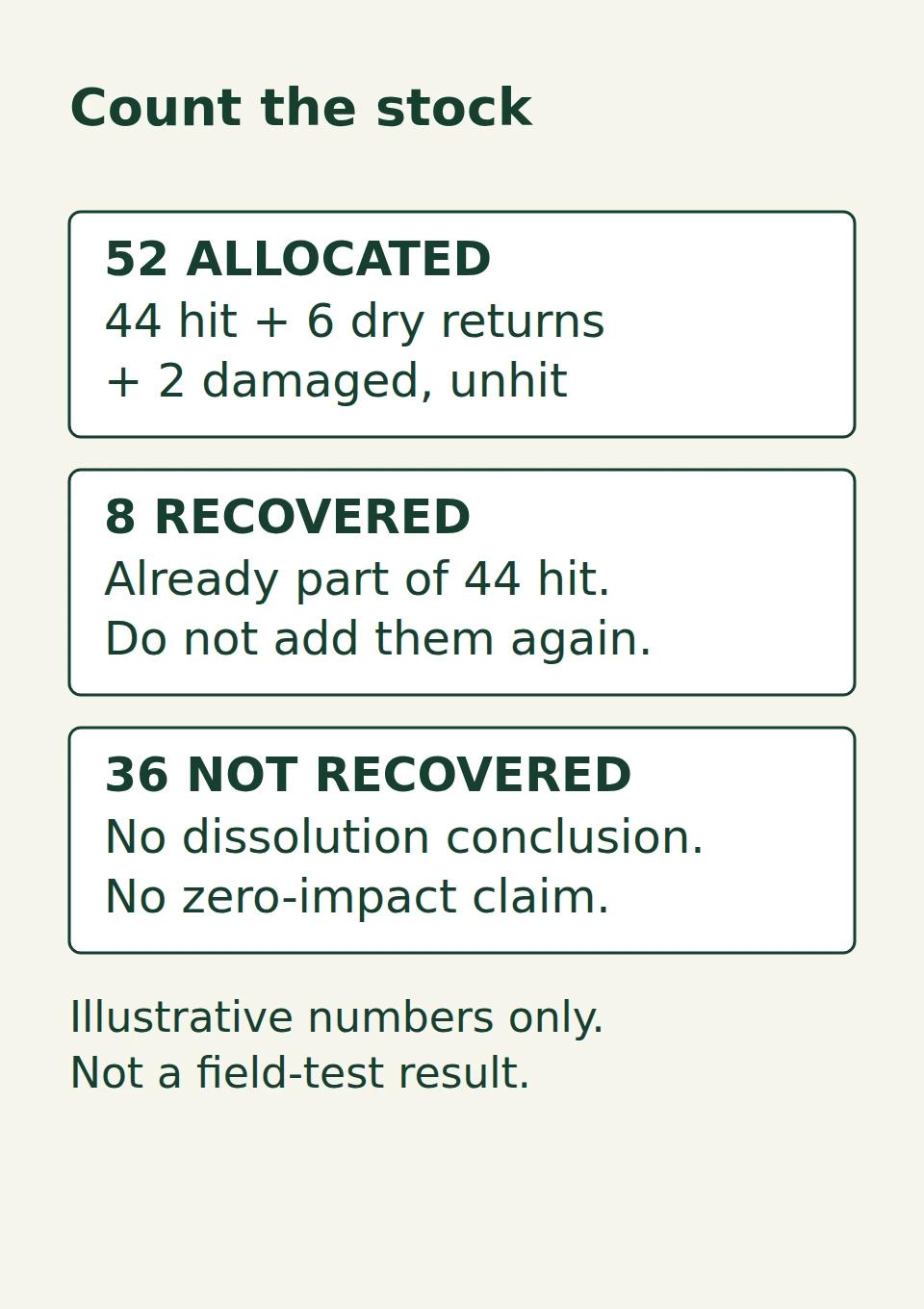
Illustrative stock reconciliation. Recovery is a subset of hit balls; a count cannot measure biodegradation.
NOAA’s marine-debris guidance recommends properly stowing and securing trash, and attempting recovery of small debris only carefully and safely. Apply that general principle to packaging and cleanup: keep materials controlled, follow the venue’s retrieval plan, and do not enter water or hazardous areas to improve the count. NOAA’s page is not a golf-ball approval or a determination of local legality.
Keep sponsor copy tied to observable actions
A sponsor can describe its support for the activity and the controls actually used. Suggested wording, only when true: “Supported a supervised team-building golf station with a defined shot allocation and an end-of-session inventory check.” A tally of shots alone cannot substantiate “zero waste,” “ocean-restoring,” or “leaves no trace.”
EPA’s Green Meetings resource lists reusable signage, minimized packing and shipping materials, and fewer prizes and giveaways among planning considerations. Use these as options to discuss with the event team, not as evidence that the station or event is EPA-certified.
Check the sponsor wording guide before printing signs. Confirm consent and usage rights before publishing recognizable guests or sponsor marks; this is a production check, not a universal legal opinion.
What this checklist does not establish
A completed checklist does not certify the venue, establish that a shot is legal, guarantee safety, or measure environmental outcomes. Product solubility does not establish wildlife suitability or a universal field timeline. Site assessment, weather decisions, product handling instructions, and applicable rules still control whether the activity proceeds.
Choose the next step for your event
If the venue cannot approve the area or provide a workable operating plan, choose another activity. If those checks pass, review Play Greenly’s water-soluble practice-ball information and rehearse the station before confirming the guest schedule.
Sources and method
Reviewed October 11, 2026: NWS Lightning Safety and Outdoor Sports Activities; NOAA Marine Debris Program, On the Water (page dated May 28, 2025); EPA Green Meetings (page dated October 5, 2026). Product wording was checked against Play Greenly’s controlled Claims Map. The checklist and numerical example are original editorial guidance, not an observed event, independent product test, or legal assessment.