Slug: biodegradable-golf-balls-with-seeds
Quick Answer
Biodegradable golf balls with seeds sound useful, but they are usually the wrong mental model for golf practice. A seed claim adds plant-choice, permission, and cleanup questions to a product that is already easy to overstate. For Play Greenly, the safer answer is simpler: use controlled water-soluble practice balls where the venue allows them, and do not treat seeds as proof of environmental benefit.
Why This Question Comes Up
Searchers are not only asking whether biodegradable golf balls exist. They are asking what happens after a ball is lost. Some product ideas answer that anxiety by adding seeds: the ball breaks apart, then flowers or grass grow.
That story has a nice shape. It also creates claims that are hard to prove in real use. A golf ball can land in water, compacted soil, turf, sand, gravel, a wetland edge, a drainage area, or a managed landscape. Those settings do not have the same moisture, sunlight, soil contact, mowing, herbicide, or permission rules.
The better question is not "does it have seeds?" It is "what use case is this ball designed for, and what evidence supports that use?"
The Seed Claim Has Three Separate Parts
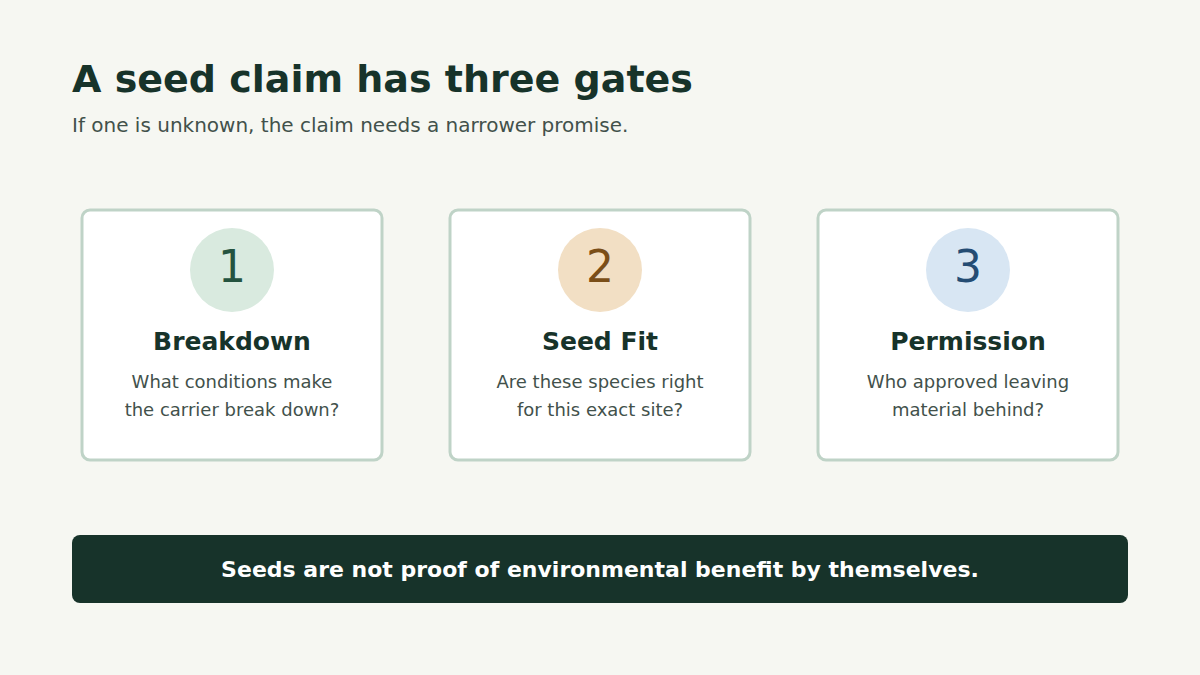
A seed-ball claim is really three claims at once:
- The carrier material breaks down under the conditions where the ball is used.
- The seed mix is appropriate for the place where it may land.
- The user is allowed to leave that material and those seeds there.
Each part needs its own evidence. If any part is unknown, the claim should be narrowed or removed.
For example, a product could contain seeds and still be a bad fit for a golf course, public beach, marina, or backyard water feature. The seeds might not germinate. They might be a species the property manager does not want. They might be legal in one region but undesirable in another. The ball might land somewhere plants cannot grow at all.
Seeds Do Not Solve The Permission Problem
A seed label is not permission to leave objects on land or in water. Golf courses, parks, beaches, resorts, HOAs, marinas, and private property owners set their own rules. Many managed landscapes are maintained for a specific turf, habitat, visual standard, or drainage function.
If a ball is designed to be left behind, the marketing has to answer a harder question: left behind where?
Play Greenly should not invite that uncertainty. The stronger position is controlled use: get permission, cap the session, mark the lane, and choose settings where a water-soluble practice product matches the plan.
Seeds Can Create Plant And Pest Risk
Seeds are living material. That means they are not just decoration. In the wrong place, a seed mix can conflict with native planting plans, introduce unwanted plants, or make cleanup harder. USDA Forest Service materials describe noxious weeds as non-native invasive plants, and seed movement can happen through human activity.
That does not mean every seed product is harmful. It means a general "plantable golf ball" claim needs location-specific support. A seed mix that makes sense for one garden does not automatically make sense for every fairway edge, lake bank, beach path, or resort lawn.
For a national ecommerce product, that is a serious claim-control problem.
Biodegradable, Compostable, And Plantable Are Not The Same Claim
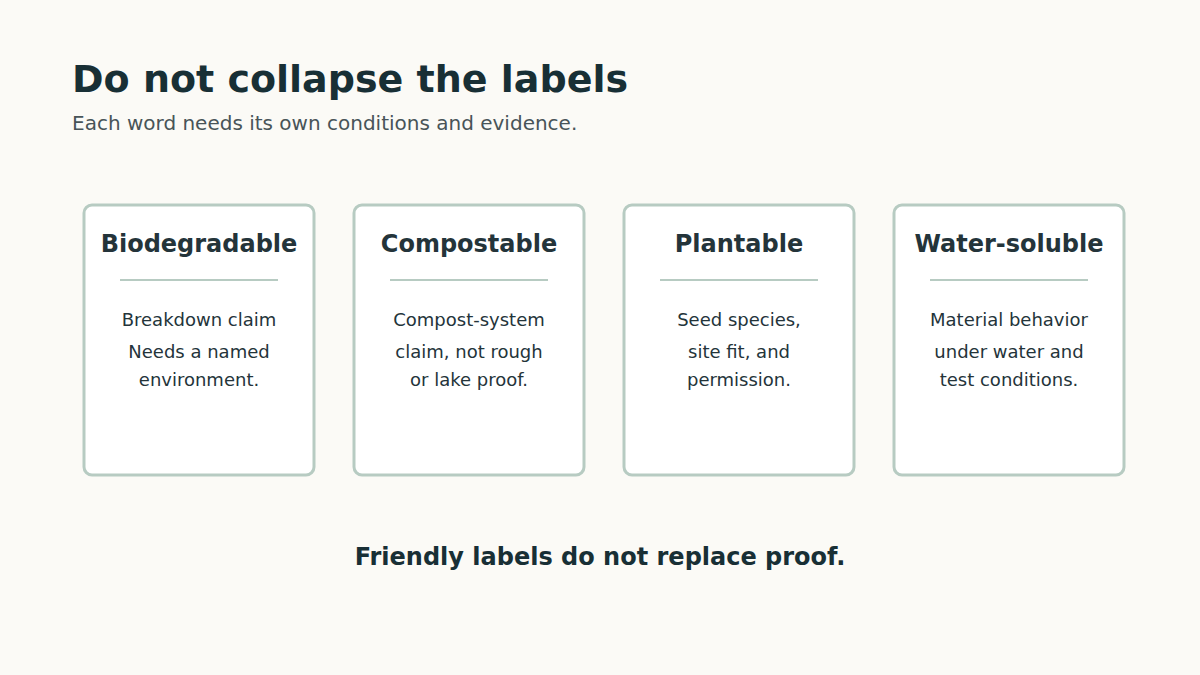
The FTC Green Guides separate general environmental claims from specific claims such as degradable, compostable, and non-toxic. A product cannot rely on a friendly word and skip evidence.
For golf balls, the distinction matters:
- Biodegradable or degradable is a breakdown claim tied to evidence and conditions.
- Compostable is a compost-system claim, not a lost-in-the-rough promise.
- Plantable or seeded is a planting claim that also needs species, region, and permission context.
- Water-soluble is a material-behavior claim, not a wildlife-feed, soil-improvement, or legal-access claim.
Those words can overlap in a product pitch, but they should not be treated as interchangeable.
Where Play Greenly Fits
Play Greenly does not need a seed story to explain the product clearly. The defensible position is:
Play Greenly offers water-soluble practice golf balls for controlled use near water when the venue allows it. They are for practice, demos, and event formats, not for posted tournament play, wildlife feeding, seed dispersal, or permission-free launching into public water.
That answer is less flashy than a seed-ball story. It is also easier to support.
What To Look For If A Product Says It Has Seeds
Before buying or recommending a seeded golf ball, ask five questions:
- What exact seed species are included?
- Where is that seed mix appropriate?
- What conditions are required for the carrier material to break down?
- Is the product intended for land only, water only, or both?
- Has the property owner or venue approved leaving seeded material behind?
If the listing does not answer those questions, treat the seed claim as marketing decoration, not proof of environmental performance.
A Better Use-Case Split
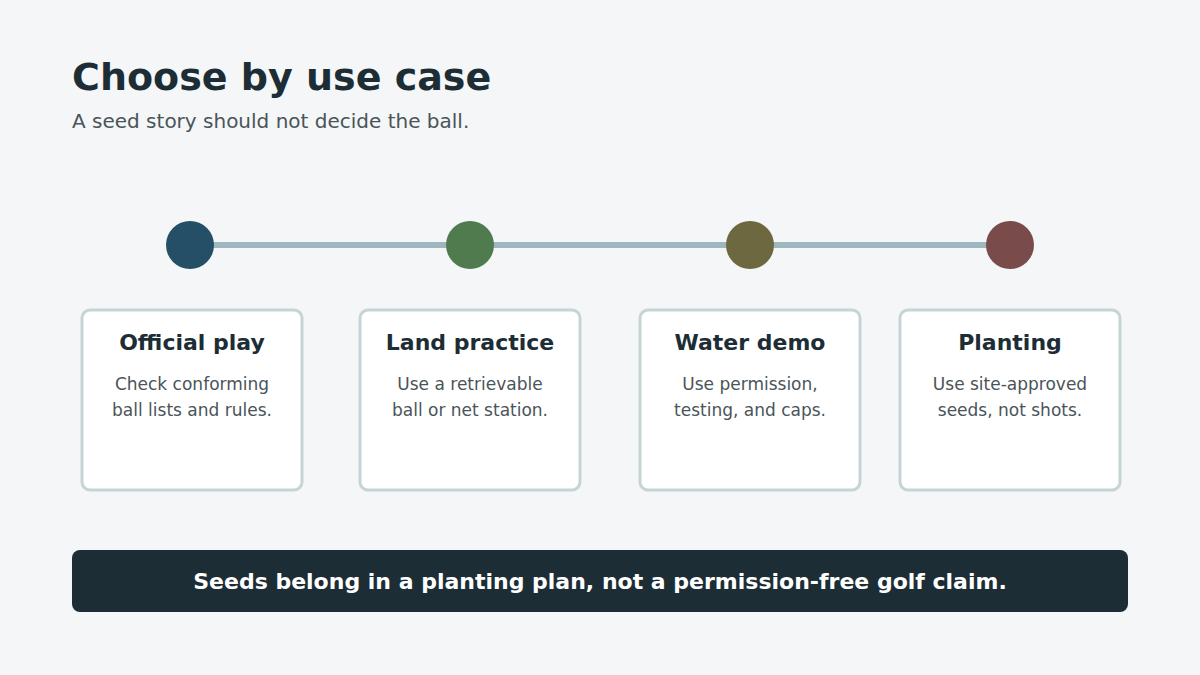
Use the setting to choose the ball:
- For posted rounds or formal competition, check the current USGA and R&A conforming-ball lists and event rules.
- For ordinary land practice, use a retrievable ball, net, mat, or controlled short-game station.
- For a permitted water-adjacent demo, use a water-soluble practice ball with a test, lane, cap, and cleanup plan.
- For planting, use seeds chosen for the site by the property owner or landscape professional, not a golf shot as a planting method.
That split keeps product claims from doing too much work.
Frequently asked questions
Are biodegradable golf balls with seeds real?
Some products and prototypes are marketed around seed or plantable concepts, but the important question is not whether seeds can be placed in a carrier. The important question is whether the seed species, breakdown conditions, and leave-behind permission fit the exact place where the ball will be used.
Are seed golf balls better for the environment?
Not automatically. A seed claim can add risk if the species is wrong for the site, the carrier does not break down as implied, or users leave material where they do not have permission. Environmental benefit should be tied to specific evidence, not assumed from the word "seed."
Can I hit seeded biodegradable golf balls into a lake or ocean?
No. A seed label is not a water permit, littering exemption, wildlife-feed claim, or proof that the product is harmless in water. For any water-adjacent use, get venue permission and use a product designed for controlled practice in that setting.
Is Play Greenly a seed golf ball?
No. Play Greenly should be described as a water-soluble practice golf ball for controlled, permitted settings. Do not position it as a seed ball, plantable product, compost-in-the-rough product, official scoring ball, or wildlife feed.
What is the safest wording for a seed-related comparison?
Use: "Seeds add a separate planting and permission question. For Play Greenly, the relevant product claim is controlled-use water solubility, not seed dispersal."
Source Notes
- FTC Green Guides, 16 CFR Part 260, especially general environmental-benefit, compostable, degradable, and non-toxic claims.
- USDA Forest Service invasive-plants guidance for the plant-risk boundary.
- USGA and R&A conforming-ball list resources for posted or tournament play boundaries.
- Play Greenly product page and existing claim-control tracker for product positioning.