Choose the job before the activity
A useful practice plan starts with a question you can actually answer during the visit. “Get better at golf” is too broad to guide the next few minutes. “Can I keep the same putting target for a short set and describe where the balls finish?” gives you something specific to do.
The planner below is an organizational suggestion. It does not prescribe a swing change or guarantee a lower score. Adapt it to your available space, equipment, and any guidance from your instructor.
Write a one-sentence brief
Finish this sentence: “Today I want to observe ___ while doing ___.” Keep both blanks narrow. For example: “Today I want to observe where my putts finish while playing toward one target from the same starting point.”
Choose something you can see without guessing. You might record finishes short or long of a target, whether you completed your chosen routine, or which question you need an instructor to answer. Avoid making the session depend on a result you cannot measure at the venue.
Pick one activity that fits the space
Check the venue’s rules before deciding on a drill. On a practice green, use only a setup that is permitted and leaves other players room. At a driving range, stay within the designated hitting area and follow staff instructions. At home, choose an appropriate putting space and keep people, pets, and fragile objects clear.
If the space does not support the plan, change the activity. Do not force a full-swing exercise into an area intended only for putting or use equipment the facility has not approved.
Set a small observation window
Decide in advance when you will pause. That could be after a short set of putts or after a few minutes of an instructor-approved activity. The exact quantity is your choice; this template does not establish a proven training dose.
Keep the starting condition consistent within that window when practical. If you move the target, change the club, and change the goal together, you may struggle to explain what you observed. Make a deliberate change, then label it as a new set.
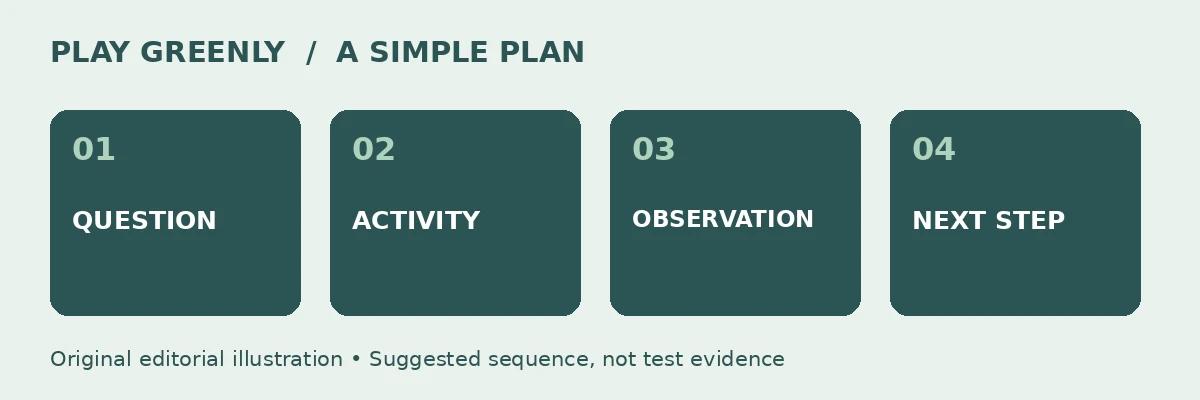
Use a four-line planning card
Question: What do I want to notice?
Activity: What will I do, and where is it permitted?
Observation: What will I record at the pause?
Next step: What would make me repeat, adjust, or ask for help?
Here is an example: “Notice short versus long finishes. Putt from one marked starting point toward a flat target on an approved practice surface. Record each finish for one short set. Repeat if the setup felt usable; ask for advice if I cannot understand what happened.” This is an example plan, not a reported test.
Finish with a decision you can use
At the pause, choose whether to repeat the activity, simplify it, or stop. You do not have to invent a technical explanation for every result. “I need help choosing a suitable target” is more useful than a confident guess about your swing.
Use Play Greenly’s practice-journal guide after the session to save what you observed. The planner chooses the work before you begin; the journal records what actually happened afterward.